

Carrots, canned, reduced sodium, cooked, fat added, NS as to fat type
Common food

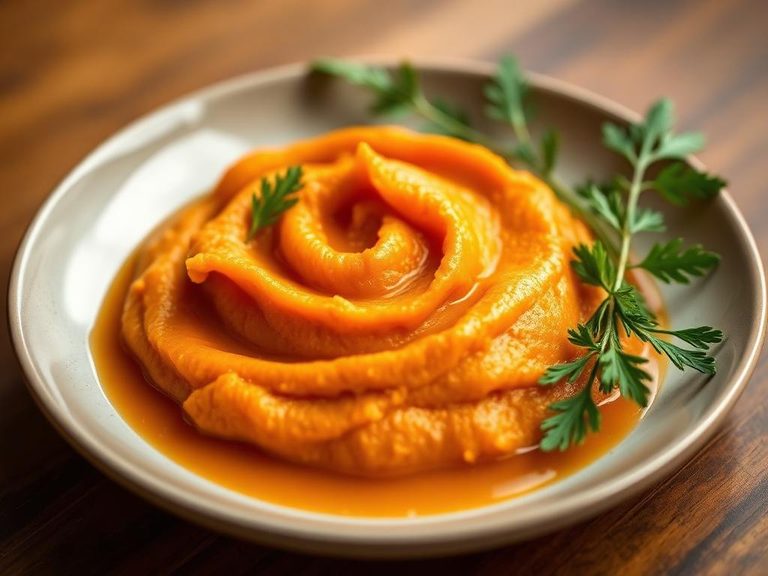
Photo: Wikipedia
These are tender, sliced carrots preserved in a light brine, then gently cooked with a touch of added fat for a richer mouthfeel. They offer a familiar, sweet-tender bite with a subtle savory note from the reduced sodium. Nutritionally, they are a low-calorie source of fiber and beta-carotene.
Calorie split: 5% protein · 44% carbs · 51% fat
↓ Full nutrition💚 Why it's loved
People love their consistent, soft-yet-firm texture and the subtle sweetness that develops during cooking. Their convenience makes them a reliable staple for quick soups, stews, and side dishes.
⚠️ Watch-outs & how to enjoy it better
The added fat, while improving texture, increases the calorie content compared to plain canned carrots. Those monitoring blood sugar should be aware that the canning process can make the natural sugars more readily available. Tip: Pair with a protein like lentils or chicken to slow glucose absorption.
Key benefits
- Excellent source of vitamin A (as beta-carotene)
- Good source of dietary fiber
- Low calorie density
- Reduced sodium content compared to standard canned versions
- Convenient and ready to eat
🍽️ Popular dishes
🌍 Where it's eaten
💡 Did you know?
The beta-carotene in carrots is more bioavailable to your body when they are cooked, especially with a small amount of fat, as in this product.
Full nutrition (USDA data · scales with serving)
| Water | 90.6 g |
| Energy | 45.0 kcal |
| Protein | 0.58 g |
| Total lipid (fat) | 2.7 g |
| Carbohydrate, by difference | 5.2 g |
| Fiber, total dietary | 1.7 g |
| Total Sugars | 2.4 g |
| Calcium, Ca | 30.0 mg |
| Iron, Fe | 0.51 mg |
| Magnesium, Mg | 9.0 mg |
| Phosphorus, P | 20.0 mg |
| Potassium, K | 154 mg |
| Sodium, Na | 42.0 mg |
| Zinc, Zn | 0.28 mg |
| Copper, Cu | 0.10 mg |
| Selenium, Se | 0.40 ug |
| Vitamin C, total ascorbic acid | 1.7 mg |
| Thiamin | 0.02 mg |
| Riboflavin | 0.03 mg |
| Niacin | 0.41 mg |
| Vitamin B-6 | 0.13 mg |
| Folate, total | 7.0 ug |
| Folic acid | 0.00 ug |
| Folate, food | 7.0 ug |
| Folate, DFE | 7.0 ug |
| Choline, total | 6.3 mg |
| Vitamin B-12 | 0.00 ug |
| Vitamin B-12, added | 0.00 ug |
| Vitamin A, RAE | 553 ug |
| Retinol | 11.0 ug |
| Carotene, beta | 5181 ug |
| Carotene, alpha | 2663 ug |
| Cryptoxanthin, beta | 0.00 ug |
| Lycopene | 0.00 ug |
| Lutein + zeaxanthin | 0.00 ug |
| Vitamin E (alpha-tocopherol) | 1.1 mg |
| Vitamin E, added | 0.00 mg |
| Vitamin D (D2 + D3) | 0.00 ug |
| Vitamin K (phylloquinone) | 11.6 ug |
| Alcohol, ethyl | 0.00 g |
| Caffeine | 0.00 mg |
| Theobromine | 0.00 mg |
Fat & fatty acid profile (per 100g)
| Fatty acids, total saturated | 0.69 g |
| SFA 4:0 | 0.02 g |
| SFA 6:0 | 0.01 g |
| SFA 8:0 | 0.01 g |
| SFA 10:0 | 0.02 g |
| SFA 12:0 | 0.02 g |
| SFA 14:0 | 0.07 g |
| SFA 16:0 | 0.38 g |
| SFA 18:0 | 0.14 g |
| Fatty acids, total monounsaturated | 0.91 g |
| MUFA 16:1 | 0.02 g |
| MUFA 18:1 | 0.88 g |
| MUFA 20:1 | 0.01 g |
| MUFA 22:1 | 0.00 g |
| Fatty acids, total polyunsaturated | 0.80 g |
| PUFA 18:2 | 0.71 g |
| PUFA 18:3 | 0.09 g |
| PUFA 18:4 | 0.00 g |
| PUFA 20:4 | 0.00 g |
| PUFA 20:5 n-3 (EPA) | 0.00 g |
| PUFA 22:5 n-3 (DPA) | 0.00 g |
| PUFA 22:6 n-3 (DHA) | 0.00 g |
| Cholesterol | 2.0 mg |
Amino acid profile (per 100g)
Estimated from Carrots, canned, no salt added, drained solids — USDA does not publish this profile for Carrots.
| Tryptophan | 0.01 g |
| Threonine | 0.02 g |
| Isoleucine | 0.03 g |
| Leucine | 0.03 g |
| Lysine | 0.03 g |
| Methionine | 0.00 g |
| Cystine | 0.01 g |
| Phenylalanine | 0.02 g |
| Tyrosine | 0.01 g |
| Valine | 0.03 g |
| Arginine | 0.03 g |
| Histidine | 0.01 g |
| Alanine | 0.04 g |
| Aspartic acid | 0.08 g |
| Glutamic acid | 0.12 g |
| Glycine | 0.02 g |
| Proline | 0.02 g |
| Serine | 0.02 g |
FAQ
How does the nutrition differ from fresh cooked carrots?
Canning can slightly reduce heat-sensitive vitamins like vitamin C, but the beta-carotene remains stable. The main differences are the added sodium (even in 'reduced sodium' versions) and the added fat in this specific product.
Is the 'fat added' typically oil or butter?
The specific fat type is not specified ('NS as to fat type'), so it could be a neutral vegetable oil, palm oil, or butter. This adds calories and can affect the flavor profile.
Can I use the liquid from the can?
Yes, the canning liquid contains some nutrients and flavor. It can be used in soups, stews, or sauces, but be mindful it contains the added sodium and fat from the product.
Nutrient density (calculated · NRF9.3)
Nutrient Rich Foods index: beneficial nutrients (protein, fiber, vitamins, minerals) minus saturated fat, added sugar & sodium, per 100 kcal.
NRF9.3 index — Fulgoni, Keast & Drewnowski, 2009. Computed from USDA nutrients.
Weight-loss friendliness (composite index)
Energy density 0.45 kcal/g · 5% calories from protein · 1.7 g fiber · 2.4 g sugar per 100 g.
Composite of energy density (Rolls et al., 1999), protein & fiber satiety, minus sugar. A calculated heuristic — ranks satiety-per-calorie, not a clinical measure.
Dietary load (calculated from USDA values)
Potential renal acid load. Positive = acid-forming, negative = alkaline-forming.
Sodium-to-potassium ratio: 0.27 (lower is better — aim for ≤ 1)
Sodium:potassium per WHO potassium guidance. Computed from USDA nutrients.