

Candy, gummy
Common food
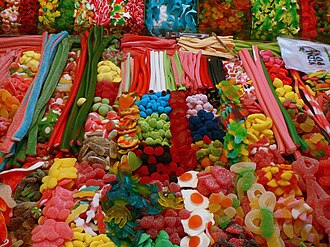
Photo: Wikipedia
Gummy candy is a chewy, gelatin-based confection known for its vibrant colors, fruit-inspired flavors, and satisfying, springy texture. Nutritionally, it is a near-pure carbohydrate source, delivering a quick energy boost from its high sugar content, with virtually no protein, fat, or fiber.
Calorie split: 0% protein · 100% carbs · 0% fat
↓ Full nutrition💚 Why it's loved
People love gummy candy for its playful, chewy texture and the burst of sweet, often tangy, fruit flavor that makes it a nostalgic and versatile treat. Its fun shapes and bright colors also make it a popular choice for parties, movie snacks, and creative dessert toppings.
⚠️ Watch-outs & how to enjoy it better
The primary downside is the very high sugar content (nearly 59g per 100g), which can contribute to blood sugar spikes and offers little nutritional value. For those monitoring sugar intake, it's best enjoyed in small portions and ideally paired with a source of protein or fat (like a handful of nuts) to help slow sugar absorption.
Key benefits
- Provides a rapid source of quick energy from simple carbohydrates.
- Offers a wide variety of fun, fruit-inspired flavors and shapes.
- Serves as a popular, portable treat for a quick mood lift or sweet craving.
- Often used as a decorative element in baking and dessert presentation.
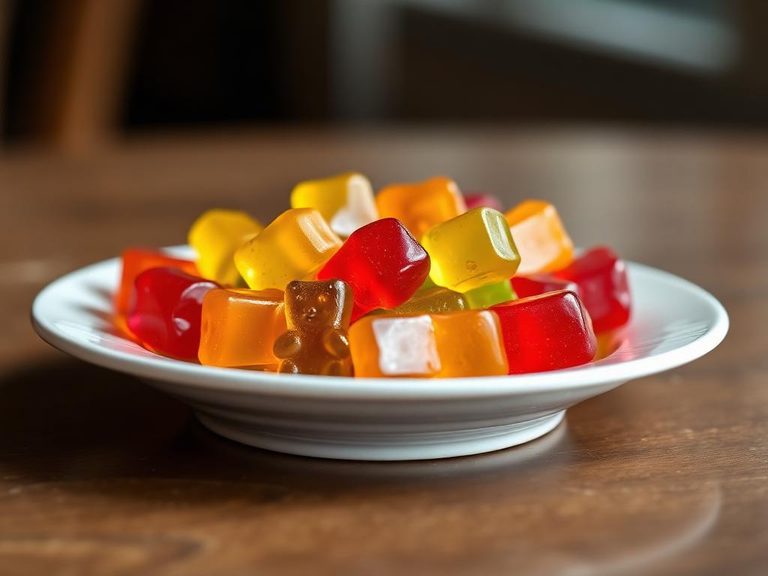
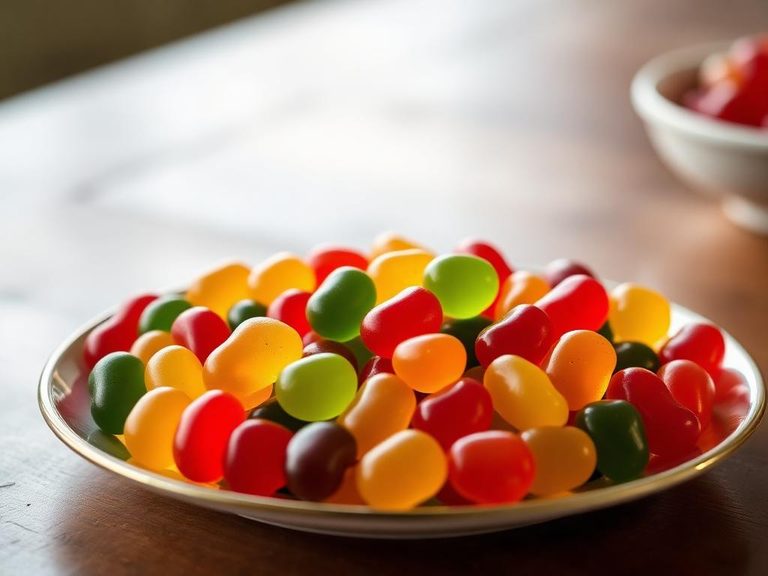
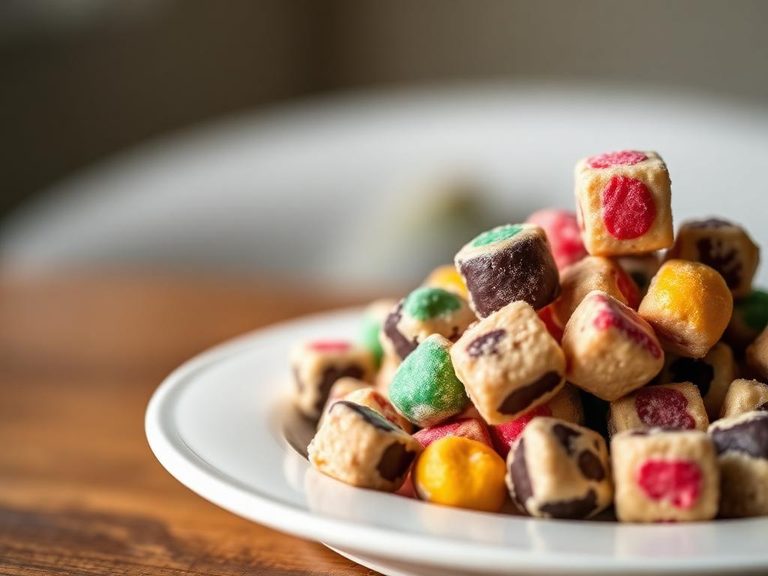
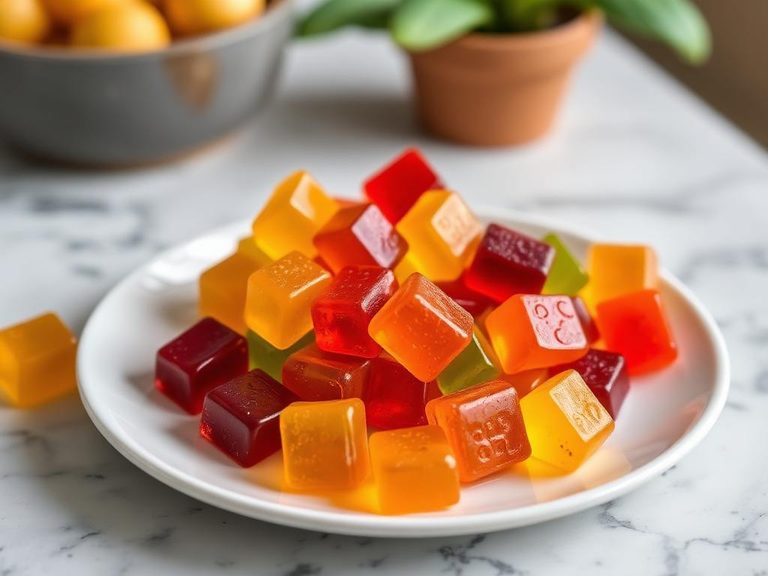
🍽️ Popular dishes
🌍 Where it's eaten
💡 Did you know?
The original gummy bear was inspired by a dancing bear tradition at German festivals and was created by Hans Riegel in Bonn in 1922, founding the Haribo company.
Full nutrition (USDA data · scales with serving)
| Water | 1.0 g |
| Energy | 396 kcal |
| Protein | 0.00 g |
| Total lipid (fat) | 0.00 g |
| Carbohydrate, by difference | 98.9 g |
| Fiber, total dietary | 0.10 g |
| Total Sugars | 59.0 g |
| Calcium, Ca | 3.0 mg |
| Iron, Fe | 0.40 mg |
| Magnesium, Mg | 1.0 mg |
| Phosphorus, P | 1.0 mg |
| Potassium, K | 5.0 mg |
| Sodium, Na | 44.0 mg |
| Zinc, Zn | 0.00 mg |
| Copper, Cu | 0.01 mg |
| Selenium, Se | 0.80 ug |
| Vitamin C, total ascorbic acid | 0.00 mg |
| Thiamin | 0.01 mg |
| Riboflavin | 0.01 mg |
| Niacin | 0.01 mg |
| Vitamin B-6 | 0.01 mg |
| Folate, total | 0.00 ug |
| Folic acid | 0.00 ug |
| Folate, food | 0.00 ug |
| Folate, DFE | 0.00 ug |
| Choline, total | 0.00 mg |
| Vitamin B-12 | 0.00 ug |
| Vitamin B-12, added | 0.00 ug |
| Vitamin A, RAE | 0.00 ug |
| Retinol | 0.00 ug |
| Carotene, beta | 0.00 ug |
| Carotene, alpha | 0.00 ug |
| Cryptoxanthin, beta | 0.00 ug |
| Lycopene | 0.00 ug |
| Lutein + zeaxanthin | 0.00 ug |
| Vitamin E (alpha-tocopherol) | 0.00 mg |
| Vitamin E, added | 0.00 mg |
| Vitamin D (D2 + D3) | 0.00 ug |
| Vitamin K (phylloquinone) | 0.00 ug |
| Alcohol, ethyl | 0.00 g |
| Caffeine | 0.00 mg |
| Theobromine | 0.00 mg |
Fat & fatty acid profile (per 100g)
| Fatty acids, total saturated | 0.00 g |
| SFA 4:0 | 0.00 g |
| SFA 6:0 | 0.00 g |
| SFA 8:0 | 0.00 g |
| SFA 10:0 | 0.00 g |
| SFA 12:0 | 0.00 g |
| SFA 14:0 | 0.00 g |
| SFA 16:0 | 0.00 g |
| SFA 18:0 | 0.00 g |
| Fatty acids, total monounsaturated | 0.00 g |
| MUFA 16:1 | 0.00 g |
| MUFA 18:1 | 0.00 g |
| MUFA 20:1 | 0.00 g |
| MUFA 22:1 | 0.00 g |
| Fatty acids, total polyunsaturated | 0.00 g |
| PUFA 18:2 | 0.00 g |
| PUFA 18:3 | 0.00 g |
| PUFA 18:4 | 0.00 g |
| PUFA 20:4 | 0.00 g |
| PUFA 20:5 n-3 (EPA) | 0.00 g |
| PUFA 22:5 n-3 (DPA) | 0.00 g |
| PUFA 22:6 n-3 (DHA) | 0.00 g |
| Cholesterol | 0.00 mg |
Amino acid profile (per 100g)
Estimated from Oil, industrial, coconut, principal uses candy coatings, oil sprays, roasting nuts — USDA does not publish this profile for Candy.
| Tryptophan | 0.00 g |
| Threonine | 0.00 g |
| Isoleucine | 0.00 g |
| Leucine | 0.00 g |
| Lysine | 0.00 g |
| Methionine | 0.00 g |
| Cystine | 0.00 g |
| Phenylalanine | 0.00 g |
| Tyrosine | 0.00 g |
| Valine | 0.00 g |
| Arginine | 0.00 g |
| Histidine | 0.00 g |
| Alanine | 0.00 g |
| Aspartic acid | 0.00 g |
| Glutamic acid | 0.00 g |
| Glycine | 0.00 g |
| Proline | 0.00 g |
| Serine | 0.00 g |
FAQ
What makes gummy candy chewy?
The chewy texture comes primarily from gelatin, a protein derived from animal collagen, which forms a flexible gel when mixed with sugar and water.
Are all gummy candies made with gelatin?
No. While traditional gummy candies use gelatin, many vegan or vegetarian versions use plant-based gelling agents like pectin, agar-agar, or starch.
Why do some gummy candies have a sour coating?
The sour coating is typically a mixture of sugar and food-grade acids, such as citric acid or malic acid, which provides a tart contrast to the sweet interior.
Nutrient density (calculated · NRF9.3)
Nutrient Rich Foods index: beneficial nutrients (protein, fiber, vitamins, minerals) minus saturated fat, added sugar & sodium, per 100 kcal.
NRF9.3 index — Fulgoni, Keast & Drewnowski, 2009. Computed from USDA nutrients.
Weight-loss friendliness (composite index)
Energy density 3.96 kcal/g · 0% calories from protein · 0.1 g fiber · 59.0 g sugar per 100 g.
Composite of energy density (Rolls et al., 1999), protein & fiber satiety, minus sugar. A calculated heuristic — ranks satiety-per-calorie, not a clinical measure.
Dietary load (calculated from USDA values)
Potential renal acid load. Positive = acid-forming, negative = alkaline-forming.
Sodium-to-potassium ratio: 8.80 (lower is better — aim for ≤ 1)
Sodium:potassium per WHO potassium guidance. Computed from USDA nutrients.