

Jelly Beans
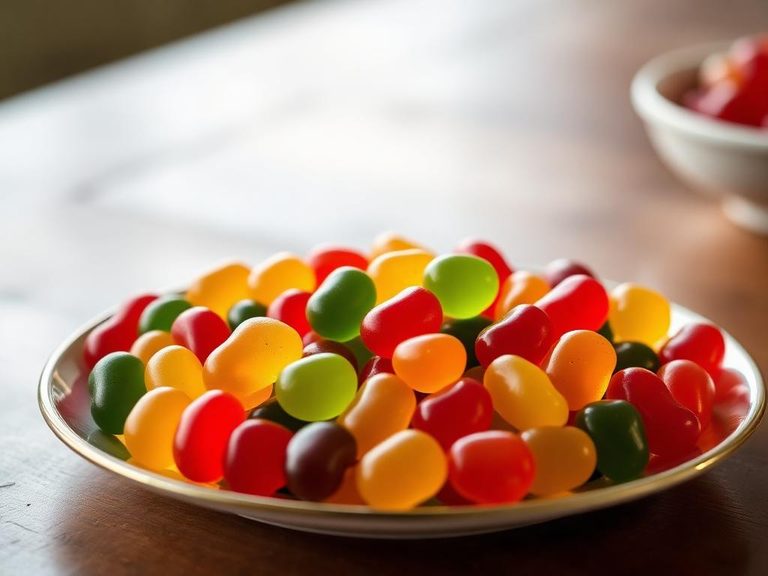
Jelly beans are small, bean-shaped candies with a soft, chewy interior and a hard, sugar-coated shell. They are primarily made from sugar, corn syrup, and starch, with a wide variety of fruit and artificial flavorings. While their exact origin is debated, they became a popular American confection in the 19th century.
🍳 View the full Jelly Beans recipe →
🍽️ Nutrition at a glance
Jelly beans are a high-carbohydrate food, almost entirely from sugar, with negligible fat and protein. A typical serving of about 25 beans (35 grams) provides roughly 130 calories and offers little nutritional value beyond quick energy.
Nutrition breakdown
| Calories | 680 kcal |
| Protein | 0 g |
| Carbs | 172 g |
| Fat | 0 g |
| Fiber | 0 g |
| Sugar | 126 g |
| Sodium | 15 mg |
| Potassium | 20 mg |
| Sodium | 15 mg |
| Calcium | 2 mg |
| Iron | 0.2 mg |
| Vitamin C | 0 mg |
| Thiamin (B1) | 0 mg |
| Riboflavin (B2) | 0 mg |
| Niacin (B3) | 0 mg |
Per 1 cup (174 g) · estimated, varies by recipe
💡 What's interesting
Culturally, jelly beans are iconic in the United States, famously associated with President Ronald Reagan, who kept a jar in the Oval Office. Their unique manufacturing process, involving a 'panning' technique to build the hard shell layer by layer, gives them their distinctive texture.
🍽️ Related dishes




AI estimate may be inaccurate · Terms