

Beef, short loin, top loin, separable lean and fat, trimmed to 1/8" fat, prime, cooked, broiled
Whole food · Beef Products
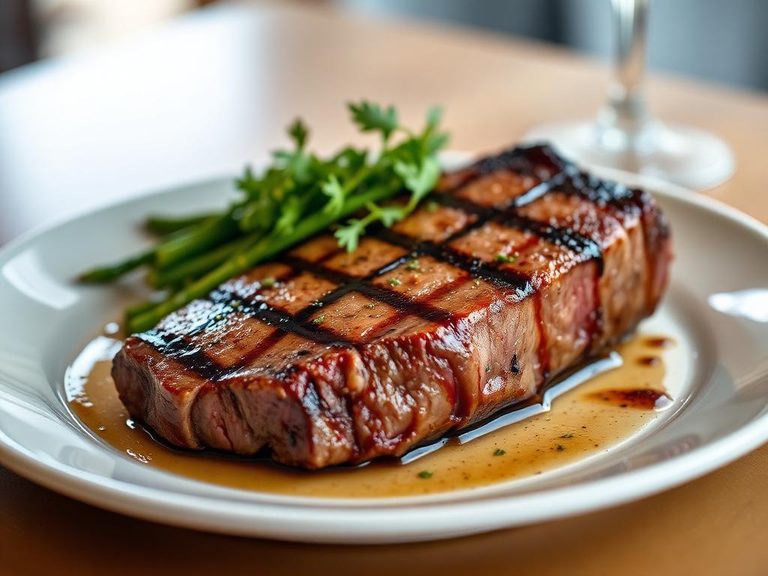
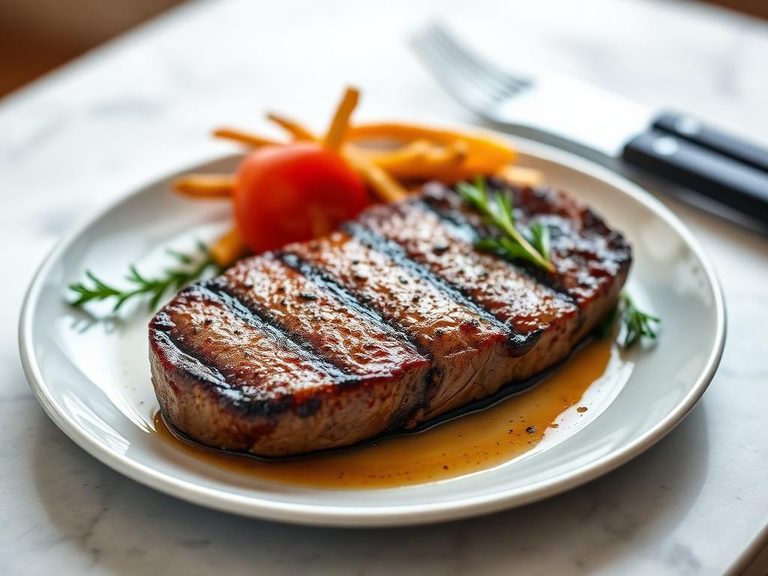
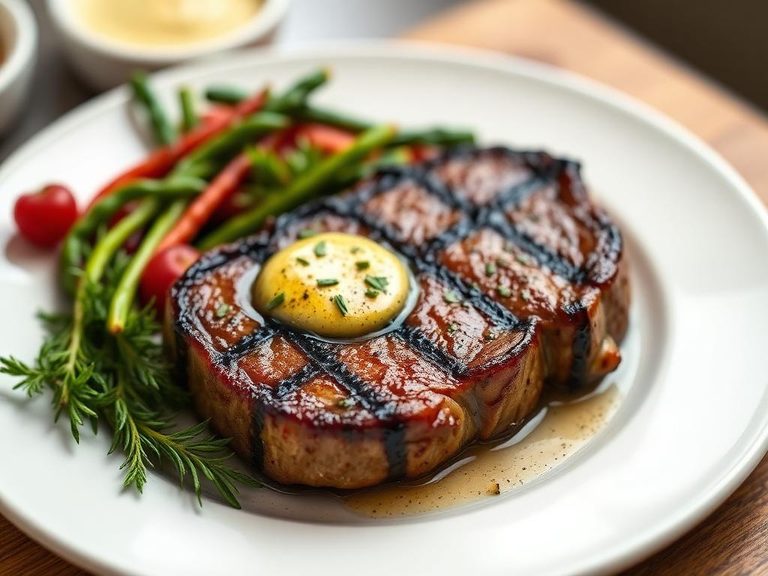
This is a premium cut of beef from the short loin, specifically the top loin, trimmed to a thin 1/8-inch fat cap and broiled to a juicy, caramelized finish. It delivers a rich, buttery beef flavor with a tender, slightly firm texture that is characteristic of prime-grade steak. Nutritionally, it is a dense source of high-quality protein and provides substantial energy from its fat content, with zero carbohydrates.
Calorie split: 34% protein · 0% carbs · 66% fat
↓ Full nutrition💚 Why it's loved
People love it for its exceptional marbling and tenderness, which result in a deeply savory, melt-in-your-mouth experience when broiled. It is the quintessential steakhouse cut, prized for its versatility in simple preparations that let the prime-grade beef flavor shine.
⚠️ Watch-outs & how to enjoy it better
The high saturated fat content means it should be consumed in moderation, especially by those managing cholesterol or heart health. To counteract this, pair it with fiber-rich vegetables like roasted broccoli or a large salad, and practice portion control by sticking to a 3-4 ounce serving.
Key benefits
- Excellent source of complete, high-quality protein for muscle maintenance.
- Provides essential nutrients like iron, zinc, and B vitamins (especially B12).
- Contains conjugated linoleic acid (CLA), a fatty acid studied for potential health benefits.
- Zero carbohydrates, making it suitable for ketogenic and low-carb diets.
🍽️ Popular dishes
🌍 Where it's eaten
💡 Did you know?
The 'top loin' is the same muscle that, when bone-in, is known as the New York strip steak; the 'short loin' is the primal cut from which it comes, located just behind the ribs.
Full nutrition (USDA data · scales with serving)
| Water | 51.3 g |
| Energy | 310 kcal |
| Energy | 1297 kj |
| Protein | 25.9 g |
| Total lipid (fat) | 22.1 g |
| Ash | 1.1 g |
| Carbohydrate, by difference | 0.00 g |
| Fiber, total dietary | 0.00 g |
| Total Sugars | 0.00 g |
| Calcium, Ca | 9.0 mg |
| Iron, Fe | 2.3 mg |
| Magnesium, Mg | 24.0 mg |
| Phosphorus, P | 197 mg |
| Potassium, K | 354 mg |
| Sodium, Na | 64.0 mg |
| Zinc, Zn | 4.7 mg |
| Copper, Cu | 0.10 mg |
| Manganese, Mn | 0.01 mg |
| Selenium, Se | 23.7 ug |
| Vitamin C, total ascorbic acid | 0.00 mg |
| Thiamin | 0.08 mg |
| Riboflavin | 0.18 mg |
| Niacin | 4.8 mg |
| Pantothenic acid | 0.33 mg |
| Vitamin B-6 | 0.38 mg |
| Folate, total | 7.0 ug |
| Folic acid | 0.00 ug |
| Folate, food | 7.0 ug |
| Folate, DFE | 7.0 ug |
| Choline, total | 98.7 mg |
| Betaine | 13.0 mg |
| Vitamin B-12 | 1.9 ug |
| Vitamin B-12, added | 0.00 ug |
| Vitamin A, RAE | 0.00 ug |
| Carotene, beta | 0.00 ug |
| Carotene, alpha | 0.00 ug |
| Cryptoxanthin, beta | 0.00 ug |
| Vitamin A, IU | 0.00 iu |
| Lycopene | 0.00 ug |
| Lutein + zeaxanthin | 0.00 ug |
| Alcohol, ethyl | 0.00 g |
| Caffeine | 0.00 mg |
| Theobromine | 0.00 mg |
Fat & fatty acid profile (per 100g)
| Fatty acids, total saturated | 8.9 g |
| SFA 4:0 | 0.00 g |
| SFA 6:0 | 0.00 g |
| SFA 8:0 | 0.00 g |
| SFA 10:0 | 0.05 g |
| SFA 12:0 | 0.05 g |
| SFA 14:0 | 0.69 g |
| SFA 16:0 | 5.3 g |
| SFA 18:0 | 2.6 g |
| Fatty acids, total monounsaturated | 9.4 g |
| MUFA 16:1 | 0.84 g |
| MUFA 18:1 | 8.3 g |
| MUFA 20:1 | 0.03 g |
| Fatty acids, total polyunsaturated | 0.80 g |
| PUFA 18:2 | 0.54 g |
| PUFA 18:3 | 0.18 g |
| PUFA 18:4 | 0.00 g |
| PUFA 20:4 | 0.05 g |
| Cholesterol | 79.0 mg |
Amino acid profile (per 100g)
| Tryptophan | 0.29 g |
| Threonine | 1.1 g |
| Isoleucine | 1.2 g |
| Leucine | 2.0 g |
| Lysine | 2.2 g |
| Methionine | 0.66 g |
| Cystine | 0.29 g |
| Phenylalanine | 1.0 g |
| Tyrosine | 0.87 g |
| Valine | 1.3 g |
| Arginine | 1.6 g |
| Histidine | 0.89 g |
| Alanine | 1.6 g |
| Aspartic acid | 2.4 g |
| Glutamic acid | 3.9 g |
| Glycine | 1.4 g |
| Proline | 1.1 g |
| Serine | 0.99 g |
FAQ
What is the difference between 'top loin' and 'New York strip'?
They are the same muscle (the longissimus dorsi). 'Top loin' refers to the boneless cut, while 'New York strip' is typically the bone-in version from the short loin.
Why is 'prime' grade important for this cut?
Prime is the highest USDA grade, indicating superior marbling (intramuscular fat), which ensures exceptional tenderness, juiciness, and flavor when broiled.
Is it healthy to eat this regularly?
While it provides valuable protein and nutrients, its high fat and calorie content means it's best enjoyed as part of a balanced diet, not as a daily staple. Pairing it with vegetables helps balance the meal.
How should I cook it to preserve its quality?
Broiling or high-heat pan-searing is ideal to create a flavorful crust while keeping the interior juicy. Avoid overcooking; aim for medium-rare to medium for the best texture.
Nutrient density (calculated · NRF9.3)
Nutrient Rich Foods index: beneficial nutrients (protein, fiber, vitamins, minerals) minus saturated fat, added sugar & sodium, per 100 kcal.
NRF9.3 index — Fulgoni, Keast & Drewnowski, 2009. Computed from USDA nutrients.
Weight-loss friendliness (composite index)
Energy density 3.10 kcal/g · 33% calories from protein · 0.0 g fiber · 0.0 g sugar per 100 g.
Composite of energy density (Rolls et al., 1999), protein & fiber satiety, minus sugar. A calculated heuristic — ranks satiety-per-calorie, not a clinical measure.
Dietary load (calculated from USDA values)
Potential renal acid load. Positive = acid-forming, negative = alkaline-forming.
Sodium-to-potassium ratio: 0.18 (lower is better — aim for ≤ 1)
Sodium:potassium per WHO potassium guidance. Computed from USDA nutrients.