

Bagel
Common food
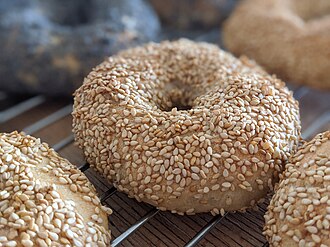
Photo: Wikipedia
A bagel is a dense, ring-shaped bread product with a distinctive chewy texture and a glossy, boiled-then-baked crust. Its flavor is subtly malty and slightly sweet, often with a hint of yeast. Nutritionally, it is a concentrated source of carbohydrates, providing quick energy with minimal fat.
Calorie split: 16% protein · 79% carbs · 5% fat
↓ Full nutrition💚 Why it's loved
People love the bagel for its uniquely satisfying chew and its incredible versatility—it serves as a perfect vehicle for both sweet spreads and savory sandwiches. It's deeply embedded in breakfast culture, especially in North American delis and bakeries.
⚠️ Watch-outs & how to enjoy it better
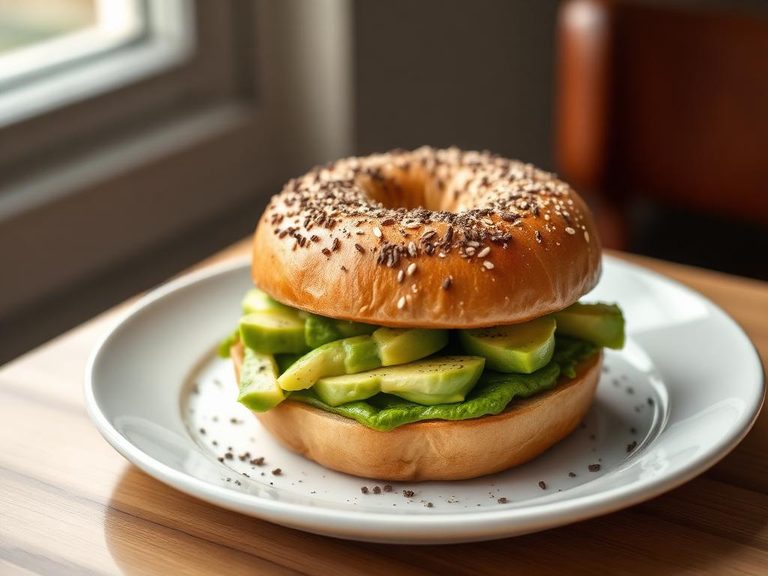
Its high glycemic load can cause rapid blood-sugar spikes, and commercial versions are often high in sodium. To counteract this, pair it with protein and healthy fats (like cream cheese, smoked salmon, or avocado) to slow digestion, choose whole-grain varieties for more fiber, and practice portion control by enjoying half a bagel with your meal.
Key benefits
- Excellent source of quick-release energy for active mornings
- Provides a solid base for protein-rich toppings
- Low in fat, making it a lean carbohydrate option
- The dense texture promotes prolonged chewing and satiety
🍽️ Popular dishes




🌍 Where it's eaten
💡 Did you know?
The hole in the center isn't just for looks; it was traditionally created to ensure the bagel cooked evenly and quickly by increasing the dough's surface area exposed to boiling water.
Full nutrition (USDA data · scales with serving)
| Water | 33.8 g |
| Energy | 264 kcal |
| Protein | 10.6 g |
| Total lipid (fat) | 1.3 g |
| Carbohydrate, by difference | 52.4 g |
| Fiber, total dietary | 1.6 g |
| Total Sugars | 8.4 g |
| Calcium, Ca | 70.0 mg |
| Iron, Fe | 3.6 mg |
| Magnesium, Mg | 29.0 mg |
| Phosphorus, P | 99.0 mg |
| Potassium, K | 107 mg |
| Sodium, Na | 422 mg |
| Zinc, Zn | 0.83 mg |
| Copper, Cu | 0.13 mg |
| Selenium, Se | 21.5 ug |
| Vitamin C, total ascorbic acid | 0.00 mg |
| Thiamin | 0.57 mg |
| Riboflavin | 0.34 mg |
| Niacin | 4.5 mg |
| Vitamin B-6 | 0.07 mg |
| Folate, total | 106 ug |
| Folic acid | 82.0 ug |
| Folate, food | 24.0 ug |
| Folate, DFE | 163 ug |
| Choline, total | 14.6 mg |
| Vitamin B-12 | 0.00 ug |
| Vitamin B-12, added | 0.00 ug |
| Vitamin A, RAE | 0.00 ug |
| Retinol | 0.00 ug |
| Carotene, beta | 0.00 ug |
| Carotene, alpha | 0.00 ug |
| Cryptoxanthin, beta | 0.00 ug |
| Lycopene | 0.00 ug |
| Lutein + zeaxanthin | 0.00 ug |
| Vitamin E (alpha-tocopherol) | 0.32 mg |
| Vitamin E, added | 0.00 mg |
| Vitamin D (D2 + D3) | 0.00 ug |
| Vitamin K (phylloquinone) | 0.20 ug |
| Alcohol, ethyl | 0.00 g |
| Caffeine | 0.00 mg |
| Theobromine | 0.00 mg |
Fat & fatty acid profile (per 100g)
| Fatty acids, total saturated | 0.36 g |
| SFA 4:0 | 0.00 g |
| SFA 6:0 | 0.00 g |
| SFA 8:0 | 0.00 g |
| SFA 10:0 | 0.00 g |
| SFA 12:0 | 0.00 g |
| SFA 14:0 | 0.00 g |
| SFA 16:0 | 0.23 g |
| SFA 18:0 | 0.12 g |
| Fatty acids, total monounsaturated | 0.39 g |
| MUFA 16:1 | 0.01 g |
| MUFA 18:1 | 0.19 g |
| MUFA 20:1 | 0.01 g |
| MUFA 22:1 | 0.00 g |
| Fatty acids, total polyunsaturated | 0.53 g |
| PUFA 18:2 | 0.50 g |
| PUFA 18:3 | 0.02 g |
| PUFA 18:4 | 0.00 g |
| PUFA 20:4 | 0.00 g |
| PUFA 20:5 n-3 (EPA) | 0.00 g |
| PUFA 22:5 n-3 (DPA) | 0.00 g |
| PUFA 22:6 n-3 (DHA) | 0.00 g |
| Cholesterol | 0.00 mg |
Amino acid profile (per 100g)
Estimated from Bagels, plain, unenriched, without calcium propionate(includes onion, poppy, sesame) — USDA does not publish this profile for Bagel.
| Tryptophan | 0.12 g |
| Threonine | 0.30 g |
| Isoleucine | 0.40 g |
| Leucine | 0.73 g |
| Lysine | 0.25 g |
| Methionine | 0.19 g |
| Cystine | 0.23 g |
| Phenylalanine | 0.52 g |
| Tyrosine | 0.30 g |
| Valine | 0.46 g |
| Arginine | 0.38 g |
| Histidine | 0.23 g |
| Alanine | 0.35 g |
| Aspartic acid | 0.48 g |
| Glutamic acid | 3.5 g |
| Glycine | 0.37 g |
| Proline | 1.2 g |
| Serine | 0.51 g |
FAQ
Why are bagels boiled before baking?
Boiling the shaped dough in water (often with malt or honey) gelatinizes the starches on the surface, which creates the signature shiny, crisp crust and chewy interior when baked.
What's the difference between a bagel and a bread roll?
A bagel is boiled then baked, resulting in a denser, chewier texture and a distinct crust. A typical bread roll is only baked, yielding a softer, lighter crumb.
Are bagels a good source of protein?
While they contain some protein (about 10g per 100g), they are primarily a carbohydrate food. For a balanced meal, you should add protein-rich toppings like cream cheese, eggs, or smoked fish.
Nutrient density (calculated · NRF9.3)
Nutrient Rich Foods index: beneficial nutrients (protein, fiber, vitamins, minerals) minus saturated fat, added sugar & sodium, per 100 kcal.
NRF9.3 index — Fulgoni, Keast & Drewnowski, 2009. Computed from USDA nutrients.
Weight-loss friendliness (composite index)
Energy density 2.64 kcal/g · 16% calories from protein · 1.6 g fiber · 8.4 g sugar per 100 g.
Composite of energy density (Rolls et al., 1999), protein & fiber satiety, minus sugar. A calculated heuristic — ranks satiety-per-calorie, not a clinical measure.
Dietary load (calculated from USDA values)
Potential renal acid load. Positive = acid-forming, negative = alkaline-forming.
Sodium-to-potassium ratio: 3.94 (lower is better — aim for ≤ 1)
Sodium:potassium per WHO potassium guidance. Computed from USDA nutrients.