

Bagels, plain, unenriched, without calcium propionate(includes onion, poppy, sesame)
Whole food · Baked Products
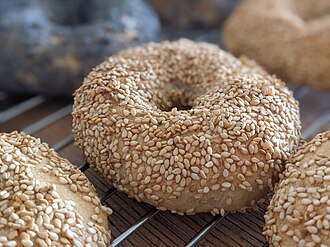
Photo: Wikipedia
A plain, unenriched bagel is a dense, chewy bread ring with a crisp, golden crust and a soft, slightly sweet interior. Its classic, mild wheat flavor and satisfying heft make it a versatile canvas for toppings. Nutritionally, it's a significant source of carbohydrates for energy, providing over 53g per 100g, with a modest protein boost.
Calorie split: 16% protein · 79% carbs · 5% fat
↓ Full nutrition💚 Why it's loved
People adore its iconic chewy texture and the comforting, toasty aroma it releases when warmed. It's the ultimate versatile base, effortlessly transitioning from a savory breakfast sandwich to a sweet, schmeared snack.
⚠️ Watch-outs & how to enjoy it better
Its high carbohydrate density can lead to rapid blood-sugar spikes, especially when eaten plain. Those monitoring blood sugar or gluten intake should exercise caution. Tip: Pair it with protein and healthy fats (like cream cheese, smoked salmon, or avocado) to slow digestion and create a more balanced meal.
Key benefits
- High in complex carbohydrates for sustained energy
- Good source of plant-based protein (10.5g per 100g)
- Low in fat (1.6g per 100g)
- Provides dietary fiber (2.3g per 100g)
- Simple, unenriched ingredients
🍽️ Popular dishes






🌍 Where it's eaten
💡 Did you know?
The hole in the middle isn't just for looks; it was traditionally created to ensure the bagel cooked evenly and quickly in boiling water before baking, giving it its signature crust and chew.
Full nutrition (USDA data · scales with serving)
| Water | 32.6 g |
| Energy | 275 kcal |
| Energy | 1151 kj |
| Protein | 10.5 g |
| Total lipid (fat) | 1.6 g |
| Ash | 1.8 g |
| Carbohydrate, by difference | 53.4 g |
| Fiber, total dietary | 2.3 g |
| Calcium, Ca | 18.0 mg |
| Iron, Fe | 1.4 mg |
| Magnesium, Mg | 29.0 mg |
| Phosphorus, P | 96.0 mg |
| Potassium, K | 101 mg |
| Sodium, Na | 534 mg |
| Zinc, Zn | 0.88 mg |
| Copper, Cu | 0.16 mg |
| Manganese, Mn | 0.54 mg |
| Vitamin C, total ascorbic acid | 0.00 mg |
| Thiamin | 0.16 mg |
| Riboflavin | 0.05 mg |
| Niacin | 1.8 mg |
| Pantothenic acid | 0.36 mg |
| Vitamin B-6 | 0.05 mg |
| Folate, total | 22.0 ug |
| Folic acid | 0.00 ug |
| Folate, food | 22.0 ug |
| Folate, DFE | 22.0 ug |
| Vitamin B-12 | 0.00 ug |
| Vitamin A, RAE | 0.00 ug |
| Retinol | 0.00 ug |
| Vitamin A, IU | 0.00 iu |
Fat & fatty acid profile (per 100g)
| Fatty acids, total saturated | 0.22 g |
| SFA 12:0 | 0.00 g |
| SFA 16:0 | 0.21 g |
| SFA 18:0 | 0.01 g |
| Fatty acids, total monounsaturated | 0.13 g |
| MUFA 16:1 | 0.01 g |
| MUFA 18:1 | 0.12 g |
| Fatty acids, total polyunsaturated | 0.70 g |
| PUFA 18:2 | 0.66 g |
| PUFA 18:3 | 0.04 g |
| Cholesterol | 0.00 mg |
Amino acid profile (per 100g)
| Tryptophan | 0.12 g |
| Threonine | 0.30 g |
| Isoleucine | 0.40 g |
| Leucine | 0.73 g |
| Lysine | 0.25 g |
| Methionine | 0.19 g |
| Cystine | 0.23 g |
| Phenylalanine | 0.52 g |
| Tyrosine | 0.30 g |
| Valine | 0.46 g |
| Arginine | 0.38 g |
| Histidine | 0.23 g |
| Alanine | 0.35 g |
| Aspartic acid | 0.48 g |
| Glutamic acid | 3.5 g |
| Glycine | 0.37 g |
| Proline | 1.2 g |
| Serine | 0.51 g |
FAQ
What's the difference between a plain bagel and a bread roll?
A bagel is boiled in water (often with malt or honey) before baking, which gelatinizes the crust and creates its signature dense, chewy texture. A roll is typically just baked, resulting in a softer, lighter crumb.
Why is this bagel labeled 'unenriched'?
It means the flour used hasn't had certain vitamins and minerals (like iron, B vitamins, and folic acid) added back in after processing, which is common in refined white flours.
Is a plain bagel a healthy breakfast?
It provides energy and some protein, but on its own, it's high in refined carbs. To make it a more balanced meal, top it with protein and fat like cream cheese, nut butter, or eggs, and add some fiber with vegetables or fruit.
Nutrient density (calculated · NRF9.3)
Nutrient Rich Foods index: beneficial nutrients (protein, fiber, vitamins, minerals) minus saturated fat, added sugar & sodium, per 100 kcal.
NRF9.3 index — Fulgoni, Keast & Drewnowski, 2009. Computed from USDA nutrients.
Weight-loss friendliness (composite index)
Energy density 2.75 kcal/g · 15% calories from protein · 2.3 g fiber · 0.0 g sugar per 100 g.
Composite of energy density (Rolls et al., 1999), protein & fiber satiety, minus sugar. A calculated heuristic — ranks satiety-per-calorie, not a clinical measure.
Dietary load (calculated from USDA values)
Potential renal acid load. Positive = acid-forming, negative = alkaline-forming.
Sodium-to-potassium ratio: 5.29 (lower is better — aim for ≤ 1)
Sodium:potassium per WHO potassium guidance. Computed from USDA nutrients.