

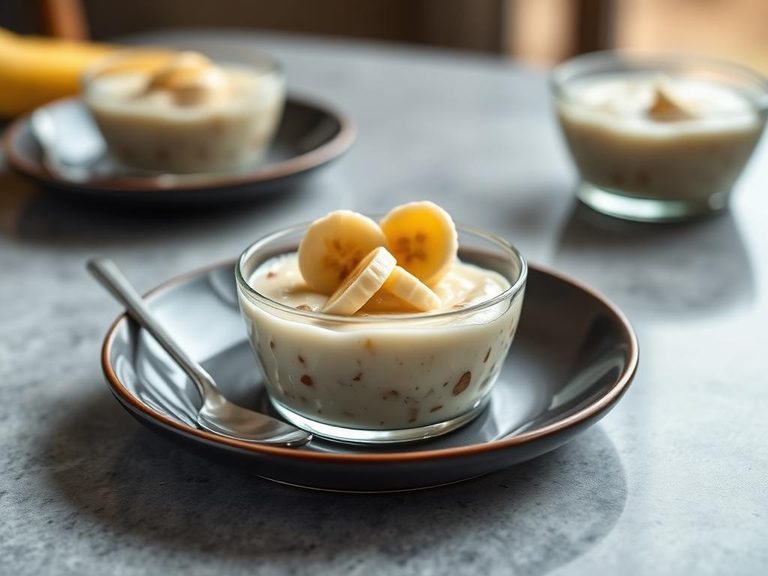
Babyfood, fruit, bananas with tapioca, strained
Whole food · Baby Foods

Photo: Wikipedia
A smooth, velvety puree of ripe bananas blended with tapioca starch, creating a naturally sweet, subtly tropical flavor with a uniquely silky, pudding-like texture. This strained baby food is a gentle, easily digestible first food, offering a mild sweetness and a comforting, familiar taste for infants. Its nutritional profile is characterized by a high carbohydrate content for quick energy, with minimal protein and fat, making it a simple, energy-dense option.
Calorie split: 3% protein · 96% carbs · 1% fat
↓ Full nutrition💚 Why it's loved
Parents love it for its mild, universally accepted banana flavor and its incredibly smooth, lump-free consistency that's perfect for early weaning. It's a reliable, fuss-free staple that babies often take to readily, providing a comforting and familiar taste.
⚠️ Watch-outs & how to enjoy it better
The high carbohydrate content (15.3g per 100g) can lead to rapid blood sugar spikes, which is a concern for infants with specific metabolic conditions. To counteract this, it's best served in small portions and paired with a source of protein or fat, like a spoonful of full-fat yogurt or a tiny bit of nut butter (if age-appropriate and no allergies), to slow digestion and stabilize energy release.
Key benefits
- Provides quick, easily digestible energy from natural fruit sugars and starch.
- The tapioca adds a smooth, thickening agent that is gentle on developing digestive systems.
- Naturally low in fat and sodium, suitable for a baby's simple dietary needs.
- Offers a source of dietary fiber (1.6g per 100g) to support digestive health.
🍽️ Popular dishes
🌍 Where it's eaten
💡 Did you know?
Tapioca, derived from the cassava root, was a crucial food source for indigenous peoples in the Amazon basin long before it became a common thickener in baby foods and puddings worldwide.
Full nutrition (USDA data · scales with serving)
| Water | 84.0 g |
| Energy | 56.0 kcal |
| Energy | 236 kj |
| Protein | 0.40 g |
| Total lipid (fat) | 0.10 g |
| Ash | 0.30 g |
| Carbohydrate, by difference | 15.3 g |
| Fiber, total dietary | 1.6 g |
| Total Sugars | 0.38 g |
| Calcium, Ca | 5.0 mg |
| Iron, Fe | 0.20 mg |
| Magnesium, Mg | 10.0 mg |
| Phosphorus, P | 7.0 mg |
| Potassium, K | 88.0 mg |
| Sodium, Na | 0.00 mg |
| Zinc, Zn | 0.06 mg |
| Copper, Cu | 0.04 mg |
| Selenium, Se | 0.60 ug |
| Fluoride, F | 36.2 ug |
| Vitamin C, total ascorbic acid | 16.7 mg |
| Thiamin | 0.01 mg |
| Riboflavin | 0.03 mg |
| Niacin | 0.18 mg |
| Pantothenic acid | 0.15 mg |
| Vitamin B-6 | 0.12 mg |
| Folate, total | 6.0 ug |
| Folic acid | 0.00 ug |
| Folate, food | 6.0 ug |
| Folate, DFE | 6.0 ug |
| Choline, total | 4.1 mg |
| Vitamin B-12 | 0.00 ug |
| Vitamin B-12, added | 0.00 ug |
| Vitamin A, RAE | 2.0 ug |
| Retinol | 0.00 ug |
| Carotene, beta | 17.0 ug |
| Carotene, alpha | 17.0 ug |
| Cryptoxanthin, beta | 0.00 ug |
| Vitamin A, IU | 43.0 iu |
| Lycopene | 0.00 ug |
| Lutein + zeaxanthin | 0.00 ug |
| Vitamin E (alpha-tocopherol) | 0.60 mg |
| Vitamin E, added | 0.00 mg |
| Vitamin D (D2 + D3), International Units | 0.00 iu |
| Vitamin D (D2 + D3) | 0.00 ug |
| Vitamin K (phylloquinone) | 0.00 ug |
| Alcohol, ethyl | 0.00 g |
| Caffeine | 0.00 mg |
| Theobromine | 0.00 mg |
Fat & fatty acid profile (per 100g)
| Fatty acids, total saturated | 0.04 g |
| SFA 4:0 | 0.00 g |
| SFA 6:0 | 0.00 g |
| SFA 8:0 | 0.00 g |
| SFA 10:0 | 0.00 g |
| SFA 12:0 | 0.00 g |
| SFA 14:0 | 0.00 g |
| SFA 16:0 | 0.03 g |
| SFA 18:0 | 0.00 g |
| Fatty acids, total monounsaturated | 0.01 g |
| MUFA 16:1 | 0.00 g |
| MUFA 18:1 | 0.01 g |
| MUFA 20:1 | 0.00 g |
| MUFA 22:1 | 0.00 g |
| Fatty acids, total polyunsaturated | 0.02 g |
| PUFA 18:2 | 0.01 g |
| PUFA 18:3 | 0.01 g |
| PUFA 18:4 | 0.00 g |
| PUFA 20:4 | 0.00 g |
| PUFA 20:5 n-3 (EPA) | 0.00 g |
| PUFA 22:5 n-3 (DPA) | 0.00 g |
| PUFA 22:6 n-3 (DHA) | 0.00 g |
| Cholesterol | 0.00 mg |
Amino acid profile (per 100g)
Estimated from Babyfood, grape juice, no sugar, canned — USDA does not publish this profile for Babyfood.
| Threonine | 0.02 g |
| Isoleucine | 0.01 g |
| Leucine | 0.02 g |
| Lysine | 0.02 g |
| Methionine | 0.03 g |
| Cystine | 0.01 g |
| Phenylalanine | 0.02 g |
| Tyrosine | 0.02 g |
| Valine | 0.02 g |
| Arginine | 0.06 g |
| Histidine | 0.03 g |
| Alanine | 0.04 g |
| Aspartic acid | 0.10 g |
| Glutamic acid | 0.18 g |
| Glycine | 0.03 g |
| Proline | 0.03 g |
| Serine | 0.04 g |
FAQ
Is this a good first food for babies?
Yes, it's often recommended as an early weaning food due to its smooth texture, mild flavor, and easy digestibility. However, always consult with a pediatrician before introducing new foods.
Does it contain added sugar?
The sugar content (0.38g per 100g) is naturally occurring from the bananas. The tapioca itself is a starch and doesn't add sugar. Always check the label for any added ingredients.
Can I mix it with other foods?
Absolutely. It's very versatile and can be mixed with other pureed fruits, vegetables, or a bit of breast milk/formula to introduce new flavors and textures.
Nutrient density (calculated · NRF9.3)
Nutrient Rich Foods index: beneficial nutrients (protein, fiber, vitamins, minerals) minus saturated fat, added sugar & sodium, per 100 kcal.
NRF9.3 index — Fulgoni, Keast & Drewnowski, 2009. Computed from USDA nutrients.
Weight-loss friendliness (composite index)
Energy density 0.56 kcal/g · 3% calories from protein · 1.6 g fiber · 0.4 g sugar per 100 g.
Composite of energy density (Rolls et al., 1999), protein & fiber satiety, minus sugar. A calculated heuristic — ranks satiety-per-calorie, not a clinical measure.
Dietary load (calculated from USDA values)
Potential renal acid load. Positive = acid-forming, negative = alkaline-forming.
Sodium-to-potassium ratio: 0.00 (lower is better — aim for ≤ 1)
Sodium:potassium per WHO potassium guidance. Computed from USDA nutrients.