

Babyfood, carrots, toddler
Whole food · Baby Foods

Photo: Wikipedia
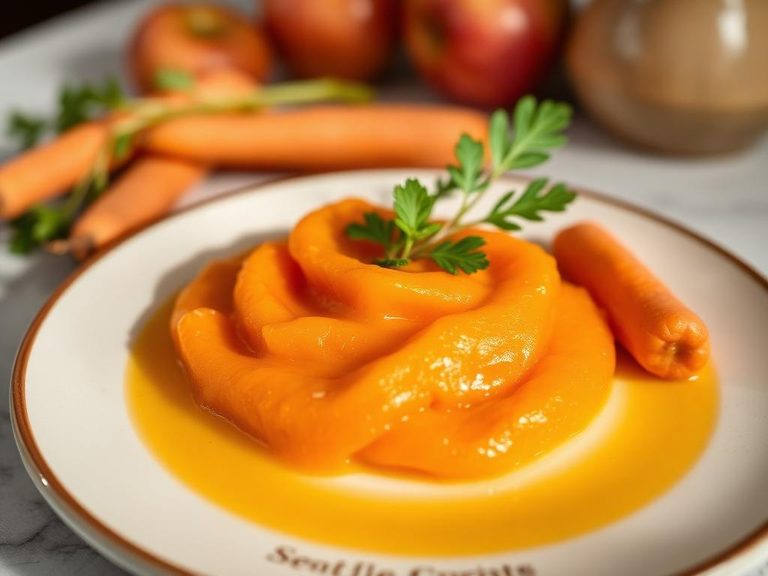
This is a smooth, vibrant orange purée of carrots, specifically prepared for toddlers. It has a naturally sweet, earthy flavor and a silky, spoonable texture that's gentle on developing palates. Nutritionally, it's a low-calorie, high-fiber source of beta-carotene, which the body converts to vitamin A.
Calorie split: 9% protein · 80% carbs · 10% fat
↓ Full nutrition💚 Why it's loved
Parents love it for its convenient, mess-free nutrition and its role in establishing early acceptance of vegetables. Its natural sweetness makes it a reliable favorite for many toddlers.
⚠️ Watch-outs & how to enjoy it better
The natural sugars, while healthy, can contribute to blood sugar spikes if served alone in large amounts. To counteract this, pair it with a source of protein or healthy fat, like a smear of nut butter or a side of yogurt, to slow digestion and create a more balanced snack.
Key benefits
- Excellent source of beta-carotene (vitamin A precursor) for eye health.
- High in dietary fiber for digestive regularity.
- Naturally low in fat and sodium.
- Provides a gentle introduction to vegetable flavors.
- Contains antioxidants like lutein.
🍽️ Popular dishes
🌍 Where it's eaten
💡 Did you know?
Commercial baby food carrots are often more intensely orange and sweeter than homemade versions because manufacturers use carrot varieties bred for high sugar content and color uniformity.
Full nutrition (USDA data · scales with serving)
| Water | 93.5 g |
| Energy | 21.0 kcal |
| Energy | 90.0 kj |
| Protein | 0.60 g |
| Total lipid (fat) | 0.30 g |
| Ash | 0.37 g |
| Carbohydrate, by difference | 5.2 g |
| Fiber, total dietary | 2.3 g |
| Total Sugars | 2.5 g |
| Calcium, Ca | 19.0 mg |
| Iron, Fe | 0.20 mg |
| Magnesium, Mg | 6.0 mg |
| Phosphorus, P | 21.0 mg |
| Potassium, K | 129 mg |
| Sodium, Na | 48.0 mg |
| Zinc, Zn | 0.20 mg |
| Copper, Cu | 0.08 mg |
| Selenium, Se | 0.80 ug |
| Vitamin C, total ascorbic acid | 0.70 mg |
| Thiamin | 0.02 mg |
| Riboflavin | 0.03 mg |
| Niacin | 0.25 mg |
| Vitamin B-6 | 0.05 mg |
| Folate, total | 7.0 ug |
| Folic acid | 0.00 ug |
| Folate, food | 7.0 ug |
| Folate, DFE | 7.0 ug |
| Choline, total | 5.0 mg |
| Vitamin B-12 | 0.00 ug |
| Vitamin B-12, added | 0.00 ug |
| Vitamin A, RAE | 736 ug |
| Retinol | 0.00 ug |
| Carotene, beta | 7156 ug |
| Carotene, alpha | 3340 ug |
| Cryptoxanthin, beta | 0.00 ug |
| Vitamin A, IU | 14710 iu |
| Lycopene | 1.0 ug |
| Lutein + zeaxanthin | 167 ug |
| Vitamin E (alpha-tocopherol) | 0.59 mg |
| Vitamin E, added | 0.00 mg |
| Vitamin D (D2 + D3), International Units | 0.00 iu |
| Vitamin D (D2 + D3) | 0.00 ug |
| Vitamin K (phylloquinone) | 7.9 ug |
| Alcohol, ethyl | 0.00 g |
| Caffeine | 0.00 mg |
| Theobromine | 0.00 mg |
Fat & fatty acid profile (per 100g)
| Fatty acids, total saturated | 0.05 g |
| SFA 4:0 | 0.00 g |
| SFA 6:0 | 0.00 g |
| SFA 8:0 | 0.00 g |
| SFA 10:0 | 0.00 g |
| SFA 12:0 | 0.00 g |
| SFA 14:0 | 0.00 g |
| SFA 16:0 | 0.04 g |
| SFA 18:0 | 0.00 g |
| Fatty acids, total monounsaturated | 0.01 g |
| MUFA 16:1 | 0.00 g |
| MUFA 18:1 | 0.01 g |
| MUFA 20:1 | 0.00 g |
| MUFA 22:1 | 0.00 g |
| Fatty acids, total polyunsaturated | 0.15 g |
| PUFA 18:2 | 0.13 g |
| PUFA 18:3 | 0.02 g |
| PUFA 18:4 | 0.00 g |
| PUFA 20:4 | 0.00 g |
| PUFA 20:5 n-3 (EPA) | 0.00 g |
| PUFA 22:5 n-3 (DPA) | 0.00 g |
| PUFA 22:6 n-3 (DHA) | 0.00 g |
| Cholesterol | 0.00 mg |
Amino acid profile (per 100g)
Estimated from Babyfood, grape juice, no sugar, canned — USDA does not publish this profile for Babyfood.
| Threonine | 0.02 g |
| Isoleucine | 0.01 g |
| Leucine | 0.02 g |
| Lysine | 0.02 g |
| Methionine | 0.03 g |
| Cystine | 0.01 g |
| Phenylalanine | 0.02 g |
| Tyrosine | 0.02 g |
| Valine | 0.02 g |
| Arginine | 0.06 g |
| Histidine | 0.03 g |
| Alanine | 0.04 g |
| Aspartic acid | 0.10 g |
| Glutamic acid | 0.18 g |
| Glycine | 0.03 g |
| Proline | 0.03 g |
| Serine | 0.04 g |
FAQ
Is this the same as just mashed cooked carrots?
Commercial toddler purées are typically cooked longer and processed to a finer, more uniform consistency for safety. They may also be fortified with nutrients like iron or vitamin C, which aren't naturally abundant in carrots.
Why is the fiber content listed as 2.3g per 100g when it's a smooth purée?
The fiber comes from the carrot's cell walls, which are broken down but not removed during processing. Even in a smooth purée, the insoluble fiber remains, contributing to digestive health.
Can this be used in family meals?
Absolutely. It's a versatile ingredient for adding moisture, natural sweetness, and nutrients to muffins, pancakes, meatballs, soups, and sauces without altering the flavor profile significantly.
Nutrient density (calculated · NRF9.3)
Nutrient Rich Foods index: beneficial nutrients (protein, fiber, vitamins, minerals) minus saturated fat, added sugar & sodium, per 100 kcal.
NRF9.3 index — Fulgoni, Keast & Drewnowski, 2009. Computed from USDA nutrients.
Weight-loss friendliness (composite index)
Energy density 0.21 kcal/g · 11% calories from protein · 2.3 g fiber · 2.5 g sugar per 100 g.
Composite of energy density (Rolls et al., 1999), protein & fiber satiety, minus sugar. A calculated heuristic — ranks satiety-per-calorie, not a clinical measure.
Dietary load (calculated from USDA values)
Potential renal acid load. Positive = acid-forming, negative = alkaline-forming.
Sodium-to-potassium ratio: 0.37 (lower is better — aim for ≤ 1)
Sodium:potassium per WHO potassium guidance. Computed from USDA nutrients.