

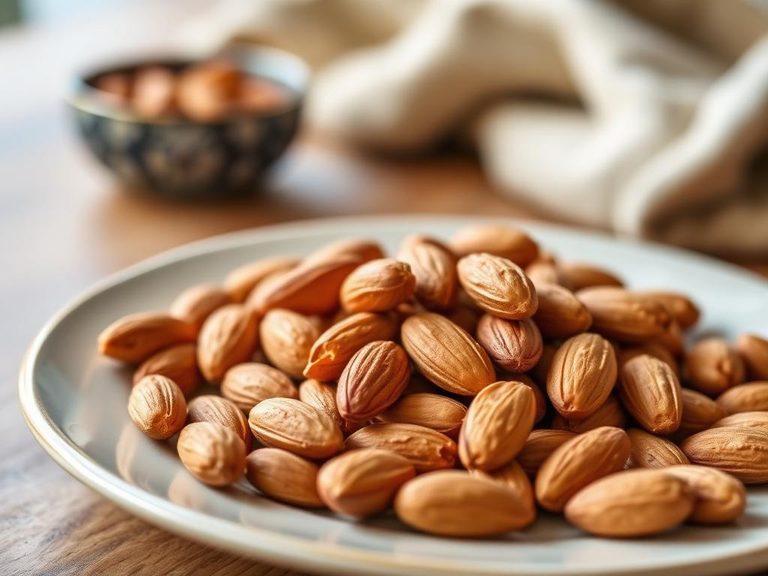
Almonds, unsalted
Common food

Photo: Wikipedia
Almonds are the edible seed of the Prunus dulcis tree, prized for their satisfyingly crisp, crunchy texture and subtly sweet, nutty flavor. Nutritionally, they are a powerhouse, delivering a remarkable amount of healthy monounsaturated fats and plant-based protein in a small, dense package.
Calorie split: 13% protein · 13% carbs · 75% fat
↓ Full nutrition💚 Why it's loved
People adore almonds for their versatile, toasty flavor that enhances both sweet and savory dishes, and for their reliable, satisfying crunch. They are a cultural staple, enjoyed raw, roasted, or as almond butter, making them a go-to snack and ingredient worldwide.
⚠️ Watch-outs & how to enjoy it better
As a common tree nut, almonds are a major allergen and must be strictly avoided by those with allergies. Their high fat and calorie density can lead to overconsumption, and they contain oxalates, which may be a concern for individuals prone to certain kidney stones. To manage intake, practice strict portion control (e.g., a small handful) and pair them with other foods to enhance satiety.
Key benefits
- Excellent source of heart-healthy monounsaturated fats
- Rich in plant-based protein for muscle maintenance
- High in dietary fiber, promoting digestive health
- Provides key minerals like magnesium and vitamin E
- Low glycemic index, helping to manage blood sugar
🍽️ Popular dishes





🌍 Where it's eaten
💡 Did you know?
The almond tree is a member of the rose family (Rosaceae), making it a close relative of peaches, cherries, and plums.
Full nutrition (USDA data · scales with serving)
| Water | 2.3 g |
| Energy | 607 kcal |
| Protein | 20.3 g |
| Total lipid (fat) | 54.0 g |
| Carbohydrate, by difference | 20.4 g |
| Fiber, total dietary | 10.6 g |
| Total Sugars | 4.7 g |
| Calcium, Ca | 260 mg |
| Iron, Fe | 3.6 mg |
| Magnesium, Mg | 271 mg |
| Phosphorus, P | 457 mg |
| Potassium, K | 692 mg |
| Sodium, Na | 3.0 mg |
| Zinc, Zn | 3.2 mg |
| Copper, Cu | 1.1 mg |
| Selenium, Se | 1.9 ug |
| Vitamin C, total ascorbic acid | 0.00 mg |
| Thiamin | 0.07 mg |
| Riboflavin | 1.2 mg |
| Niacin | 3.5 mg |
| Vitamin B-6 | 0.13 mg |
| Folate, total | 53.0 ug |
| Folic acid | 0.00 ug |
| Folate, food | 53.0 ug |
| Folate, DFE | 53.0 ug |
| Choline, total | 50.5 mg |
| Vitamin B-12 | 0.00 ug |
| Vitamin B-12, added | 0.00 ug |
| Vitamin A, RAE | 0.00 ug |
| Retinol | 0.00 ug |
| Carotene, beta | 1.0 ug |
| Carotene, alpha | 0.00 ug |
| Cryptoxanthin, beta | 0.00 ug |
| Lycopene | 0.00 ug |
| Lutein + zeaxanthin | 1.0 ug |
| Vitamin E (alpha-tocopherol) | 23.8 mg |
| Vitamin E, added | 0.00 mg |
| Vitamin D (D2 + D3) | 0.00 ug |
| Vitamin K (phylloquinone) | 3.0 ug |
| Alcohol, ethyl | 0.00 g |
| Caffeine | 0.00 mg |
| Theobromine | 0.00 mg |
Fat & fatty acid profile (per 100g)
| Fatty acids, total saturated | 4.4 g |
| SFA 4:0 | 0.00 g |
| SFA 6:0 | 0.00 g |
| SFA 8:0 | 0.00 g |
| SFA 10:0 | 0.00 g |
| SFA 12:0 | 0.00 g |
| SFA 14:0 | 0.02 g |
| SFA 16:0 | 3.5 g |
| SFA 18:0 | 0.77 g |
| Fatty acids, total monounsaturated | 33.4 g |
| MUFA 16:1 | 0.26 g |
| MUFA 18:1 | 33.0 g |
| MUFA 20:1 | 0.03 g |
| MUFA 22:1 | 0.00 g |
| Fatty acids, total polyunsaturated | 13.7 g |
| PUFA 18:2 | 13.6 g |
| PUFA 18:3 | 0.14 g |
| PUFA 18:4 | 0.00 g |
| PUFA 20:4 | 0.00 g |
| PUFA 20:5 n-3 (EPA) | 0.00 g |
| PUFA 22:5 n-3 (DPA) | 0.00 g |
| PUFA 22:6 n-3 (DHA) | 0.00 g |
| Cholesterol | 0.00 mg |
Amino acid profile (per 100g)
Estimated from Nuts, almonds, honey roasted, unblanched — USDA does not publish this profile for Almonds.
| Tryptophan | 0.28 g |
| Threonine | 0.57 g |
| Isoleucine | 0.68 g |
| Leucine | 1.2 g |
| Lysine | 0.52 g |
| Methionine | 0.18 g |
| Cystine | 0.28 g |
| Phenylalanine | 0.87 g |
| Tyrosine | 0.55 g |
| Valine | 0.80 g |
| Arginine | 1.9 g |
| Histidine | 0.43 g |
| Alanine | 0.74 g |
| Aspartic acid | 1.8 g |
| Glutamic acid | 4.6 g |
| Glycine | 0.96 g |
| Proline | 0.98 g |
| Serine | 0.70 g |
FAQ
What's the difference between raw and roasted almonds?
Raw almonds are not heat-treated, offering a milder flavor. Roasting enhances their nutty taste and crunch but can slightly reduce heat-sensitive nutrients like vitamin E.
Are blanched almonds less nutritious?
Blanching removes the skin, which contains some fiber and antioxidants. While the difference is minor, unblanched almonds with skin intact offer slightly more nutritional benefit.
How should I store almonds to keep them fresh?
Store in an airtight container in a cool, dark place for up to 3 months, or in the freezer for up to a year. Their high fat content makes them prone to going rancid if exposed to heat or light.
Nutrient density (calculated · NRF9.3)
Nutrient Rich Foods index: beneficial nutrients (protein, fiber, vitamins, minerals) minus saturated fat, added sugar & sodium, per 100 kcal.
NRF9.3 index — Fulgoni, Keast & Drewnowski, 2009. Computed from USDA nutrients.
Weight-loss friendliness (composite index)
Energy density 6.07 kcal/g · 13% calories from protein · 10.6 g fiber · 4.7 g sugar per 100 g.
Composite of energy density (Rolls et al., 1999), protein & fiber satiety, minus sugar. A calculated heuristic — ranks satiety-per-calorie, not a clinical measure.
Dietary load (calculated from USDA values)
Potential renal acid load. Positive = acid-forming, negative = alkaline-forming.
Sodium-to-potassium ratio: 0.00 (lower is better — aim for ≤ 1)
Sodium:potassium per WHO potassium guidance. Computed from USDA nutrients.