

Almonds, salted
Common food
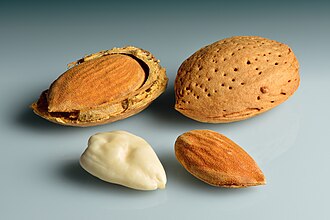
Photo: Wikipedia
Salted almonds are whole or blanched almonds roasted and lightly dusted with salt, creating a satisfying crunch with a savory, nutty flavor. Each 100g delivers a potent 53g of healthy monounsaturated fats and over 20g of plant-based protein, making it a dense, energy-rich snack.
Calorie split: 13% protein · 13% carbs · 75% fat
↓ Full nutrition💚 Why it's loved
People adore the perfect marriage of savory salt and rich, buttery nuttiness, making it an addictive and satisfying snack. Its incredible versatility allows it to be enjoyed straight from the bag, tossed into salads, or used as a crunchy topping.
⚠️ Watch-outs & how to enjoy it better
The added sodium can be a concern for those monitoring salt intake, and the high calorie density requires mindful portioning. As a tree nut, almonds are a common allergen, and the oxalate content may be a consideration for individuals prone to certain kidney stones. To counteract, opt for lightly salted or unsalted versions, strictly measure portions (e.g., a small handful), and pair with water or other low-sodium foods.
Key benefits
- Excellent source of heart-healthy monounsaturated fats
- High in plant-based protein for satiety
- Provides dietary fiber to support digestion
- Rich in vitamin E, an antioxidant
- Contains essential minerals like magnesium and manganese
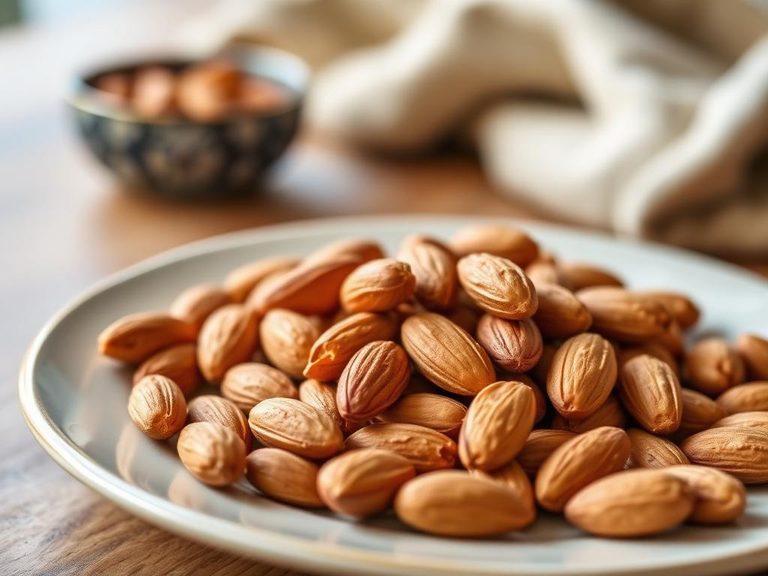
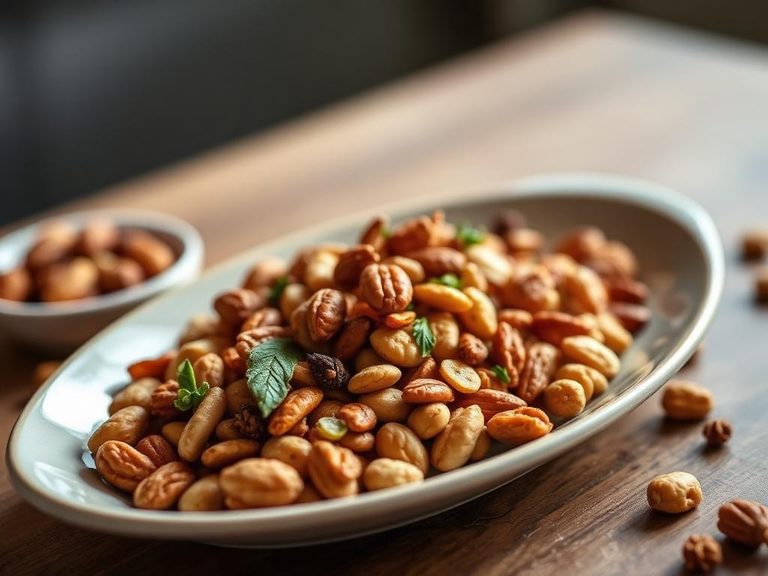
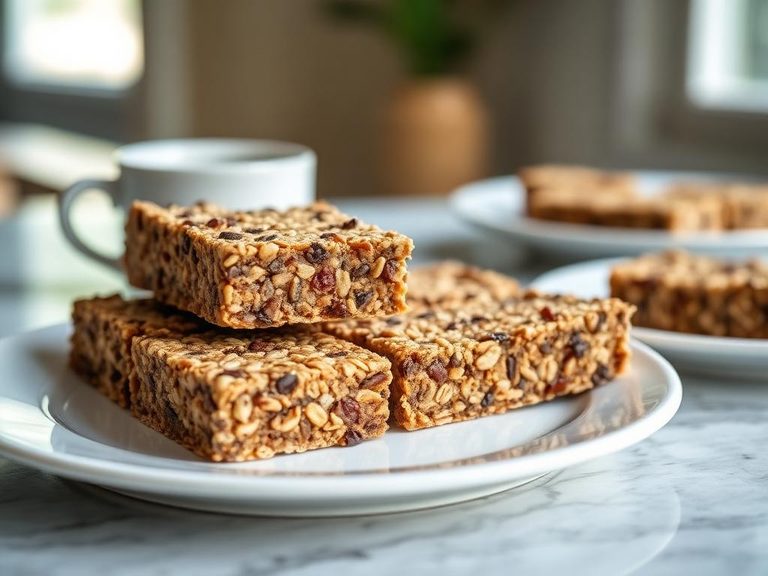
🍽️ Popular dishes



🌍 Where it's eaten
💡 Did you know?
Almonds are not true nuts but the edible seed of a drupe, closely related to peaches and plums.
Full nutrition (USDA data · scales with serving)
| Water | 2.3 g |
| Energy | 601 kcal |
| Protein | 20.1 g |
| Total lipid (fat) | 53.4 g |
| Carbohydrate, by difference | 20.2 g |
| Fiber, total dietary | 10.5 g |
| Total Sugars | 4.7 g |
| Calcium, Ca | 258 mg |
| Iron, Fe | 3.6 mg |
| Magnesium, Mg | 268 mg |
| Phosphorus, P | 452 mg |
| Potassium, K | 685 mg |
| Sodium, Na | 386 mg |
| Zinc, Zn | 3.2 mg |
| Copper, Cu | 1.1 mg |
| Selenium, Se | 1.9 ug |
| Vitamin C, total ascorbic acid | 0.00 mg |
| Thiamin | 0.07 mg |
| Riboflavin | 1.1 mg |
| Niacin | 3.5 mg |
| Vitamin B-6 | 0.13 mg |
| Folate, total | 53.0 ug |
| Folic acid | 0.00 ug |
| Folate, food | 53.0 ug |
| Folate, DFE | 53.0 ug |
| Choline, total | 50.0 mg |
| Vitamin B-12 | 0.00 ug |
| Vitamin B-12, added | 0.00 ug |
| Vitamin A, RAE | 0.00 ug |
| Retinol | 0.00 ug |
| Carotene, beta | 1.0 ug |
| Carotene, alpha | 0.00 ug |
| Cryptoxanthin, beta | 0.00 ug |
| Lycopene | 0.00 ug |
| Lutein + zeaxanthin | 1.0 ug |
| Vitamin E (alpha-tocopherol) | 23.5 mg |
| Vitamin E, added | 0.00 mg |
| Vitamin D (D2 + D3) | 0.00 ug |
| Vitamin K (phylloquinone) | 3.0 ug |
| Alcohol, ethyl | 0.00 g |
| Caffeine | 0.00 mg |
| Theobromine | 0.00 mg |
Fat & fatty acid profile (per 100g)
| Fatty acids, total saturated | 4.3 g |
| SFA 4:0 | 0.00 g |
| SFA 6:0 | 0.00 g |
| SFA 8:0 | 0.00 g |
| SFA 10:0 | 0.00 g |
| SFA 12:0 | 0.00 g |
| SFA 14:0 | 0.02 g |
| SFA 16:0 | 3.5 g |
| SFA 18:0 | 0.76 g |
| Fatty acids, total monounsaturated | 33.0 g |
| MUFA 16:1 | 0.26 g |
| MUFA 18:1 | 32.7 g |
| MUFA 20:1 | 0.03 g |
| MUFA 22:1 | 0.00 g |
| Fatty acids, total polyunsaturated | 13.6 g |
| PUFA 18:2 | 13.4 g |
| PUFA 18:3 | 0.14 g |
| PUFA 18:4 | 0.00 g |
| PUFA 20:4 | 0.00 g |
| PUFA 20:5 n-3 (EPA) | 0.00 g |
| PUFA 22:5 n-3 (DPA) | 0.00 g |
| PUFA 22:6 n-3 (DHA) | 0.00 g |
| Cholesterol | 0.00 mg |
Amino acid profile (per 100g)
Estimated from Nuts, almonds, honey roasted, unblanched — USDA does not publish this profile for Almonds.
| Tryptophan | 0.28 g |
| Threonine | 0.57 g |
| Isoleucine | 0.68 g |
| Leucine | 1.2 g |
| Lysine | 0.52 g |
| Methionine | 0.18 g |
| Cystine | 0.28 g |
| Phenylalanine | 0.87 g |
| Tyrosine | 0.55 g |
| Valine | 0.80 g |
| Arginine | 1.9 g |
| Histidine | 0.43 g |
| Alanine | 0.74 g |
| Aspartic acid | 1.8 g |
| Glutamic acid | 4.6 g |
| Glycine | 0.96 g |
| Proline | 0.98 g |
| Serine | 0.70 g |
FAQ
Are salted almonds healthy?
Yes, in moderation. They are nutrient-dense, providing healthy fats, protein, and fiber. However, the added salt means they are higher in sodium than raw almonds, so portion control is key.
How should I store them?
Store in an airtight container in a cool, dark place like a pantry for up to a month, or in the refrigerator for up to 6 months to prevent the oils from going rancid.
Can I make them at home?
Absolutely. Toss raw almonds with a tiny amount of oil and salt, then roast at 350°F (175°C) for 10-15 minutes. This lets you control the salt level precisely.
Nutrient density (calculated · NRF9.3)
Nutrient Rich Foods index: beneficial nutrients (protein, fiber, vitamins, minerals) minus saturated fat, added sugar & sodium, per 100 kcal.
NRF9.3 index — Fulgoni, Keast & Drewnowski, 2009. Computed from USDA nutrients.
Weight-loss friendliness (composite index)
Energy density 6.01 kcal/g · 13% calories from protein · 10.5 g fiber · 4.7 g sugar per 100 g.
Composite of energy density (Rolls et al., 1999), protein & fiber satiety, minus sugar. A calculated heuristic — ranks satiety-per-calorie, not a clinical measure.
Dietary load (calculated from USDA values)
Potential renal acid load. Positive = acid-forming, negative = alkaline-forming.
Sodium-to-potassium ratio: 0.56 (lower is better — aim for ≤ 1)
Sodium:potassium per WHO potassium guidance. Computed from USDA nutrients.