

Almonds, NFS
Common food
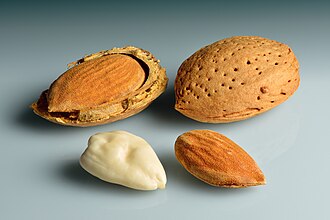
Photo: Wikipedia
Almonds, NFS (Not Further Specified) are whole, raw almonds with a firm, crunchy texture and a subtly sweet, nutty flavor. Nutritionally, they are a powerhouse, delivering over 20g of protein and a significant dose of healthy monounsaturated fats per 100g, making them a dense source of energy and satiety.
Calorie split: 13% protein · 13% carbs · 74% fat
↓ Full nutrition💚 Why it's loved
People love almonds for their satisfying crunch and versatile, mild flavor that complements both sweet and savory dishes. Their convenience as a portable, nutrient-dense snack and deep-rooted presence in global cuisines—from Middle Eastern pastries to Spanish tapas—make them a beloved staple.
⚠️ Watch-outs & how to enjoy it better
Almonds are a common tree nut allergen and contain oxalates, which may be a concern for individuals prone to certain kidney stones. To mitigate, ensure proper diagnosis if an allergy is suspected, and those with oxalate concerns can soak almonds to reduce content or consume them in moderation as part of a balanced diet.
Key benefits
- Excellent source of plant-based protein
- Rich in heart-healthy monounsaturated fats
- High in dietary fiber for digestive health
- Provides essential minerals like magnesium and vitamin E
- Supports sustained energy and satiety
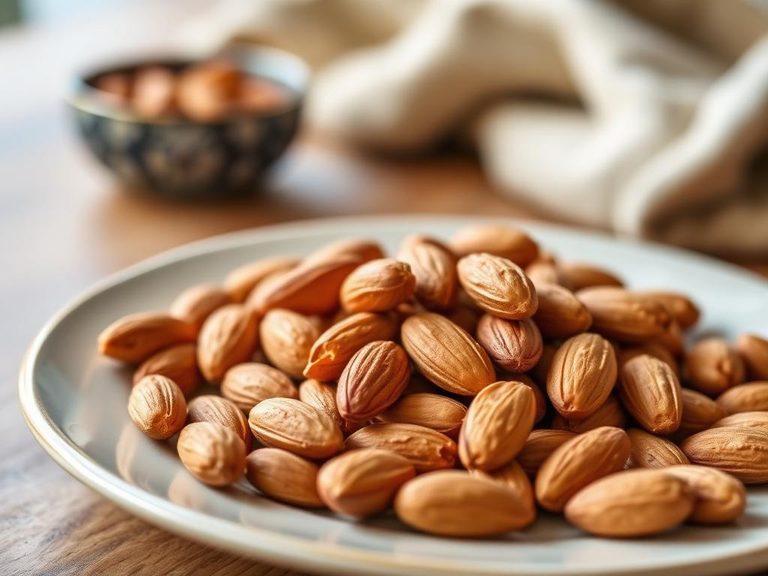
🍽️ Popular dishes





🌍 Where it's eaten
💡 Did you know?
Almonds are not true nuts botanically; they are the seeds of a fruit from a tree in the Prunus genus, making them close relatives of peaches and cherries.
Full nutrition (USDA data · scales with serving)
| Water | 2.4 g |
| Energy | 598 kcal |
| Protein | 21.0 g |
| Total lipid (fat) | 52.5 g |
| Carbohydrate, by difference | 21.0 g |
| Fiber, total dietary | 10.9 g |
| Total Sugars | 4.9 g |
| Calcium, Ca | 268 mg |
| Iron, Fe | 3.7 mg |
| Magnesium, Mg | 279 mg |
| Phosphorus, P | 471 mg |
| Potassium, K | 713 mg |
| Sodium, Na | 3.0 mg |
| Zinc, Zn | 3.3 mg |
| Copper, Cu | 1.1 mg |
| Selenium, Se | 2.0 ug |
| Vitamin C, total ascorbic acid | 0.00 mg |
| Thiamin | 0.08 mg |
| Riboflavin | 1.2 mg |
| Niacin | 3.6 mg |
| Vitamin B-6 | 0.14 mg |
| Folate, total | 55.0 ug |
| Folic acid | 0.00 ug |
| Folate, food | 55.0 ug |
| Folate, DFE | 55.0 ug |
| Choline, total | 52.1 mg |
| Vitamin B-12 | 0.00 ug |
| Vitamin B-12, added | 0.00 ug |
| Vitamin A, RAE | 0.00 ug |
| Retinol | 0.00 ug |
| Carotene, beta | 1.0 ug |
| Carotene, alpha | 0.00 ug |
| Cryptoxanthin, beta | 0.00 ug |
| Lycopene | 0.00 ug |
| Lutein + zeaxanthin | 1.0 ug |
| Vitamin E (alpha-tocopherol) | 23.9 mg |
| Vitamin E, added | 0.00 mg |
| Vitamin D (D2 + D3) | 0.00 ug |
| Vitamin K (phylloquinone) | 0.00 ug |
| Alcohol, ethyl | 0.00 g |
| Caffeine | 0.00 mg |
| Theobromine | 0.00 mg |
Fat & fatty acid profile (per 100g)
| Fatty acids, total saturated | 4.1 g |
| SFA 4:0 | 0.00 g |
| SFA 6:0 | 0.00 g |
| SFA 8:0 | 0.00 g |
| SFA 10:0 | 0.00 g |
| SFA 12:0 | 0.00 g |
| SFA 14:0 | 0.02 g |
| SFA 16:0 | 3.3 g |
| SFA 18:0 | 0.70 g |
| Fatty acids, total monounsaturated | 33.1 g |
| MUFA 16:1 | 0.26 g |
| MUFA 18:1 | 32.8 g |
| MUFA 20:1 | 0.01 g |
| MUFA 22:1 | 0.00 g |
| Fatty acids, total polyunsaturated | 13.0 g |
| PUFA 18:2 | 12.9 g |
| PUFA 18:3 | 0.01 g |
| PUFA 18:4 | 0.00 g |
| PUFA 20:4 | 0.00 g |
| PUFA 20:5 n-3 (EPA) | 0.00 g |
| PUFA 22:5 n-3 (DPA) | 0.00 g |
| PUFA 22:6 n-3 (DHA) | 0.00 g |
| Cholesterol | 0.00 mg |
Amino acid profile (per 100g)
Estimated from Nuts, almonds, honey roasted, unblanched — USDA does not publish this profile for Almonds.
| Tryptophan | 0.28 g |
| Threonine | 0.57 g |
| Isoleucine | 0.68 g |
| Leucine | 1.2 g |
| Lysine | 0.52 g |
| Methionine | 0.18 g |
| Cystine | 0.28 g |
| Phenylalanine | 0.87 g |
| Tyrosine | 0.55 g |
| Valine | 0.80 g |
| Arginine | 1.9 g |
| Histidine | 0.43 g |
| Alanine | 0.74 g |
| Aspartic acid | 1.8 g |
| Glutamic acid | 4.6 g |
| Glycine | 0.96 g |
| Proline | 0.98 g |
| Serine | 0.70 g |
FAQ
What does 'NFS' mean on a nutrition label?
NFS stands for 'Not Further Specified.' It indicates the food item is in its most basic, unprocessed form (like whole raw almonds) without added ingredients or specific preparation methods.
Are almonds a good source of protein?
Yes, almonds are an excellent plant-based protein source, providing about 21 grams of protein per 100 grams, which is substantial for a nut.
How should I store almonds to keep them fresh?
Store almonds in an airtight container in a cool, dark place like a pantry for up to 2 months, or in the refrigerator or freezer for up to a year to prevent the natural oils from going rancid.
Nutrient density (calculated · NRF9.3)
Nutrient Rich Foods index: beneficial nutrients (protein, fiber, vitamins, minerals) minus saturated fat, added sugar & sodium, per 100 kcal.
NRF9.3 index — Fulgoni, Keast & Drewnowski, 2009. Computed from USDA nutrients.
Weight-loss friendliness (composite index)
Energy density 5.98 kcal/g · 14% calories from protein · 10.9 g fiber · 4.9 g sugar per 100 g.
Composite of energy density (Rolls et al., 1999), protein & fiber satiety, minus sugar. A calculated heuristic — ranks satiety-per-calorie, not a clinical measure.
Dietary load (calculated from USDA values)
Potential renal acid load. Positive = acid-forming, negative = alkaline-forming.
Sodium-to-potassium ratio: 0.00 (lower is better — aim for ≤ 1)
Sodium:potassium per WHO potassium guidance. Computed from USDA nutrients.