Muffins, English, mixed-grain (includes granola)
Whole food · Baked Products

Photo: Wikipedia
A hearty, wholesome English muffin made from a blend of grains like oats, barley, and rye, often with added granola for a pleasant crunch. Its texture is chewy with a slightly coarse crumb, offering a nutty, subtly sweet flavor from the grains themselves. Nutritionally, it's a solid source of complex carbohydrates and fiber, with a modest protein boost from the mixed grains.
💚 Why it's loved
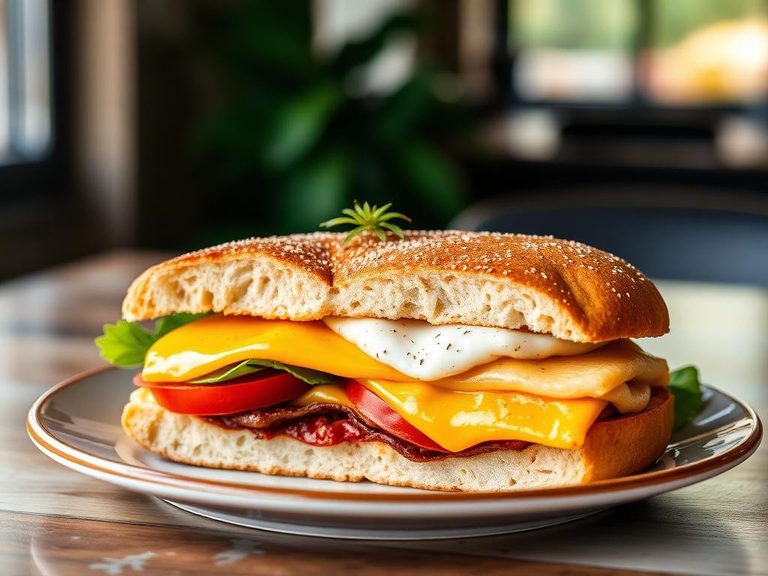
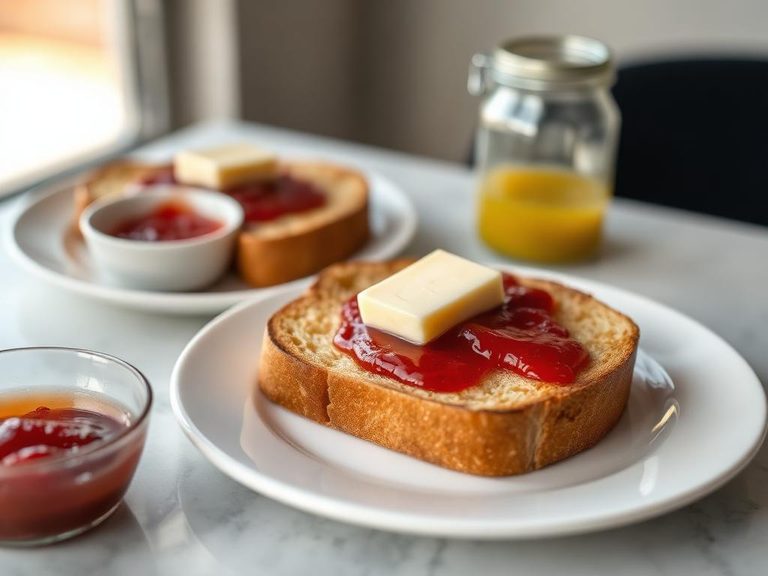
People love it for its satisfying, chewy texture and the nutty, toasty flavor that comes from the mixed grains and granola. It's a versatile base for both sweet and savory toppings, making it a staple for a quick breakfast or a substantial snack.
⚠️ Watch-outs & how to enjoy it better
The dense, high-fiber content can be heavy for some digestive systems, and the carbohydrate load (46.3g per 100g) may cause blood-sugar spikes if eaten alone. To counteract this, pair it with a source of protein (like an egg or Greek yogurt) or healthy fat (like avocado or nut butter) to slow digestion and stabilize energy levels. Also, be mindful of portion size.
Key benefits
- High in complex carbohydrates for sustained energy
- Good source of dietary fiber (2.8g per 100g)
- Provides plant-based protein (9.1g per 100g)
- Low in fat (1.8g per 100g)
- Contains a variety of whole grains for micronutrients
🍽️ Popular dishes

🌍 Where it's eaten
💡 Did you know?
The nooks and crannies of an English muffin, even a mixed-grain one, are specifically designed to trap butter and toppings, a feature famously marketed by Thomas' in the 1920s.
Full nutrition (scales with serving)
| Water | 40.2 g |
| Energy | 235 kcal |
| Energy | 983 kj |
| Protein | 9.1 g |
| Total lipid (fat) | 1.8 g |
| Ash | 2.5 g |
| Carbohydrate, by difference | 46.3 g |
| Fiber, total dietary | 2.8 g |
| Total Sugars | 0.81 g |
| Calcium, Ca | 196 mg |
| Iron, Fe | 3.0 mg |
| Magnesium, Mg | 41.0 mg |
| Phosphorus, P | 81.0 mg |
| Potassium, K | 156 mg |
| Sodium, Na | 298 mg |
| Zinc, Zn | 1.4 mg |
| Copper, Cu | 0.24 mg |
| Manganese, Mn | 0.60 mg |
| Selenium, Se | 25.5 ug |
| Vitamin C, total ascorbic acid | 0.00 mg |
| Thiamin | 0.43 mg |
| Riboflavin | 0.31 mg |
| Niacin | 3.6 mg |
| Pantothenic acid | 0.41 mg |
| Vitamin B-6 | 0.04 mg |
| Folate, total | 80.0 ug |
| Folic acid | 45.0 ug |
| Folate, food | 35.0 ug |
| Folate, DFE | 112 ug |
| Choline, total | 13.7 mg |
| Vitamin B-12 | 0.00 ug |
| Vitamin B-12, added | 0.00 ug |
| Vitamin A, RAE | 0.00 ug |
| Retinol | 0.00 ug |
| Carotene, beta | 0.00 ug |
| Carotene, alpha | 0.00 ug |
| Cryptoxanthin, beta | 0.00 ug |
| Vitamin A, IU | 0.00 iu |
| Lycopene | 0.00 ug |
| Lutein + zeaxanthin | 1.0 ug |
| Vitamin E (alpha-tocopherol) | 0.00 mg |
| Vitamin E, added | 0.00 mg |
| Vitamin D (D2 + D3), International Units | 0.00 iu |
| Vitamin D (D2 + D3) | 0.00 ug |
| Vitamin K (phylloquinone) | 0.00 ug |
| Alcohol, ethyl | 0.00 g |
| Caffeine | 0.00 mg |
| Theobromine | 0.00 mg |
Fat & fatty acid profile (per 100g)
| Fatty acids, total saturated | 0.23 g |
| SFA 4:0 | 0.00 g |
| SFA 6:0 | 0.00 g |
| SFA 8:0 | 0.00 g |
| SFA 10:0 | 0.00 g |
| SFA 12:0 | 0.00 g |
| SFA 14:0 | 0.01 g |
| SFA 16:0 | 0.17 g |
| SFA 18:0 | 0.05 g |
| Fatty acids, total monounsaturated | 0.83 g |
| MUFA 16:1 | 0.01 g |
| MUFA 18:1 | 0.81 g |
| MUFA 20:1 | 0.00 g |
| MUFA 22:1 | 0.00 g |
| Fatty acids, total polyunsaturated | 0.56 g |
| PUFA 18:2 | 0.53 g |
| PUFA 18:3 | 0.03 g |
| PUFA 18:4 | 0.00 g |
| PUFA 20:4 | 0.00 g |
| PUFA 20:5 n-3 (EPA) | 0.00 g |
| PUFA 22:5 n-3 (DPA) | 0.00 g |
| PUFA 22:6 n-3 (DHA) | 0.00 g |
| Cholesterol | 0.00 mg |
Amino acid profile (per 100g)
| Tryptophan | 0.12 g |
| Threonine | 0.28 g |
| Isoleucine | 0.36 g |
| Leucine | 0.65 g |
| Lysine | 0.29 g |
| Methionine | 0.16 g |
| Cystine | 0.20 g |
| Phenylalanine | 0.45 g |
| Tyrosine | 0.28 g |
| Valine | 0.42 g |
| Arginine | 0.44 g |
| Histidine | 0.20 g |
| Alanine | 0.35 g |
| Aspartic acid | 0.55 g |
| Glutamic acid | 2.7 g |
| Glycine | 0.37 g |
| Proline | 0.85 g |
| Serine | 0.43 g |
FAQ
How is this different from a regular English muffin?
It's made with a blend of whole grains (like oats, rye, or barley) and often includes granola, giving it a more complex, nutty flavor, denser texture, and higher fiber content than a standard white-flour English muffin.
Is it good for weight management?
It can be, due to its high fiber and protein content which promote satiety. However, it's still calorie-dense (235 kcal per 100g), so portion control and pairing it with protein or healthy fats is key.
Can I make it at home?
Yes, but it requires a yeast dough with a mix of whole grain flours and granola. The dough is shaped, allowed to rise, then cooked on a griddle or skillet, not baked, to achieve the classic texture.