

Yogurt, NFS
Common food
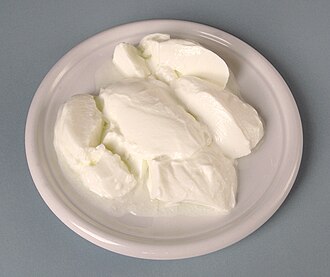
Photo: Wikipedia
Yogurt, NFS is a versatile, cultured dairy product with a smooth, creamy texture and a characteristic tangy flavor. It is a solid source of protein and calcium, while also containing natural sugars from milk. Its simple, clean profile makes it a staple for both sweet and savory preparations.
Calorie split: 29% protein · 44% carbs · 28% fat
↓ Full nutrition💚 Why it's loved
People love yogurt for its creamy, tangy taste and incredible versatility, serving as a healthy breakfast, a cooling condiment, or a base for smoothies. Its cultural significance in cuisines from the Mediterranean to South Asia makes it a beloved, familiar comfort food.
⚠️ Watch-outs & how to enjoy it better
The natural lactose and added sugars in some yogurts can cause blood-sugar spikes or digestive discomfort for some individuals. To counteract this, choose plain, unsweetened varieties and pair with high-fiber foods like berries or nuts to slow sugar absorption, or opt for lactose-free versions if sensitive.
Key benefits
- Rich in high-quality protein for muscle maintenance.
- Excellent source of calcium for bone health.
- Contains probiotics that support gut health.
- A convenient, portable source of energy and nutrients.
- Can be used as a base for both sweet and savory dishes.
🍽️ Popular dishes






🌍 Where it's eaten
💡 Did you know?
The word 'yogurt' comes from the Turkish word 'yoğurmak,' which means 'to thicken' or 'to curdle,' reflecting its ancient origins as a method of preserving milk.
Full nutrition (USDA data · scales with serving)
| Water | 79.4 g |
| Energy | 94.0 kcal |
| Protein | 6.7 g |
| Total lipid (fat) | 2.9 g |
| Carbohydrate, by difference | 10.2 g |
| Fiber, total dietary | 0.10 g |
| Total Sugars | 8.1 g |
| Calcium, Ca | 136 mg |
| Iron, Fe | 0.07 mg |
| Magnesium, Mg | 13.0 mg |
| Phosphorus, P | 126 mg |
| Potassium, K | 179 mg |
| Sodium, Na | 49.0 mg |
| Zinc, Zn | 0.62 mg |
| Copper, Cu | 0.02 mg |
| Selenium, Se | 6.4 ug |
| Vitamin C, total ascorbic acid | 1.0 mg |
| Thiamin | 0.05 mg |
| Riboflavin | 0.22 mg |
| Niacin | 0.17 mg |
| Vitamin B-6 | 0.04 mg |
| Folate, total | 8.0 ug |
| Folic acid | 0.00 ug |
| Folate, food | 8.0 ug |
| Folate, DFE | 8.0 ug |
| Choline, total | 14.8 mg |
| Vitamin B-12 | 0.62 ug |
| Vitamin B-12, added | 0.00 ug |
| Vitamin A, RAE | 25.0 ug |
| Retinol | 25.0 ug |
| Carotene, beta | 1.0 ug |
| Carotene, alpha | 0.00 ug |
| Cryptoxanthin, beta | 0.00 ug |
| Lycopene | 0.00 ug |
| Lutein + zeaxanthin | 0.00 ug |
| Vitamin E (alpha-tocopherol) | 0.03 mg |
| Vitamin E, added | 0.00 mg |
| Vitamin D (D2 + D3) | 0.60 ug |
| Vitamin K (phylloquinone) | 0.10 ug |
| Alcohol, ethyl | 0.00 g |
| Caffeine | 0.00 mg |
| Theobromine | 0.00 mg |
Fat & fatty acid profile (per 100g)
| Fatty acids, total saturated | 1.6 g |
| SFA 4:0 | 0.02 g |
| SFA 6:0 | 0.04 g |
| SFA 8:0 | 0.05 g |
| SFA 10:0 | 0.15 g |
| SFA 12:0 | 0.09 g |
| SFA 14:0 | 0.28 g |
| SFA 16:0 | 0.72 g |
| SFA 18:0 | 0.23 g |
| Fatty acids, total monounsaturated | 0.67 g |
| MUFA 16:1 | 0.04 g |
| MUFA 18:1 | 0.57 g |
| MUFA 20:1 | 0.02 g |
| MUFA 22:1 | 0.00 g |
| Fatty acids, total polyunsaturated | 0.25 g |
| PUFA 18:2 | 0.07 g |
| PUFA 18:3 | 0.02 g |
| PUFA 18:4 | 0.00 g |
| PUFA 20:4 | 0.00 g |
| PUFA 20:5 n-3 (EPA) | 0.00 g |
| PUFA 22:5 n-3 (DPA) | 0.00 g |
| PUFA 22:6 n-3 (DHA) | 0.00 g |
| Cholesterol | 11.0 mg |
Amino acid profile (per 100g)
Estimated from Frozen yogurts, vanilla, soft-serve — USDA does not publish this profile for Yogurt.
| Tryptophan | 0.05 g |
| Threonine | 0.17 g |
| Isoleucine | 0.23 g |
| Leucine | 0.37 g |
| Lysine | 0.30 g |
| Methionine | 0.09 g |
| Cystine | 0.04 g |
| Phenylalanine | 0.18 g |
| Tyrosine | 0.18 g |
| Valine | 0.25 g |
| Arginine | 0.14 g |
| Histidine | 0.10 g |
| Alanine | 0.13 g |
| Aspartic acid | 0.28 g |
| Glutamic acid | 0.79 g |
| Glycine | 0.08 g |
| Proline | 0.36 g |
| Serine | 0.20 g |
FAQ
What does 'NFS' mean in 'Yogurt, NFS'?
NFS stands for 'Not Further Specified,' meaning it's a generic entry for yogurt without details on fat content (e.g., non-fat, whole milk) or flavor.
Is yogurt a good source of probiotics?
Yes, yogurt contains live active cultures (probiotics) that can support digestive health, but the specific strains and amounts vary by brand and type.
How does yogurt differ from other dairy products like milk or cheese?
Yogurt is made by fermenting milk with specific bacterial cultures, which thickens it and gives it a tangy flavor, while also increasing its digestibility for some people.
Nutrient density (calculated · NRF9.3)
Nutrient Rich Foods index: beneficial nutrients (protein, fiber, vitamins, minerals) minus saturated fat, added sugar & sodium, per 100 kcal.
NRF9.3 index — Fulgoni, Keast & Drewnowski, 2009. Computed from USDA nutrients.
Weight-loss friendliness (composite index)
Energy density 0.94 kcal/g · 28% calories from protein · 0.1 g fiber · 8.1 g sugar per 100 g.
Composite of energy density (Rolls et al., 1999), protein & fiber satiety, minus sugar. A calculated heuristic — ranks satiety-per-calorie, not a clinical measure.
Dietary load (calculated from USDA values)
Potential renal acid load. Positive = acid-forming, negative = alkaline-forming.
Sodium-to-potassium ratio: 0.27 (lower is better — aim for ≤ 1)
Sodium:potassium per WHO potassium guidance. Computed from USDA nutrients.