

Tomatoes, for use on a sandwich
Common food

Photo: Wikipedia
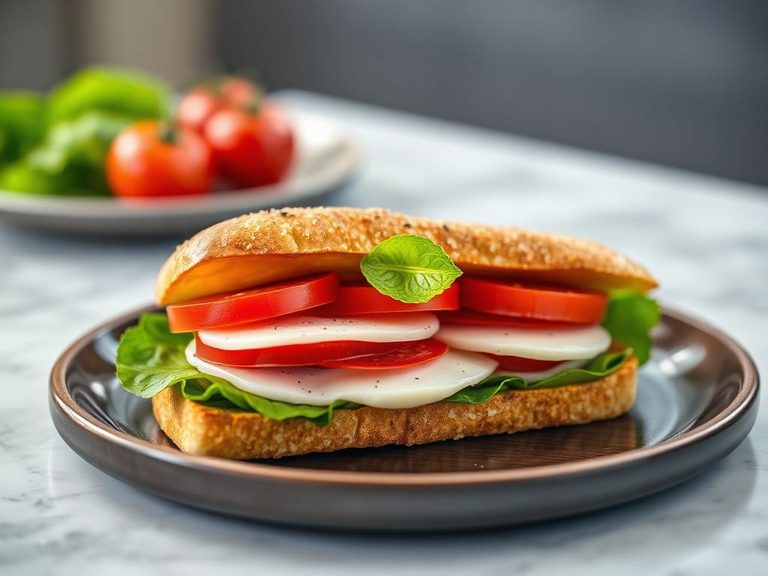
A ripe, juicy tomato slice is the quintessential sandwich topping, offering a bright, acidic burst and a soft, seed-filled texture. Nutritionally, it's a low-calorie powerhouse, packing more than a quarter of your daily vitamin C needs in just 100 grams. Its high water content and natural sugars provide a refreshing, slightly sweet counterpoint to savory sandwich fillings.
Calorie split: 15% protein · 73% carbs · 13% fat
↓ Full nutrition💚 Why it's loved
People adore the tomato's vibrant, umami-rich flavor that instantly elevates a sandwich from plain to spectacular. Its juicy texture and natural acidity cut through rich, fatty ingredients like cheese or mayo, creating a perfectly balanced bite.
⚠️ Watch-outs & how to enjoy it better
For some, the high acidity can trigger heartburn or acid reflux, especially when eaten raw. Tomatoes are also high in natural sugars, which can contribute to blood sugar spikes if consumed in very large quantities without other macronutrients. To counteract, pair tomato slices with protein (like turkey or cheese) and healthy fats (like avocado) to slow sugar absorption and balance the meal.
Key benefits
- Excellent source of vitamin C for immune support.
- Rich in the antioxidant lycopene, linked to heart health.
- Very low in calories and fat, aiding in weight management.
- Provides dietary fiber for digestive health.
- High water content helps with hydration.
🍽️ Popular dishes




🌍 Where it's eaten
💡 Did you know?
Botanically, a tomato is a fruit (specifically a berry), but legally, the U.S. Supreme Court ruled it a vegetable for tariff purposes in 1893.
Full nutrition (USDA data · scales with serving)
| Water | 94.4 g |
| Energy | 20.0 kcal |
| Protein | 0.82 g |
| Total lipid (fat) | 0.31 g |
| Carbohydrate, by difference | 4.0 g |
| Fiber, total dietary | 1.2 g |
| Total Sugars | 2.6 g |
| Calcium, Ca | 10.0 mg |
| Iron, Fe | 0.22 mg |
| Magnesium, Mg | 10.0 mg |
| Phosphorus, P | 23.0 mg |
| Potassium, K | 226 mg |
| Sodium, Na | 4.0 mg |
| Zinc, Zn | 0.15 mg |
| Copper, Cu | 0.05 mg |
| Selenium, Se | 0.00 ug |
| Vitamin C, total ascorbic acid | 16.3 mg |
| Thiamin | 0.05 mg |
| Riboflavin | 0.02 mg |
| Niacin | 0.60 mg |
| Vitamin B-6 | 0.08 mg |
| Folate, total | 13.0 ug |
| Folic acid | 0.00 ug |
| Folate, food | 13.0 ug |
| Folate, DFE | 13.0 ug |
| Choline, total | 7.0 mg |
| Vitamin B-12 | 0.00 ug |
| Vitamin B-12, added | 0.00 ug |
| Vitamin A, RAE | 32.0 ug |
| Retinol | 0.00 ug |
| Carotene, beta | 397 ug |
| Carotene, alpha | 61.0 ug |
| Cryptoxanthin, beta | 6.0 ug |
| Lycopene | 2813 ug |
| Lutein + zeaxanthin | 103 ug |
| Vitamin E (alpha-tocopherol) | 0.58 mg |
| Vitamin E, added | 0.00 mg |
| Vitamin D (D2 + D3) | 0.00 ug |
| Vitamin K (phylloquinone) | 7.5 ug |
| Alcohol, ethyl | 0.00 g |
| Caffeine | 0.00 mg |
| Theobromine | 0.00 mg |
Fat & fatty acid profile (per 100g)
| Fatty acids, total saturated | 0.03 g |
| SFA 4:0 | 0.00 g |
| SFA 6:0 | 0.00 g |
| SFA 8:0 | 0.00 g |
| SFA 10:0 | 0.00 g |
| SFA 12:0 | 0.00 g |
| SFA 14:0 | 0.00 g |
| SFA 16:0 | 0.02 g |
| SFA 18:0 | 0.01 g |
| Fatty acids, total monounsaturated | 0.03 g |
| MUFA 16:1 | 0.00 g |
| MUFA 18:1 | 0.03 g |
| MUFA 20:1 | 0.00 g |
| MUFA 22:1 | 0.00 g |
| Fatty acids, total polyunsaturated | 0.08 g |
| PUFA 18:2 | 0.08 g |
| PUFA 18:3 | 0.00 g |
| PUFA 18:4 | 0.00 g |
| PUFA 20:4 | 0.00 g |
| PUFA 20:5 n-3 (EPA) | 0.00 g |
| PUFA 22:5 n-3 (DPA) | 0.00 g |
| PUFA 22:6 n-3 (DHA) | 0.00 g |
| Cholesterol | 0.00 mg |
Amino acid profile (per 100g)
Estimated from Tomatoes, sun-dried, packed in oil, drained — USDA does not publish this profile for Tomatoes.
| Tryptophan | 0.04 g |
| Threonine | 0.13 g |
| Isoleucine | 0.12 g |
| Leucine | 0.18 g |
| Lysine | 0.19 g |
| Methionine | 0.04 g |
| Cystine | 0.07 g |
| Phenylalanine | 0.13 g |
| Tyrosine | 0.09 g |
| Valine | 0.13 g |
| Arginine | 0.12 g |
| Histidine | 0.08 g |
| Alanine | 0.14 g |
| Aspartic acid | 0.70 g |
| Glutamic acid | 1.9 g |
| Glycine | 0.13 g |
| Proline | 0.10 g |
| Serine | 0.13 g |
FAQ
Should I store sliced tomatoes in the fridge?
For best flavor and texture, store whole tomatoes at room temperature until ripe. Once sliced, refrigerate in an airtight container for up to 2 days, but note that cold temperatures can dull the flavor and make the flesh mealy.
Are the seeds and gel the most nutritious part?
The seeds and surrounding gel contain a high concentration of lycopene and other nutrients. While the entire tomato is healthy, consuming the whole slice ensures you get the full nutritional benefit.
How can I prevent my sandwich from getting soggy?
Place the tomato slices between drier ingredients (like lettuce and meat) and add them last. You can also lightly salt the slices and let them sit on a paper towel for a few minutes to draw out excess moisture before assembling.
Nutrient density (calculated · NRF9.3)
Nutrient Rich Foods index: beneficial nutrients (protein, fiber, vitamins, minerals) minus saturated fat, added sugar & sodium, per 100 kcal.
NRF9.3 index — Fulgoni, Keast & Drewnowski, 2009. Computed from USDA nutrients.
Weight-loss friendliness (composite index)
Energy density 0.20 kcal/g · 16% calories from protein · 1.2 g fiber · 2.6 g sugar per 100 g.
Composite of energy density (Rolls et al., 1999), protein & fiber satiety, minus sugar. A calculated heuristic — ranks satiety-per-calorie, not a clinical measure.
Dietary load (calculated from USDA values)
Potential renal acid load. Positive = acid-forming, negative = alkaline-forming.
Sodium-to-potassium ratio: 0.02 (lower is better — aim for ≤ 1)
Sodium:potassium per WHO potassium guidance. Computed from USDA nutrients.