

Sweet potato, canned, no added fat
Common food

Photo: Wikipedia
Canned sweet potatoes are tender, pre-cooked chunks or mash with a deep, caramel-like sweetness and a soft, almost silky texture. Packed with beta-carotene and fiber, they offer a convenient, low-fat source of complex carbs. Their natural sugars are concentrated during canning, making them a quick, energy-boosting staple.
Calorie split: 7% protein · 91% carbs · 2% fat
↓ Full nutrition💚 Why it's loved
People love canned sweet potatoes for their intense, natural sweetness and melt-in-your-mouth texture, which makes them a comforting addition to both savory and sweet dishes. They are a beloved staple in Southern U.S. cuisine, especially during holidays, and are prized for their ease of preparation.
⚠️ Watch-outs & how to enjoy it better
The high natural sugar content can cause rapid blood sugar spikes, so those managing diabetes should pair them with protein or healthy fats (like nuts or a dollop of Greek yogurt) to slow absorption. Some brands may contain added sodium, so rinsing the canned pieces or choosing low-sodium varieties is a simple countermeasure.
Key benefits
- Rich in beta-carotene, which converts to vitamin A
- Good source of dietary fiber for digestive health
- Low in fat and cholesterol-free
- Provides potassium for electrolyte balance
- Convenient, shelf-stable, and ready to eat
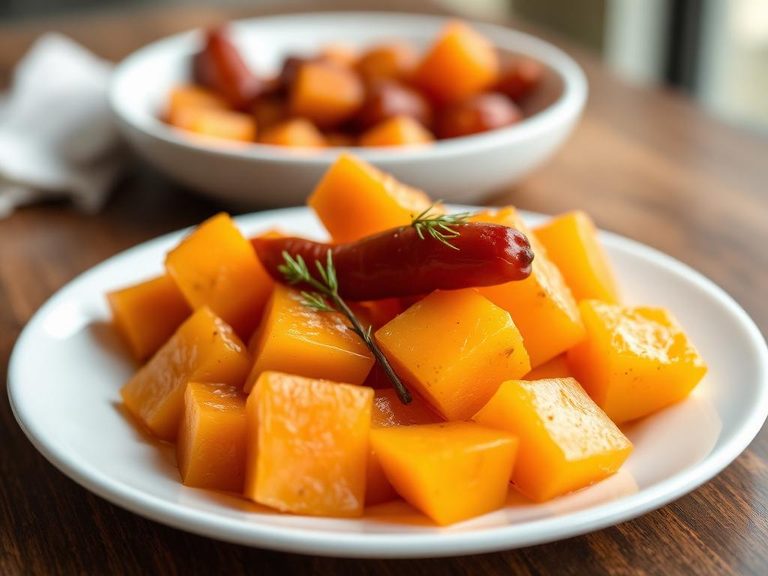
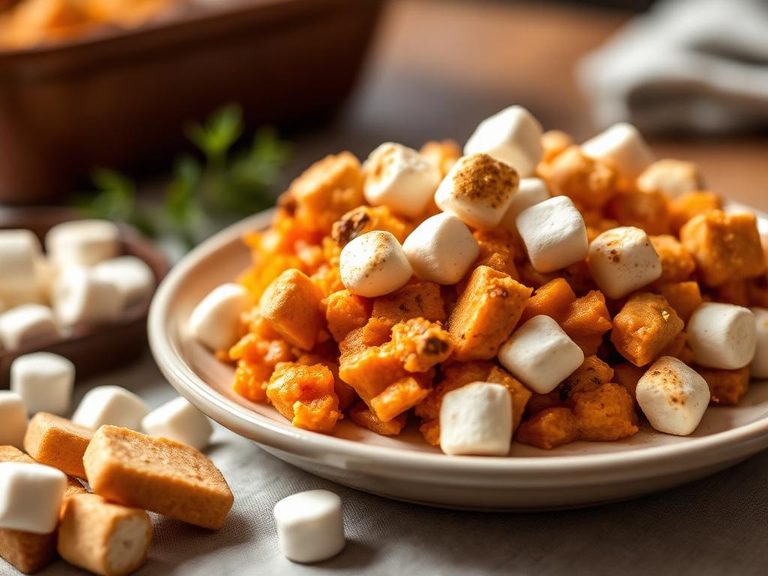
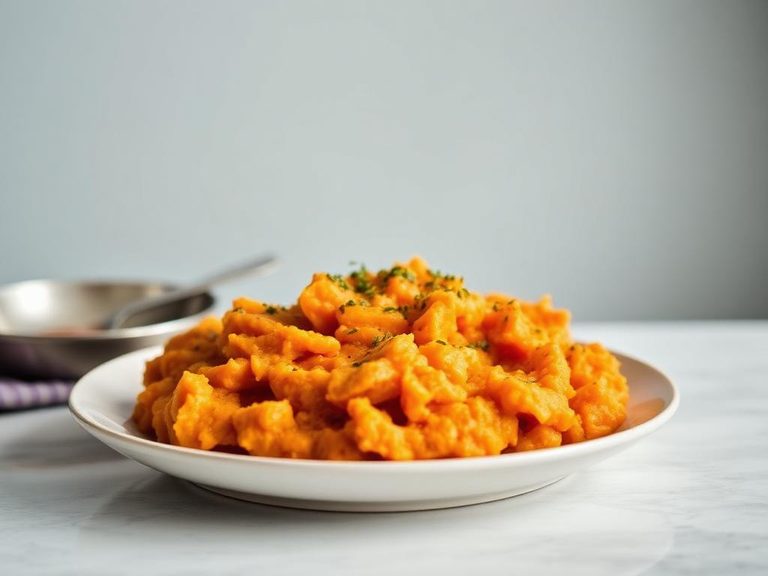
🍽️ Popular dishes

🌍 Where it's eaten
💡 Did you know?
The orange color of sweet potatoes comes from beta-carotene, a pigment so potent that eating large amounts can temporarily turn your skin a yellowish-orange hue—a harmless condition called carotenemia.
Full nutrition (USDA data · scales with serving)
| Water | 75.7 g |
| Energy | 91.0 kcal |
| Protein | 1.6 g |
| Total lipid (fat) | 0.20 g |
| Carbohydrate, by difference | 21.0 g |
| Fiber, total dietary | 1.8 g |
| Total Sugars | 5.0 g |
| Calcium, Ca | 22.0 mg |
| Iron, Fe | 0.89 mg |
| Magnesium, Mg | 22.0 mg |
| Phosphorus, P | 49.0 mg |
| Potassium, K | 311 mg |
| Sodium, Na | 207 mg |
| Zinc, Zn | 0.18 mg |
| Copper, Cu | 0.14 mg |
| Selenium, Se | 0.70 ug |
| Vitamin C, total ascorbic acid | 26.3 mg |
| Thiamin | 0.04 mg |
| Riboflavin | 0.06 mg |
| Niacin | 0.74 mg |
| Vitamin B-6 | 0.19 mg |
| Folate, total | 17.0 ug |
| Folic acid | 0.00 ug |
| Folate, food | 17.0 ug |
| Folate, DFE | 17.0 ug |
| Choline, total | 12.9 mg |
| Vitamin B-12 | 0.00 ug |
| Vitamin B-12, added | 0.00 ug |
| Vitamin A, RAE | 397 ug |
| Retinol | 0.00 ug |
| Carotene, beta | 4771 ug |
| Carotene, alpha | 0.00 ug |
| Cryptoxanthin, beta | 0.00 ug |
| Lycopene | 0.00 ug |
| Lutein + zeaxanthin | 0.00 ug |
| Vitamin E (alpha-tocopherol) | 1.0 mg |
| Vitamin E, added | 0.00 mg |
| Vitamin D (D2 + D3) | 0.00 ug |
| Vitamin K (phylloquinone) | 2.2 ug |
| Alcohol, ethyl | 0.00 g |
| Caffeine | 0.00 mg |
| Theobromine | 0.00 mg |
Fat & fatty acid profile (per 100g)
| Fatty acids, total saturated | 0.04 g |
| SFA 4:0 | 0.00 g |
| SFA 6:0 | 0.00 g |
| SFA 8:0 | 0.00 g |
| SFA 10:0 | 0.00 g |
| SFA 12:0 | 0.00 g |
| SFA 14:0 | 0.00 g |
| SFA 16:0 | 0.04 g |
| SFA 18:0 | 0.00 g |
| Fatty acids, total monounsaturated | 0.01 g |
| MUFA 16:1 | 0.00 g |
| MUFA 18:1 | 0.01 g |
| MUFA 20:1 | 0.00 g |
| MUFA 22:1 | 0.00 g |
| Fatty acids, total polyunsaturated | 0.08 g |
| PUFA 18:2 | 0.07 g |
| PUFA 18:3 | 0.01 g |
| PUFA 18:4 | 0.00 g |
| PUFA 20:4 | 0.00 g |
| PUFA 20:5 n-3 (EPA) | 0.00 g |
| PUFA 22:5 n-3 (DPA) | 0.00 g |
| PUFA 22:6 n-3 (DHA) | 0.00 g |
| Cholesterol | 0.00 mg |
Amino acid profile (per 100g)
Estimated from Snacks, sweet potato chips, unsalted — USDA does not publish this profile for Sweet potato.
| Tryptophan | 0.10 g |
| Threonine | 0.26 g |
| Isoleucine | 0.17 g |
| Leucine | 0.29 g |
| Lysine | 0.20 g |
| Methionine | 0.09 g |
| Cystine | 0.07 g |
| Phenylalanine | 0.28 g |
| Tyrosine | 0.11 g |
| Valine | 0.27 g |
| Arginine | 0.17 g |
| Histidine | 0.10 g |
| Alanine | 0.24 g |
| Aspartic acid | 1.2 g |
| Glutamic acid | 0.48 g |
| Glycine | 0.20 g |
| Proline | 0.16 g |
| Serine | 0.28 g |
FAQ
Are canned sweet potatoes as nutritious as fresh?
Yes, they retain most vitamins and minerals, though some water-soluble nutrients like vitamin C may be slightly reduced. Their fiber and beta-carotene content remain high.
How should I store opened canned sweet potatoes?
Transfer leftovers to an airtight container and refrigerate for up to 3-4 days. They can also be frozen for up to 3 months.
Can I use canned sweet potatoes in baking?
Absolutely. They are commonly used in pies, muffins, and breads, adding moisture and natural sweetness without needing extra sugar.
Nutrient density (calculated · NRF9.3)
Nutrient Rich Foods index: beneficial nutrients (protein, fiber, vitamins, minerals) minus saturated fat, added sugar & sodium, per 100 kcal.
NRF9.3 index — Fulgoni, Keast & Drewnowski, 2009. Computed from USDA nutrients.
Weight-loss friendliness (composite index)
Energy density 0.91 kcal/g · 7% calories from protein · 1.8 g fiber · 5.0 g sugar per 100 g.
Composite of energy density (Rolls et al., 1999), protein & fiber satiety, minus sugar. A calculated heuristic — ranks satiety-per-calorie, not a clinical measure.
Dietary load (calculated from USDA values)
Potential renal acid load. Positive = acid-forming, negative = alkaline-forming.
Sodium-to-potassium ratio: 0.67 (lower is better — aim for ≤ 1)
Sodium:potassium per WHO potassium guidance. Computed from USDA nutrients.