

Soup, ramen noodle, dry, any flavor, reduced fat, reduced sodium
Whole food · Soups, Sauces, and Gravies
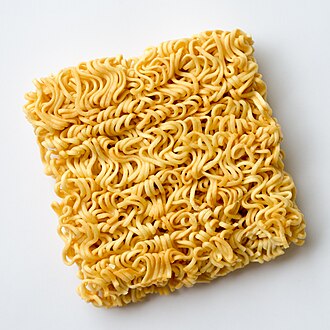
Photo: Wikipedia
This is a lightweight, instant ramen noodle block designed for quick preparation, offering a satisfying chew with a mild, savory flavor profile. Nutritionally, it's a high-carbohydrate, low-fat option that provides a quick energy boost, though it's notably low in protein and fiber.
Calorie split: 12% protein · 81% carbs · 6% fat
↓ Full nutrition💚 Why it's loved
People love it for its ultimate convenience and comforting, nostalgic appeal, serving as a quick meal or snack. Its mild flavor acts as a blank canvas, making it incredibly versatile for customization with sauces, proteins, and vegetables.
⚠️ Watch-outs & how to enjoy it better
The primary downside is its high carbohydrate density and low protein/fiber content, which can lead to a rapid blood sugar spike and subsequent crash. To counteract this, pair it with a significant source of protein (like an egg, tofu, or lean meat) and fiber (like leafy greens or mushrooms) to slow digestion and create a more balanced meal.
Key benefits
- Extremely convenient and fast to prepare
- Low in fat and calories per serving
- Provides a quick source of energy from carbohydrates
- Lightweight and non-perishable for easy storage
- Can be a base for adding healthier ingredients
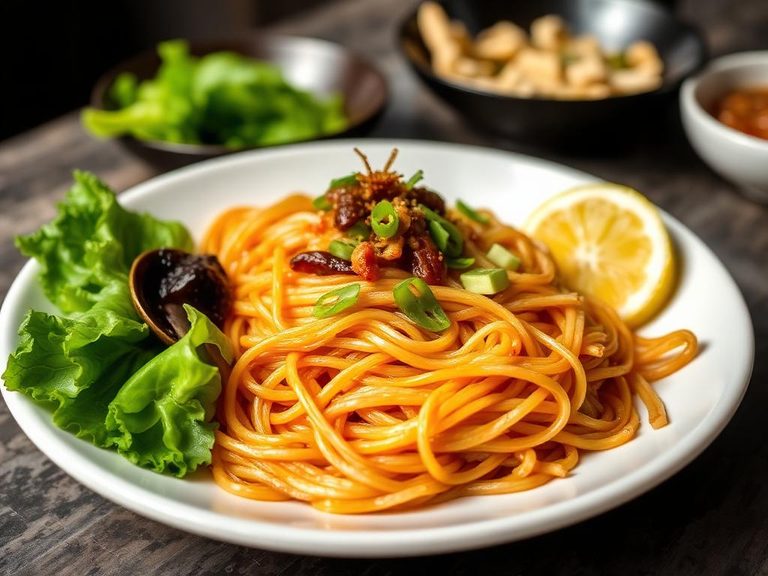
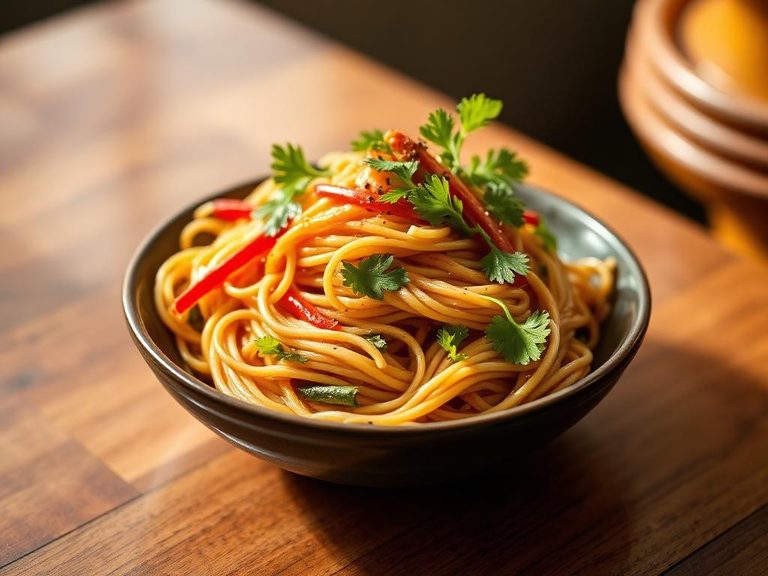
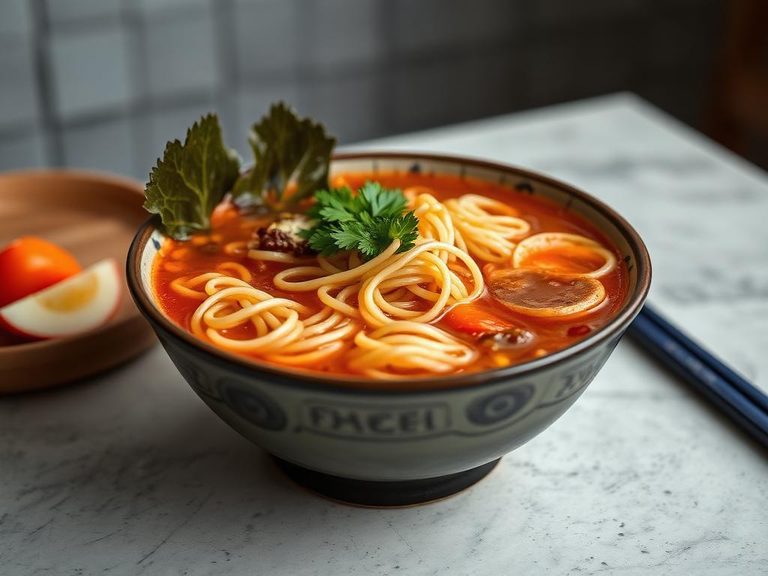
🍽️ Popular dishes
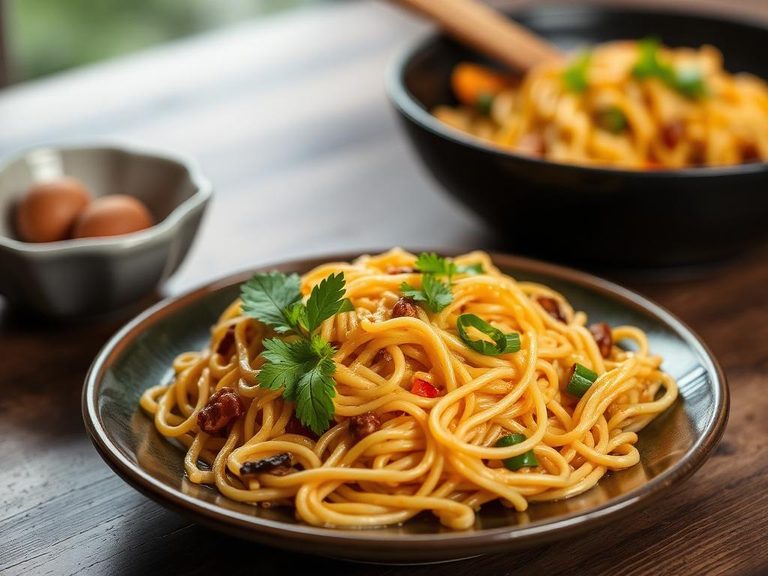
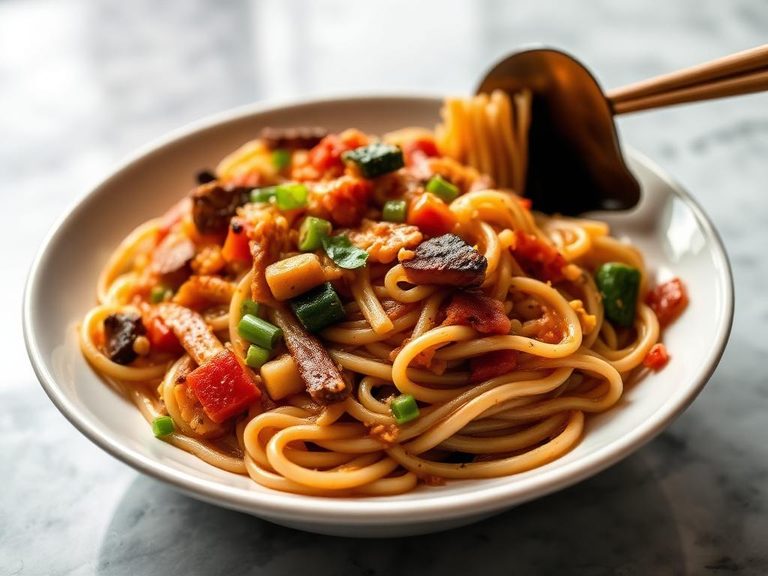
🌍 Where it's eaten
💡 Did you know?
The original instant ramen, invented in 1958, was created by flash-frying cooked noodles, a method that drastically reduced cooking time to just 3 minutes and made it a revolutionary convenience food.
Full nutrition (USDA data · scales with serving)
| Water | 12.1 g |
| Energy | 350 kcal |
| Energy | 1464 kj |
| Protein | 10.9 g |
| Total lipid (fat) | 2.5 g |
| Ash | 3.6 g |
| Carbohydrate, by difference | 71.0 g |
| Fiber, total dietary | 2.7 g |
| Total Sugars | 0.85 g |
| Calcium, Ca | 22.0 mg |
| Iron, Fe | 4.5 mg |
| Magnesium, Mg | 23.0 mg |
| Phosphorus, P | 117 mg |
| Potassium, K | 128 mg |
| Sodium, Na | 1200 mg |
| Zinc, Zn | 0.74 mg |
| Copper, Cu | 0.17 mg |
| Selenium, Se | 30.9 ug |
| Vitamin C, total ascorbic acid | 1.2 mg |
| Thiamin | 0.58 mg |
| Riboflavin | 0.41 mg |
| Niacin | 4.9 mg |
| Vitamin B-6 | 0.07 mg |
| Folate, total | 122 ug |
| Folic acid | 98.0 ug |
| Folate, food | 24.0 ug |
| Folate, DFE | 191 ug |
| Choline, total | 13.1 mg |
| Vitamin B-12 | 0.00 ug |
| Vitamin B-12, added | 0.00 ug |
| Vitamin A, RAE | 0.00 ug |
| Retinol | 0.00 ug |
| Carotene, beta | 1.0 ug |
| Carotene, alpha | 0.00 ug |
| Cryptoxanthin, beta | 0.00 ug |
| Vitamin A, IU | 2.0 iu |
| Lycopene | 0.00 ug |
| Lutein + zeaxanthin | 16.0 ug |
| Vitamin E (alpha-tocopherol) | 0.24 mg |
| Vitamin E, added | 0.00 mg |
| Vitamin D (D2 + D3), International Units | 0.00 iu |
| Vitamin D (D2 + D3) | 0.00 ug |
| Vitamin K (phylloquinone) | 0.90 ug |
| Alcohol, ethyl | 0.00 g |
| Caffeine | 0.00 mg |
| Theobromine | 0.00 mg |
Fat & fatty acid profile (per 100g)
| Fatty acids, total saturated | 0.00 g |
| SFA 4:0 | 0.00 g |
| SFA 6:0 | 0.00 g |
| SFA 8:0 | 0.00 g |
| SFA 10:0 | 0.00 g |
| SFA 12:0 | 0.00 g |
| SFA 14:0 | 0.00 g |
| SFA 16:0 | 0.00 g |
| SFA 18:0 | 0.00 g |
| Fatty acids, total monounsaturated | 0.69 g |
| MUFA 16:1 | 0.00 g |
| MUFA 18:1 | 0.68 g |
| MUFA 20:1 | 0.00 g |
| MUFA 22:1 | 0.00 g |
| Fatty acids, total polyunsaturated | 1.4 g |
| PUFA 18:2 | 1.4 g |
| PUFA 18:3 | 0.08 g |
| PUFA 18:4 | 0.00 g |
| PUFA 20:4 | 0.00 g |
| PUFA 20:5 n-3 (EPA) | 0.00 g |
| PUFA 22:5 n-3 (DPA) | 0.00 g |
| PUFA 22:6 n-3 (DHA) | 0.00 g |
| Fatty acids, total trans | 0.00 g |
| Cholesterol | 0.00 mg |
Amino acid profile (per 100g)
Estimated from Soup, bean with pork, canned, condensed — USDA does not publish this profile for Soup.
| Tryptophan | 0.06 g |
| Threonine | 0.24 g |
| Isoleucine | 0.29 g |
| Leucine | 0.48 g |
| Lysine | 0.40 g |
| Methionine | 0.07 g |
| Cystine | 0.07 g |
| Phenylalanine | 0.33 g |
| Tyrosine | 0.18 g |
| Valine | 0.32 g |
| Arginine | 0.31 g |
| Histidine | 0.15 g |
| Alanine | 0.29 g |
| Aspartic acid | 0.66 g |
| Glutamic acid | 1.1 g |
| Glycine | 0.28 g |
| Proline | 0.27 g |
| Serine | 0.29 g |
FAQ
Is this the same as regular instant ramen?
It is a specific type of instant ramen engineered to have reduced fat and sodium compared to standard versions. The noodle block itself is typically fried in less oil or air-dried, and the seasoning packet is formulated with less salt.
How can I make it a more complete meal?
Boost its nutritional value by adding a fried or boiled egg, canned tuna, shredded chicken, or tofu for protein. Toss in a handful of frozen peas, spinach, or shredded cabbage for fiber and vitamins.
Why is it so high in carbs?
The primary ingredient is refined wheat flour, which is almost entirely carbohydrate. This provides quick energy but lacks the sustained fuel and nutrients found in whole grains or foods with more protein and fat.
Nutrient density (calculated · NRF9.3)
Nutrient Rich Foods index: beneficial nutrients (protein, fiber, vitamins, minerals) minus saturated fat, added sugar & sodium, per 100 kcal.
NRF9.3 index — Fulgoni, Keast & Drewnowski, 2009. Computed from USDA nutrients.
Weight-loss friendliness (composite index)
Energy density 3.50 kcal/g · 12% calories from protein · 2.7 g fiber · 0.8 g sugar per 100 g.
Composite of energy density (Rolls et al., 1999), protein & fiber satiety, minus sugar. A calculated heuristic — ranks satiety-per-calorie, not a clinical measure.
Dietary load (calculated from USDA values)
Potential renal acid load. Positive = acid-forming, negative = alkaline-forming.
Sodium-to-potassium ratio: 9.38 (lower is better — aim for ≤ 1)
Sodium:potassium per WHO potassium guidance. Computed from USDA nutrients.