

Soup, peanut
Common food

Photo: Wikipedia
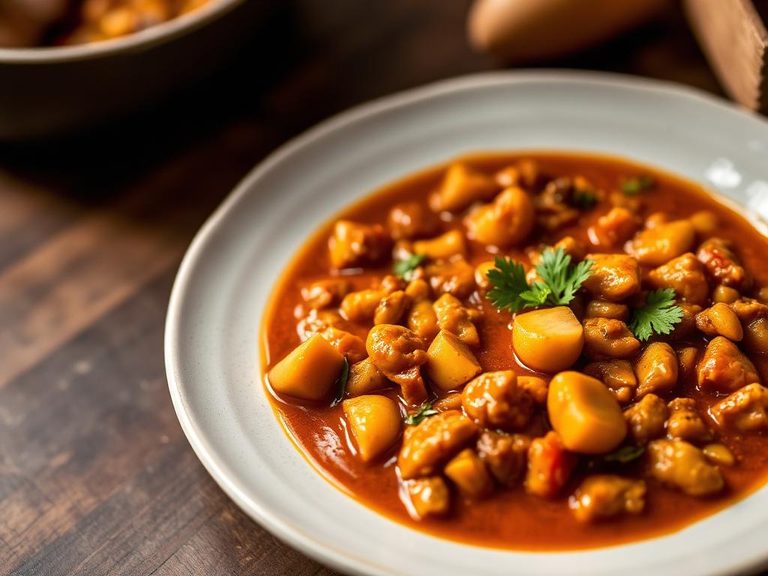
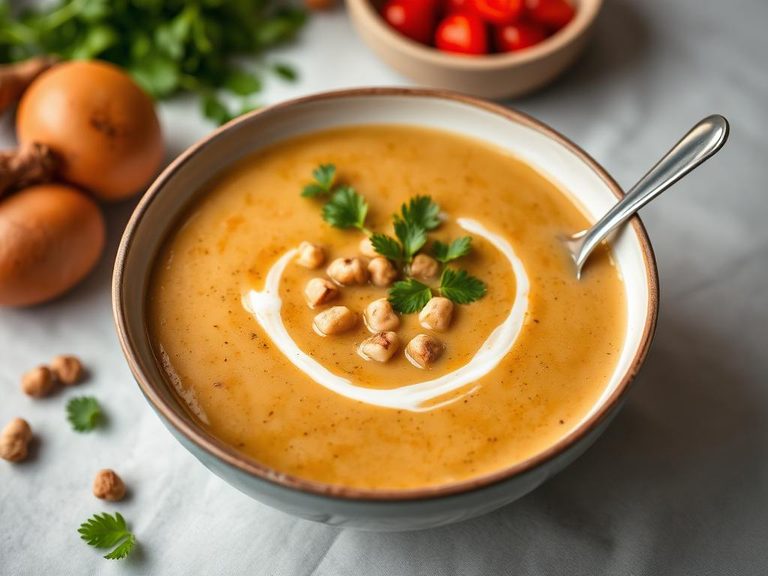
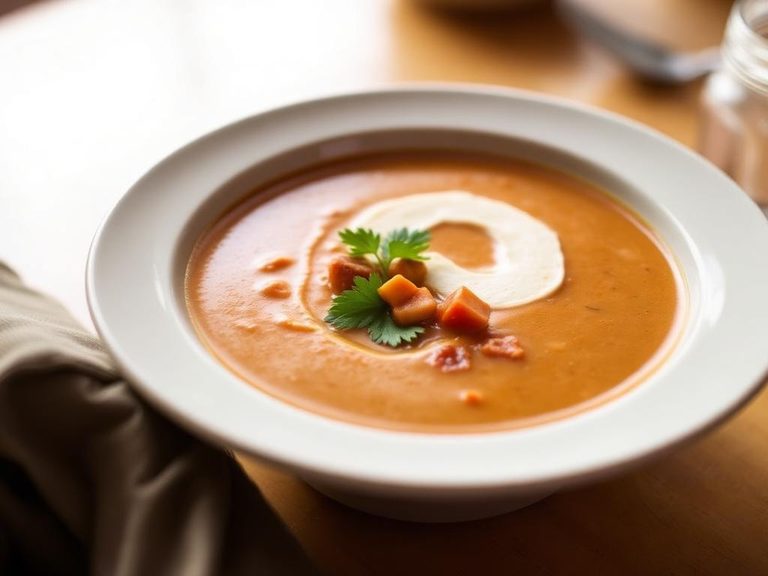
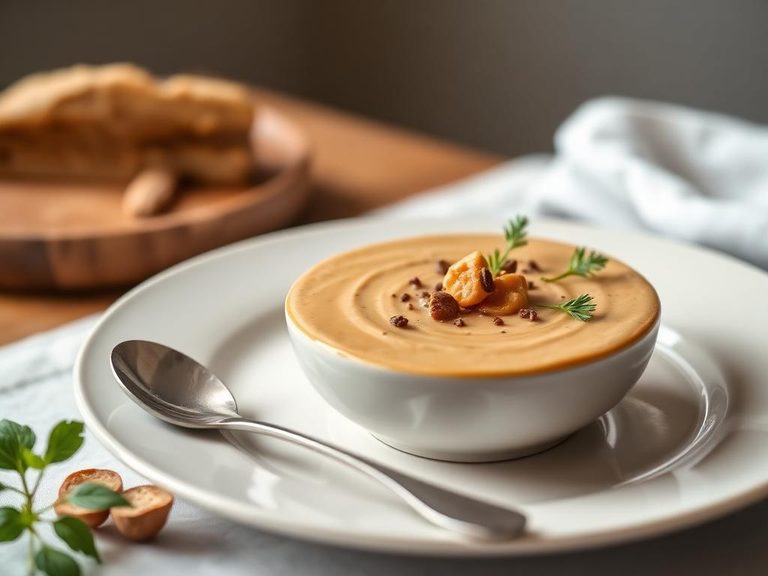
A savory, creamy soup made from boiled and blended peanuts, often with a base of broth or milk, offering a velvety texture and a rich, nutty flavor. It's a comforting, protein-packed dish that can be served hot or cold, with a subtle sweetness from the natural sugars in peanuts. Nutritionally, it provides a good balance of plant-based protein and healthy fats for a relatively low calorie count.
Calorie split: 14% protein · 36% carbs · 51% fat
↓ Full nutrition💚 Why it's loved
People love its deeply satisfying, creamy texture and robust nutty flavor that feels both hearty and nourishing. It's cherished for its versatility, easily adapting to spicy, savory, or sweet profiles across many global cuisines.
⚠️ Watch-outs & how to enjoy it better
As a legume, peanuts are a common allergen, and the soup can be high in sodium depending on preparation. Those monitoring blood sugar should be mindful, as the carbohydrates can cause spikes. Tip: Pair with non-starchy vegetables or a side salad to slow digestion and balance the meal.
Key benefits
- Good source of plant-based protein for muscle maintenance
- Provides heart-healthy monounsaturated fats
- Contains dietary fiber for digestive health
- Naturally rich in essential minerals like magnesium and phosphorus
🍽️ Popular dishes
🌍 Where it's eaten
💡 Did you know?
Peanuts aren't nuts at all; they are legumes that develop underground, and this soup is a traditional way to preserve their harvest in many tropical regions.
Full nutrition (USDA data · scales with serving)
| Water | 81.8 g |
| Energy | 88.0 kcal |
| Protein | 3.2 g |
| Total lipid (fat) | 5.3 g |
| Carbohydrate, by difference | 8.4 g |
| Fiber, total dietary | 1.7 g |
| Total Sugars | 2.6 g |
| Calcium, Ca | 18.0 mg |
| Iron, Fe | 0.41 mg |
| Magnesium, Mg | 30.0 mg |
| Phosphorus, P | 60.0 mg |
| Potassium, K | 243 mg |
| Sodium, Na | 246 mg |
| Zinc, Zn | 0.45 mg |
| Copper, Cu | 0.09 mg |
| Selenium, Se | 0.50 ug |
| Vitamin C, total ascorbic acid | 11.0 mg |
| Thiamin | 0.05 mg |
| Riboflavin | 0.05 mg |
| Niacin | 1.8 mg |
| Vitamin B-6 | 0.12 mg |
| Folate, total | 24.0 ug |
| Folic acid | 0.00 ug |
| Folate, food | 24.0 ug |
| Folate, DFE | 24.0 ug |
| Choline, total | 13.4 mg |
| Vitamin B-12 | 0.00 ug |
| Vitamin B-12, added | 0.00 ug |
| Vitamin A, RAE | 40.0 ug |
| Retinol | 0.00 ug |
| Carotene, beta | 426 ug |
| Carotene, alpha | 104 ug |
| Cryptoxanthin, beta | 7.0 ug |
| Lycopene | 380 ug |
| Lutein + zeaxanthin | 424 ug |
| Vitamin E (alpha-tocopherol) | 1.1 mg |
| Vitamin E, added | 0.00 mg |
| Vitamin D (D2 + D3) | 0.00 ug |
| Vitamin K (phylloquinone) | 20.8 ug |
| Alcohol, ethyl | 0.00 g |
| Caffeine | 0.00 mg |
| Theobromine | 0.00 mg |
Fat & fatty acid profile (per 100g)
| Fatty acids, total saturated | 1.1 g |
| SFA 4:0 | 0.00 g |
| SFA 6:0 | 0.00 g |
| SFA 8:0 | 0.00 g |
| SFA 10:0 | 0.00 g |
| SFA 12:0 | 0.00 g |
| SFA 14:0 | 0.00 g |
| SFA 16:0 | 0.49 g |
| SFA 18:0 | 0.22 g |
| Fatty acids, total monounsaturated | 2.6 g |
| MUFA 16:1 | 0.00 g |
| MUFA 18:1 | 2.5 g |
| MUFA 20:1 | 0.06 g |
| MUFA 22:1 | 0.01 g |
| Fatty acids, total polyunsaturated | 1.3 g |
| PUFA 18:2 | 1.3 g |
| PUFA 18:3 | 0.01 g |
| PUFA 18:4 | 0.00 g |
| PUFA 20:4 | 0.00 g |
| PUFA 20:5 n-3 (EPA) | 0.00 g |
| PUFA 22:5 n-3 (DPA) | 0.00 g |
| PUFA 22:6 n-3 (DHA) | 0.00 g |
| Cholesterol | 0.00 mg |
Amino acid profile (per 100g)
Estimated from Restaurant, Latino, black bean soup — USDA does not publish this profile for Soup.
| Tryptophan | 0.04 g |
| Threonine | 0.17 g |
| Isoleucine | 0.16 g |
| Leucine | 0.32 g |
| Lysine | 0.27 g |
| Methionine | 0.10 g |
| Cystine | 0.04 g |
| Phenylalanine | 0.16 g |
| Tyrosine | 0.13 g |
| Valine | 0.20 g |
| Arginine | 0.35 g |
| Histidine | 0.09 g |
| Alanine | 0.35 g |
| Aspartic acid | 0.38 g |
| Glutamic acid | 0.72 g |
| Glycine | 0.58 g |
| Proline | 0.36 g |
| Serine | 0.20 g |
FAQ
Is peanut soup vegan?
It can be. Traditional versions often use meat or fish broth, but many modern recipes use vegetable broth and coconut milk for a fully plant-based version.
How can I make it smoother?
After blending, you can pass the soup through a fine-mesh sieve to remove any remaining peanut skins or fibrous bits for an ultra-silky texture.
Can I use crunchy peanut butter?
Yes, but it will result in a less smooth soup. For the best texture, use smooth peanut butter or blend thoroughly if using whole peanuts.
Nutrient density (calculated · NRF9.3)
Nutrient Rich Foods index: beneficial nutrients (protein, fiber, vitamins, minerals) minus saturated fat, added sugar & sodium, per 100 kcal.
NRF9.3 index — Fulgoni, Keast & Drewnowski, 2009. Computed from USDA nutrients.
Weight-loss friendliness (composite index)
Energy density 0.88 kcal/g · 15% calories from protein · 1.7 g fiber · 2.6 g sugar per 100 g.
Composite of energy density (Rolls et al., 1999), protein & fiber satiety, minus sugar. A calculated heuristic — ranks satiety-per-calorie, not a clinical measure.
Dietary load (calculated from USDA values)
Potential renal acid load. Positive = acid-forming, negative = alkaline-forming.
Sodium-to-potassium ratio: 1.01 (lower is better — aim for ≤ 1)
Sodium:potassium per WHO potassium guidance. Computed from USDA nutrients.