

Peanut butter sandwich, with regular peanut butter, on white bread
Common food
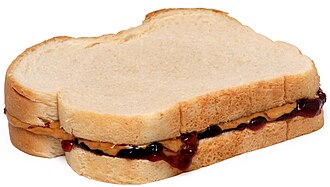
Photo: Wikipedia
A peanut butter sandwich on white bread is a nostalgic, comforting staple: soft, slightly sweet bread cradling a thick, creamy, and salty-savory spread. It delivers a satisfying, chewy texture contrast and a quick energy boost from its carbohydrate base, with a solid protein punch from the peanut butter.
Calorie split: 14% protein · 40% carbs · 46% fat
↓ Full nutrition💚 Why it's loved
People love it for its simple, nostalgic flavor—a perfect balance of salty, sweet, and savory—and its unmatched convenience as a ready-in-seconds meal or snack that satisfies hunger immediately.
⚠️ Watch-outs & how to enjoy it better
The white bread can cause a rapid blood-sugar spike, and the sandwich is a common allergen (peanuts). To counteract this, pair it with a source of fiber or protein like an apple or a glass of milk, or choose a whole-grain bread to slow digestion.
Key benefits
- Provides a quick source of energy from carbohydrates.
- Offers plant-based protein for muscle maintenance.
- Contains heart-healthy monounsaturated fats from peanuts.
- A convenient, shelf-stable, and no-cook meal option.
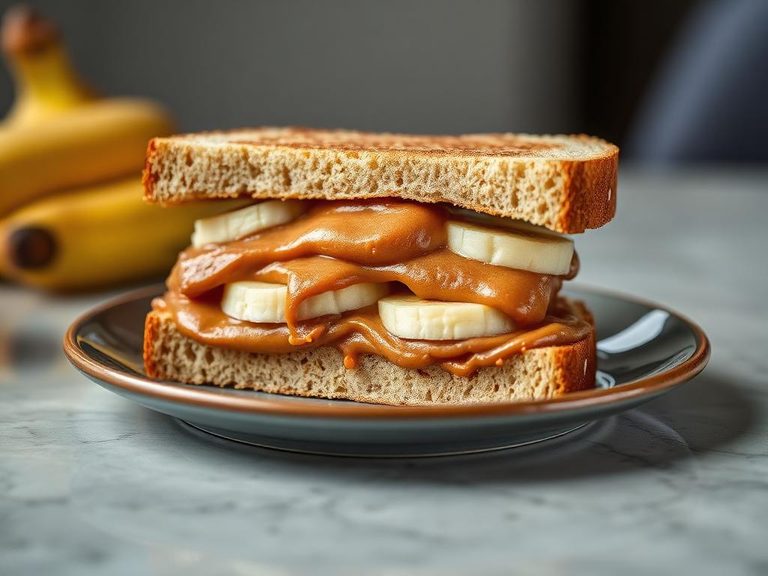
- Highly customizable with added fruits or seeds.
🍽️ Popular dishes




🌍 Where it's eaten
💡 Did you know?
It is estimated that over 75% of American pantries have a jar of peanut butter at any given time, making its most iconic pairing—the PB&J—arguably the nation's most consumed sandwich.
Full nutrition (USDA data · scales with serving)
| Water | 23.7 g |
| Energy | 382 kcal |
| Protein | 13.9 g |
| Total lipid (fat) | 20.2 g |
| Carbohydrate, by difference | 39.9 g |
| Fiber, total dietary | 3.2 g |
| Total Sugars | 7.1 g |
| Calcium, Ca | 155 mg |
| Iron, Fe | 2.8 mg |
| Magnesium, Mg | 76.0 mg |
| Phosphorus, P | 190 mg |
| Potassium, K | 270 mg |
| Sodium, Na | 442 mg |
| Zinc, Zn | 1.4 mg |
| Copper, Cu | 0.23 mg |
| Selenium, Se | 16.6 ug |
| Vitamin C, total ascorbic acid | 0.00 mg |
| Thiamin | 0.38 mg |
| Riboflavin | 0.22 mg |
| Niacin | 7.7 mg |
| Vitamin B-6 | 0.21 mg |
| Folate, total | 103 ug |
| Folic acid | 56.0 ug |
| Folate, food | 47.0 ug |
| Folate, DFE | 142 ug |
| Choline, total | 31.4 mg |
| Vitamin B-12 | 0.00 ug |
| Vitamin B-12, added | 0.00 ug |
| Vitamin A, RAE | 0.00 ug |
| Retinol | 0.00 ug |
| Carotene, beta | 0.00 ug |
| Carotene, alpha | 0.00 ug |
| Cryptoxanthin, beta | 0.00 ug |
| Lycopene | 0.00 ug |
| Lutein + zeaxanthin | 29.0 ug |
| Vitamin E (alpha-tocopherol) | 3.3 mg |
| Vitamin E, added | 0.00 mg |
| Vitamin D (D2 + D3) | 0.00 ug |
| Vitamin K (phylloquinone) | 0.20 ug |
| Alcohol, ethyl | 0.00 g |
| Caffeine | 0.00 mg |
| Theobromine | 0.00 mg |
Fat & fatty acid profile (per 100g)
| Fatty acids, total saturated | 4.1 g |
| SFA 4:0 | 0.00 g |
| SFA 6:0 | 0.00 g |
| SFA 8:0 | 0.00 g |
| SFA 10:0 | 0.00 g |
| SFA 12:0 | 0.01 g |
| SFA 14:0 | 0.02 g |
| SFA 16:0 | 2.0 g |
| SFA 18:0 | 0.92 g |
| Fatty acids, total monounsaturated | 9.5 g |
| MUFA 16:1 | 0.03 g |
| MUFA 18:1 | 9.1 g |
| MUFA 20:1 | 0.21 g |
| MUFA 22:1 | 0.02 g |
| Fatty acids, total polyunsaturated | 5.6 g |
| PUFA 18:2 | 5.4 g |
| PUFA 18:3 | 0.14 g |
| PUFA 18:4 | 0.00 g |
| PUFA 20:4 | 0.01 g |
| PUFA 20:5 n-3 (EPA) | 0.00 g |
| PUFA 22:5 n-3 (DPA) | 0.00 g |
| PUFA 22:6 n-3 (DHA) | 0.00 g |
| Cholesterol | 0.00 mg |
Amino acid profile (per 100g)
Estimated from Peanut butter, chunk style, without salt — USDA does not publish this profile for Peanut butter sandwich.
| Tryptophan | 0.23 g |
| Threonine | 0.52 g |
| Isoleucine | 0.61 g |
| Leucine | 1.5 g |
| Lysine | 0.67 g |
| Methionine | 0.26 g |
| Cystine | 0.23 g |
| Phenylalanine | 1.2 g |
| Tyrosine | 0.82 g |
| Valine | 0.77 g |
| Arginine | 2.7 g |
| Histidine | 0.55 g |
| Alanine | 0.90 g |
| Aspartic acid | 3.0 g |
| Glutamic acid | 5.0 g |
| Glycine | 1.4 g |
| Proline | 1.4 g |
| Serine | 1.5 g |
| Hydroxyproline | 0.04 g |
FAQ
Is a peanut butter sandwich on white bread a good source of protein?
Yes, it provides a decent amount of plant-based protein, primarily from the peanut butter. The white bread contributes minimal protein.
Why does it sometimes feel heavy or cause an energy crash?
The refined carbohydrates in white bread can cause a quick blood-sugar rise and fall. To avoid this, use whole-grain bread or add fiber-rich toppings like sliced fruit.
Can I make it healthier?
Absolutely. Switch to whole-wheat or whole-grain bread, use natural peanut butter with no added sugar, and add sliced bananas, strawberries, or a sprinkle of chia seeds for extra fiber and nutrients.
Nutrient density (calculated · NRF9.3)
Nutrient Rich Foods index: beneficial nutrients (protein, fiber, vitamins, minerals) minus saturated fat, added sugar & sodium, per 100 kcal.
NRF9.3 index — Fulgoni, Keast & Drewnowski, 2009. Computed from USDA nutrients.
Weight-loss friendliness (composite index)
Energy density 3.82 kcal/g · 15% calories from protein · 3.2 g fiber · 7.1 g sugar per 100 g.
Composite of energy density (Rolls et al., 1999), protein & fiber satiety, minus sugar. A calculated heuristic — ranks satiety-per-calorie, not a clinical measure.
Dietary load (calculated from USDA values)
Potential renal acid load. Positive = acid-forming, negative = alkaline-forming.
Sodium-to-potassium ratio: 1.64 (lower is better — aim for ≤ 1)
Sodium:potassium per WHO potassium guidance. Computed from USDA nutrients.