

Peanut butter sandwich, with regular peanut butter, on wheat bread
Common food
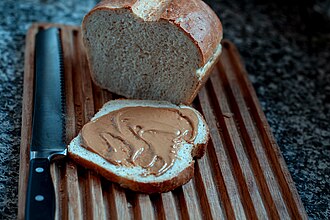
Photo: Wikipedia
A peanut butter sandwich on wheat bread is a classic, hearty staple—a satisfying balance of nutty, slightly sweet spread against the earthy, chewy backdrop of whole-grain bread. Each bite delivers a dense, creamy texture with a satisfying crunch from the wheat, packing a solid protein and healthy-fat punch for a quick energy boost.
Calorie split: 15% protein · 38% carbs · 47% fat
↓ Full nutrition💚 Why it's loved
People love it for its comforting, nostalgic simplicity and the perfect salty-sweet harmony of peanut butter against the mild, nutty wheat. It's a universally customizable staple, equally at home in a child's lunchbox or a quick adult's breakfast.
⚠️ Watch-outs & how to enjoy it better
As a common allergen, peanuts can cause severe reactions, making this off-limits for many. The combination of carbs and sugar can also cause blood-sugar spikes, and commercial peanut butter is often high in sodium and added sugars. To counteract, choose natural peanut butter (no added sugar/oil), pair with a piece of fruit for extra fiber, and be mindful of portion size.
Key benefits
- Excellent source of plant-based protein for muscle maintenance.
- Provides sustained energy from complex carbs and healthy fats.
- Good source of dietary fiber for digestive health.
- Contains heart-healthy monounsaturated fats from peanuts.
- Quick and convenient no-cook meal or snack.
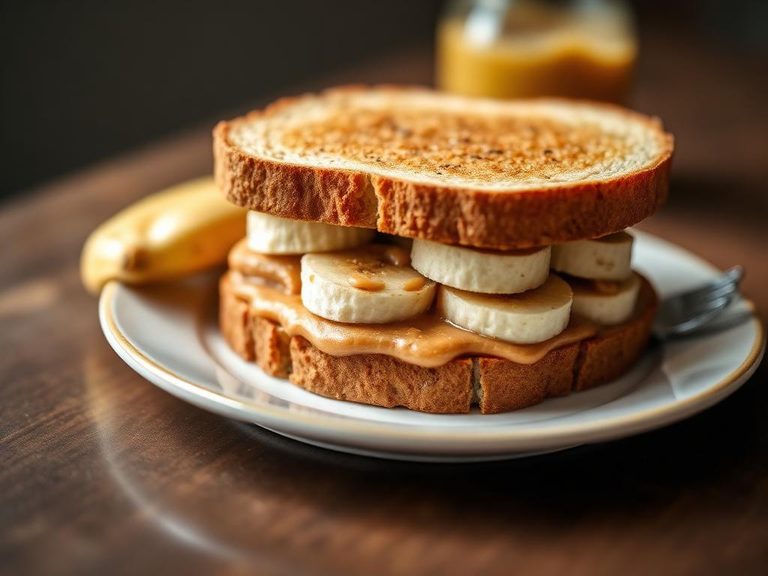
🍽️ Popular dishes




🌍 Where it's eaten
💡 Did you know?
It takes about 540 peanuts to make one 12-ounce jar of peanut butter, and the average American eats enough peanut butter in a year to make 1,000 sandwiches.
Full nutrition (USDA data · scales with serving)
| Water | 24.5 g |
| Energy | 380 kcal |
| Protein | 15.2 g |
| Total lipid (fat) | 20.5 g |
| Carbohydrate, by difference | 37.4 g |
| Fiber, total dietary | 5.3 g |
| Total Sugars | 7.0 g |
| Calcium, Ca | 122 mg |
| Iron, Fe | 2.7 mg |
| Magnesium, Mg | 95.0 mg |
| Phosphorus, P | 225 mg |
| Potassium, K | 317 mg |
| Sodium, Na | 435 mg |
| Zinc, Zn | 1.8 mg |
| Copper, Cu | 0.27 mg |
| Selenium, Se | 19.4 ug |
| Vitamin C, total ascorbic acid | 0.10 mg |
| Thiamin | 0.31 mg |
| Riboflavin | 0.21 mg |
| Niacin | 7.7 mg |
| Vitamin B-6 | 0.26 mg |
| Folate, total | 77.0 ug |
| Folic acid | 9.0 ug |
| Folate, food | 68.0 ug |
| Folate, DFE | 84.0 ug |
| Choline, total | 35.8 mg |
| Vitamin B-12 | 0.00 ug |
| Vitamin B-12, added | 0.00 ug |
| Vitamin A, RAE | 0.00 ug |
| Retinol | 0.00 ug |
| Carotene, beta | 1.0 ug |
| Carotene, alpha | 0.00 ug |
| Cryptoxanthin, beta | 0.00 ug |
| Lycopene | 0.00 ug |
| Lutein + zeaxanthin | 41.0 ug |
| Vitamin E (alpha-tocopherol) | 3.4 mg |
| Vitamin E, added | 0.00 mg |
| Vitamin D (D2 + D3) | 0.00 ug |
| Vitamin K (phylloquinone) | 3.7 ug |
| Alcohol, ethyl | 0.00 g |
| Caffeine | 0.00 mg |
| Theobromine | 0.00 mg |
Fat & fatty acid profile (per 100g)
| Fatty acids, total saturated | 4.1 g |
| SFA 4:0 | 0.00 g |
| SFA 6:0 | 0.00 g |
| SFA 8:0 | 0.00 g |
| SFA 10:0 | 0.00 g |
| SFA 12:0 | 0.01 g |
| SFA 14:0 | 0.01 g |
| SFA 16:0 | 1.9 g |
| SFA 18:0 | 0.91 g |
| Fatty acids, total monounsaturated | 9.4 g |
| MUFA 16:1 | 0.02 g |
| MUFA 18:1 | 9.0 g |
| MUFA 20:1 | 0.21 g |
| MUFA 22:1 | 0.02 g |
| Fatty acids, total polyunsaturated | 5.4 g |
| PUFA 18:2 | 5.2 g |
| PUFA 18:3 | 0.11 g |
| PUFA 18:4 | 0.00 g |
| PUFA 20:4 | 0.01 g |
| PUFA 20:5 n-3 (EPA) | 0.00 g |
| PUFA 22:5 n-3 (DPA) | 0.00 g |
| PUFA 22:6 n-3 (DHA) | 0.00 g |
| Cholesterol | 0.00 mg |
Amino acid profile (per 100g)
Estimated from Peanut butter, chunk style, without salt — USDA does not publish this profile for Peanut butter sandwich.
| Tryptophan | 0.23 g |
| Threonine | 0.52 g |
| Isoleucine | 0.61 g |
| Leucine | 1.5 g |
| Lysine | 0.67 g |
| Methionine | 0.26 g |
| Cystine | 0.23 g |
| Phenylalanine | 1.2 g |
| Tyrosine | 0.82 g |
| Valine | 0.77 g |
| Arginine | 2.7 g |
| Histidine | 0.55 g |
| Alanine | 0.90 g |
| Aspartic acid | 3.0 g |
| Glutamic acid | 5.0 g |
| Glycine | 1.4 g |
| Proline | 1.4 g |
| Serine | 1.5 g |
| Hydroxyproline | 0.04 g |
FAQ
Is peanut butter on wheat bread healthy?
Yes, it can be a nutritious choice. Whole-wheat bread provides fiber and B vitamins, while peanut butter offers protein and healthy fats. The key is to select natural peanut butter without added sugars or hydrogenated oils, and to watch portion sizes due to its calorie density.
How does it affect blood sugar?
The combination of wheat bread's carbohydrates and the sugar in some peanut butters can cause a moderate rise in blood sugar. Pairing it with extra protein (like a glass of milk) or fiber (like apple slices) can help slow digestion and stabilize the response.
Can I eat this on a weight-loss diet?
It can fit into a calorie-controlled diet due to its high satiety from protein and fat. However, because it's calorie-dense, stick to a single serving (about 2 tablespoons of peanut butter) and be mindful of what you pair it with to manage overall calorie intake.
Nutrient density (calculated · NRF9.3)
Nutrient Rich Foods index: beneficial nutrients (protein, fiber, vitamins, minerals) minus saturated fat, added sugar & sodium, per 100 kcal.
NRF9.3 index — Fulgoni, Keast & Drewnowski, 2009. Computed from USDA nutrients.
Weight-loss friendliness (composite index)
Energy density 3.80 kcal/g · 16% calories from protein · 5.3 g fiber · 7.0 g sugar per 100 g.
Composite of energy density (Rolls et al., 1999), protein & fiber satiety, minus sugar. A calculated heuristic — ranks satiety-per-calorie, not a clinical measure.
Dietary load (calculated from USDA values)
Potential renal acid load. Positive = acid-forming, negative = alkaline-forming.
Sodium-to-potassium ratio: 1.37 (lower is better — aim for ≤ 1)
Sodium:potassium per WHO potassium guidance. Computed from USDA nutrients.