

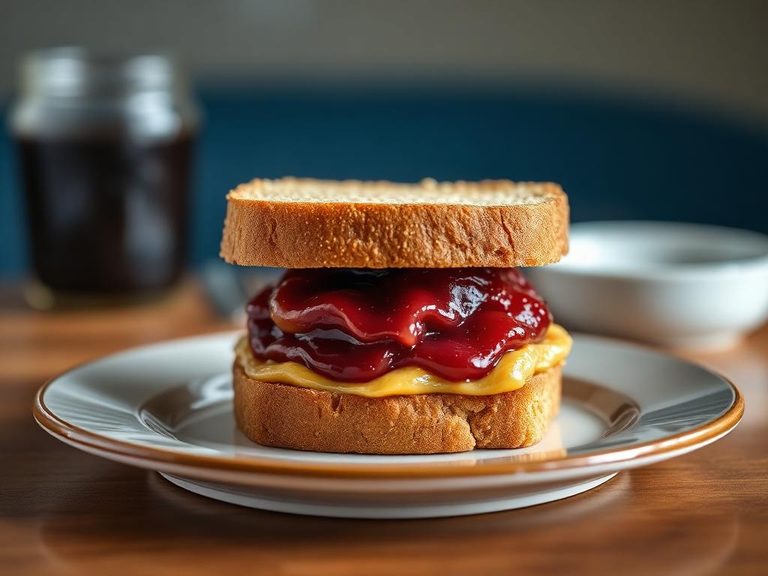
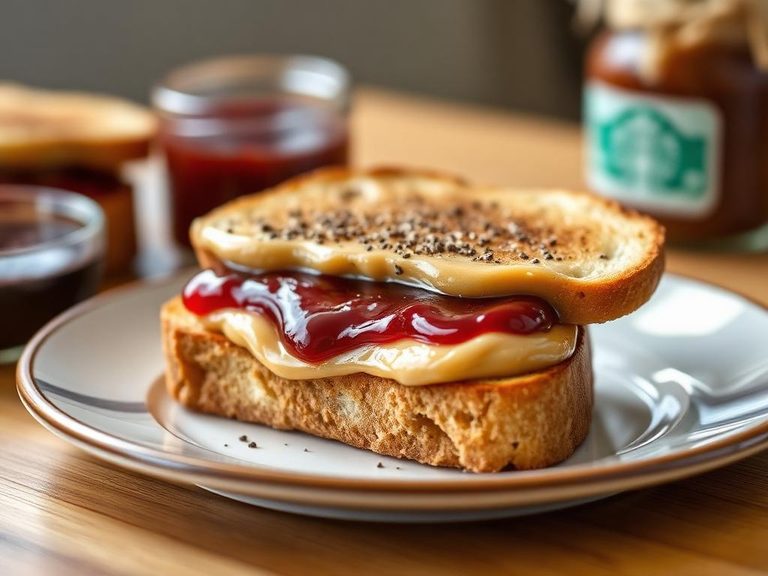
Peanut butter and jelly sandwich, with regular peanut butter, reduced sugar jelly, on wheat bread
Common food

Photo: Wikipedia
The peanut butter and jelly sandwich is a quintessential American comfort food, pairing the rich, savory crunch of peanut butter with the sweet, fruity burst of reduced sugar jelly, all held together by the nutty, chewy texture of wheat bread. It offers a balanced mix of protein, healthy fats, and carbohydrates, making it a quick and satisfying meal. The use of reduced sugar jelly and wheat bread provides a slightly more nutritious twist on the classic, adding fiber and reducing the overall sugar content.
Calorie split: 14% protein · 43% carbs · 43% fat
↓ Full nutrition💚 Why it's loved
People love the PB&J for its nostalgic, comforting flavor profile—the perfect harmony of salty, sweet, and creamy textures that evokes childhood memories. Its versatility allows for endless variations, from different nut butters to fruit spreads, making it a customizable staple in American culture.
⚠️ Watch-outs & how to enjoy it better
The sandwich can contribute to blood sugar spikes due to the sugar in jelly, even when reduced, and peanut butter is a common allergen that may cause reactions in sensitive individuals. To counteract these, pair the sandwich with a source of additional protein or fat (like a side of Greek yogurt) and opt for whole fruit or unsweetened jelly to lower sugar impact. Portion control is also key, as the calorie density can add up quickly if not moderated.
Key benefits
- Provides a balanced mix of protein, healthy fats, and complex carbs for sustained energy.
- Wheat bread adds dietary fiber, supporting digestive health and satiety.
- Reduced sugar jelly lowers overall sugar intake while maintaining sweetness.
- Peanut butter offers monounsaturated fats and plant-based protein.
- Quick and portable, ideal for busy lifestyles or on-the-go meals.
🍽️ Popular dishes
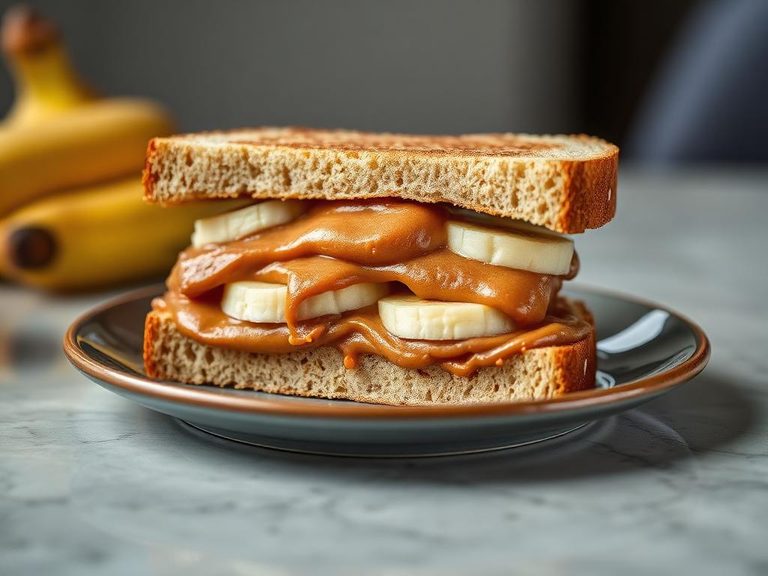
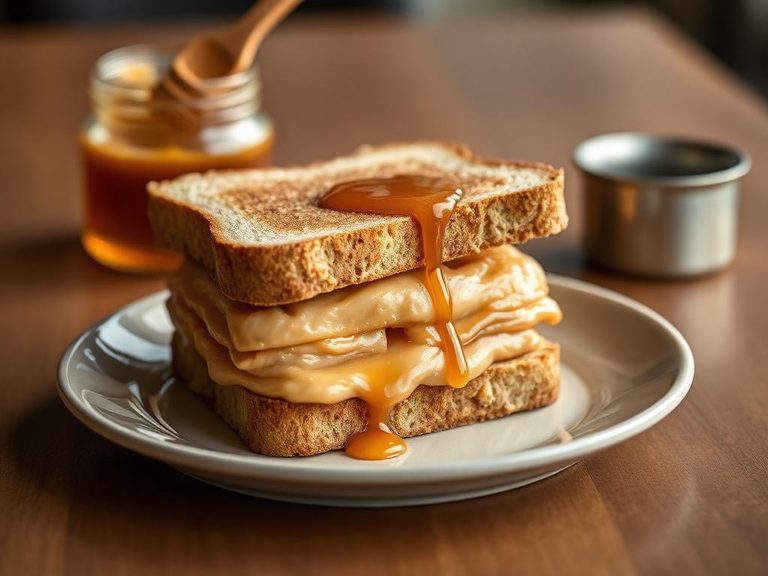
🌍 Where it's eaten
💡 Did you know?
The PB&J sandwich became a staple in American households during the 1940s due to the mass production of peanut butter and the availability of sliced bread, which made it an easy, affordable meal for soldiers and families during World War II.
Full nutrition (USDA data · scales with serving)
| Water | 31.2 g |
| Energy | 339 kcal |
| Protein | 12.4 g |
| Total lipid (fat) | 16.8 g |
| Carbohydrate, by difference | 37.4 g |
| Fiber, total dietary | 4.6 g |
| Total Sugars | 11.0 g |
| Calcium, Ca | 100 mg |
| Iron, Fe | 2.2 mg |
| Magnesium, Mg | 79.0 mg |
| Phosphorus, P | 186 mg |
| Potassium, K | 271 mg |
| Sodium, Na | 357 mg |
| Zinc, Zn | 1.4 mg |
| Copper, Cu | 0.23 mg |
| Selenium, Se | 16.0 ug |
| Vitamin C, total ascorbic acid | 2.7 mg |
| Thiamin | 0.26 mg |
| Riboflavin | 0.17 mg |
| Niacin | 6.4 mg |
| Vitamin B-6 | 0.21 mg |
| Folate, total | 67.0 ug |
| Folic acid | 8.0 ug |
| Folate, food | 59.0 ug |
| Folate, DFE | 72.0 ug |
| Choline, total | 30.1 mg |
| Vitamin B-12 | 0.00 ug |
| Vitamin B-12, added | 0.00 ug |
| Vitamin A, RAE | 0.00 ug |
| Retinol | 0.00 ug |
| Carotene, beta | 2.0 ug |
| Carotene, alpha | 0.00 ug |
| Cryptoxanthin, beta | 0.00 ug |
| Lycopene | 0.00 ug |
| Lutein + zeaxanthin | 38.0 ug |
| Vitamin E (alpha-tocopherol) | 2.8 mg |
| Vitamin E, added | 0.00 mg |
| Vitamin D (D2 + D3) | 0.00 ug |
| Vitamin K (phylloquinone) | 3.3 ug |
| Alcohol, ethyl | 0.00 g |
| Caffeine | 0.00 mg |
| Theobromine | 0.00 mg |
Fat & fatty acid profile (per 100g)
| Fatty acids, total saturated | 3.3 g |
| SFA 4:0 | 0.00 g |
| SFA 6:0 | 0.00 g |
| SFA 8:0 | 0.00 g |
| SFA 10:0 | 0.00 g |
| SFA 12:0 | 0.01 g |
| SFA 14:0 | 0.01 g |
| SFA 16:0 | 1.6 g |
| SFA 18:0 | 0.75 g |
| Fatty acids, total monounsaturated | 7.8 g |
| MUFA 16:1 | 0.02 g |
| MUFA 18:1 | 7.4 g |
| MUFA 20:1 | 0.17 g |
| MUFA 22:1 | 0.01 g |
| Fatty acids, total polyunsaturated | 4.4 g |
| PUFA 18:2 | 4.3 g |
| PUFA 18:3 | 0.09 g |
| PUFA 18:4 | 0.00 g |
| PUFA 20:4 | 0.01 g |
| PUFA 20:5 n-3 (EPA) | 0.00 g |
| PUFA 22:5 n-3 (DPA) | 0.00 g |
| PUFA 22:6 n-3 (DHA) | 0.00 g |
| Cholesterol | 0.00 mg |
Amino acid profile (per 100g)
Estimated from Peanut butter, chunk style, without salt — USDA does not publish this profile for Peanut butter and jelly sandwich.
| Tryptophan | 0.23 g |
| Threonine | 0.52 g |
| Isoleucine | 0.61 g |
| Leucine | 1.5 g |
| Lysine | 0.67 g |
| Methionine | 0.26 g |
| Cystine | 0.23 g |
| Phenylalanine | 1.2 g |
| Tyrosine | 0.82 g |
| Valine | 0.77 g |
| Arginine | 2.7 g |
| Histidine | 0.55 g |
| Alanine | 0.90 g |
| Aspartic acid | 3.0 g |
| Glutamic acid | 5.0 g |
| Glycine | 1.4 g |
| Proline | 1.4 g |
| Serine | 1.5 g |
| Hydroxyproline | 0.04 g |
FAQ
Is peanut butter and jelly sandwich healthy?
It can be part of a healthy diet when made with whole wheat bread, natural peanut butter, and reduced sugar jelly. It provides protein, fiber, and healthy fats, but moderation is key due to calorie density and sugar content.
Can I make a peanut butter and jelly sandwich without sugar?
Yes, you can use unsweetened fruit spreads or fresh fruit like mashed bananas or sliced strawberries to replace jelly, reducing added sugars while maintaining sweetness and flavor.
What are the best bread options for a peanut butter and jelly sandwich?
Whole wheat or whole grain bread is ideal for added fiber and nutrients. Sourdough or rye bread can also be used for a different texture and flavor profile, while gluten-free bread is suitable for those with gluten sensitivities.
Nutrient density (calculated · NRF9.3)
Nutrient Rich Foods index: beneficial nutrients (protein, fiber, vitamins, minerals) minus saturated fat, added sugar & sodium, per 100 kcal.
NRF9.3 index — Fulgoni, Keast & Drewnowski, 2009. Computed from USDA nutrients.
Weight-loss friendliness (composite index)
Energy density 3.39 kcal/g · 15% calories from protein · 4.6 g fiber · 11.0 g sugar per 100 g.
Composite of energy density (Rolls et al., 1999), protein & fiber satiety, minus sugar. A calculated heuristic — ranks satiety-per-calorie, not a clinical measure.
Dietary load (calculated from USDA values)
Potential renal acid load. Positive = acid-forming, negative = alkaline-forming.
Sodium-to-potassium ratio: 1.32 (lower is better — aim for ≤ 1)
Sodium:potassium per WHO potassium guidance. Computed from USDA nutrients.