

Soup, gazpacho
Common food

Photo: Wikipedia
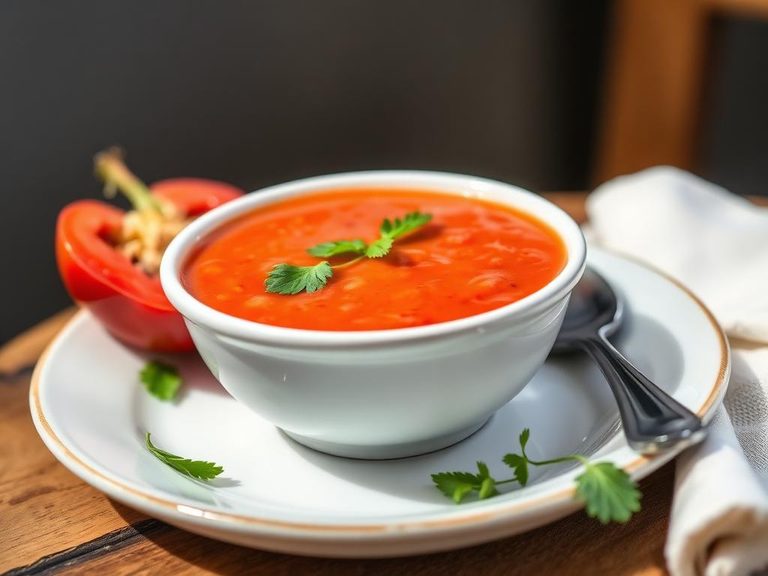
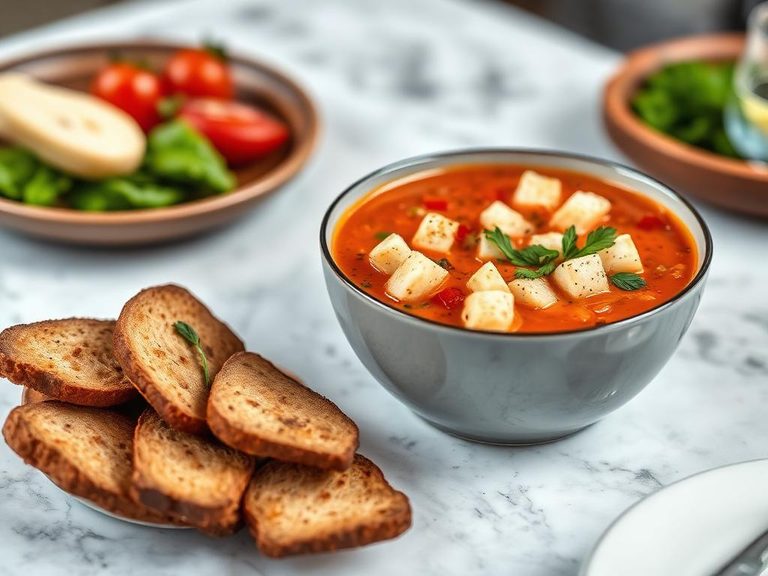
Gazpacho is a chilled Spanish soup, traditionally made from raw, blended vegetables like tomatoes, cucumbers, peppers, and garlic, resulting in a smooth, refreshing, and slightly tangy liquid. Its vibrant red color and cool temperature make it a quintessential summer dish. Nutritionally, it's exceptionally low in calories and fat while providing a good source of hydration and fiber from its vegetable base.
Calorie split: 12% protein · 67% carbs · 21% fat
↓ Full nutrition💚 Why it's loved
People love gazpacho for its vibrant, fresh taste that perfectly captures the essence of ripe summer produce. It's incredibly versatile, served as a starter, a light main, or even a palate cleanser, and is deeply embedded in Spanish culinary culture, especially in Andalusia.
⚠️ Watch-outs & how to enjoy it better
The raw garlic and onion in traditional gazpacho can cause digestive discomfort or heartburn for some individuals. It can also be high in sodium from added salt or commercial preparations. To counteract, use less raw garlic (or roast it first), choose low-sodium vegetable juice if using, and pair the soup with a protein-rich side like grilled shrimp or a slice of crusty bread with olive oil.
Key benefits
- Hydrating due to high water content from vegetables.
- Low in calories, supporting weight management.
- Provides dietary fiber from blended vegetables.
- Rich in antioxidants like lycopene from tomatoes.
- No cooking required, preserving heat-sensitive vitamins.
🍽️ Popular dishes
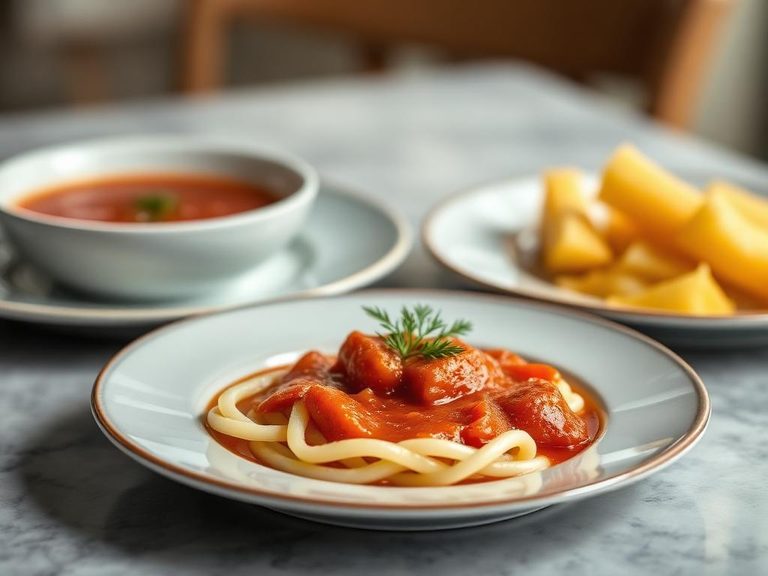
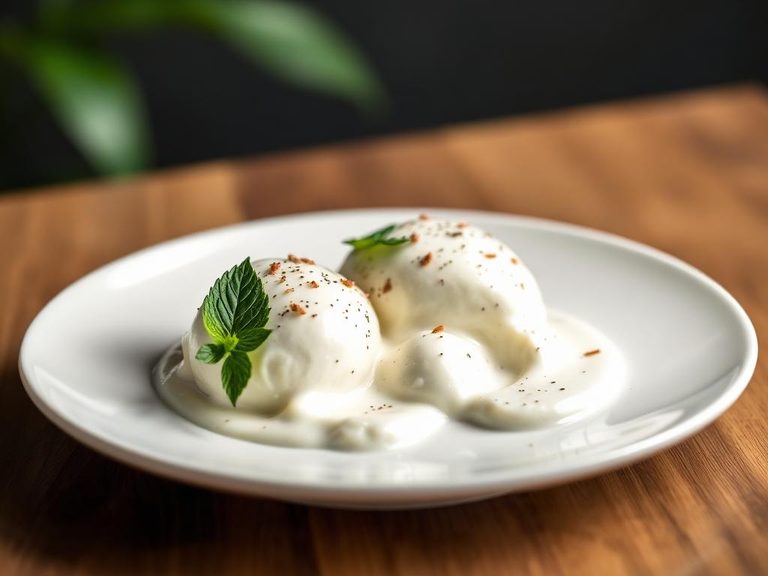
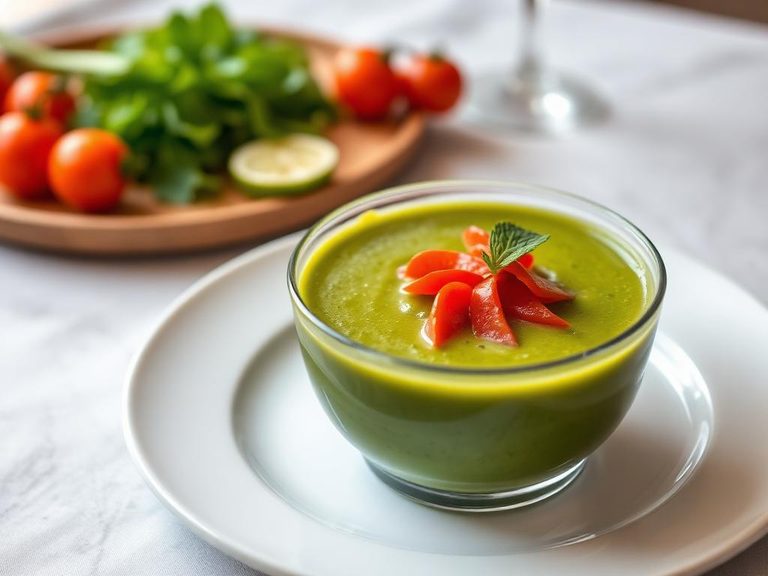
🌍 Where it's eaten
💡 Did you know?
The word 'gazpacho' likely derives from the Arabic 'gazzāḥ,' meaning 'to pound' or 'to crush,' referencing the method of pounding ingredients in a mortar before blending was invented.
Full nutrition (USDA data · scales with serving)
| Water | 93.0 g |
| Energy | 26.0 kcal |
| Protein | 0.81 g |
| Total lipid (fat) | 0.63 g |
| Carbohydrate, by difference | 4.5 g |
| Fiber, total dietary | 1.0 g |
| Total Sugars | 2.8 g |
| Calcium, Ca | 11.0 mg |
| Iron, Fe | 0.24 mg |
| Magnesium, Mg | 10.0 mg |
| Phosphorus, P | 22.0 mg |
| Potassium, K | 206 mg |
| Sodium, Na | 208 mg |
| Zinc, Zn | 0.14 mg |
| Copper, Cu | 0.05 mg |
| Selenium, Se | 0.10 ug |
| Vitamin C, total ascorbic acid | 36.0 mg |
| Thiamin | 0.04 mg |
| Riboflavin | 0.05 mg |
| Niacin | 0.43 mg |
| Vitamin B-6 | 0.10 mg |
| Folate, total | 17.0 ug |
| Folic acid | 0.00 ug |
| Folate, food | 17.0 ug |
| Folate, DFE | 17.0 ug |
| Choline, total | 6.6 mg |
| Vitamin B-12 | 0.00 ug |
| Vitamin B-12, added | 0.00 ug |
| Vitamin A, RAE | 33.0 ug |
| Retinol | 0.00 ug |
| Carotene, beta | 380 ug |
| Carotene, alpha | 33.0 ug |
| Cryptoxanthin, beta | 35.0 ug |
| Lycopene | 3634 ug |
| Lutein + zeaxanthin | 92.0 ug |
| Vitamin E (alpha-tocopherol) | 0.56 mg |
| Vitamin E, added | 0.00 mg |
| Vitamin D (D2 + D3) | 0.00 ug |
| Vitamin K (phylloquinone) | 7.0 ug |
| Alcohol, ethyl | 0.00 g |
| Caffeine | 0.00 mg |
| Theobromine | 0.00 mg |
Fat & fatty acid profile (per 100g)
| Fatty acids, total saturated | 0.08 g |
| SFA 4:0 | 0.00 g |
| SFA 6:0 | 0.00 g |
| SFA 8:0 | 0.00 g |
| SFA 10:0 | 0.00 g |
| SFA 12:0 | 0.00 g |
| SFA 14:0 | 0.00 g |
| SFA 16:0 | 0.06 g |
| SFA 18:0 | 0.02 g |
| Fatty acids, total monounsaturated | 0.18 g |
| MUFA 16:1 | 0.00 g |
| MUFA 18:1 | 0.17 g |
| MUFA 20:1 | 0.00 g |
| MUFA 22:1 | 0.00 g |
| Fatty acids, total polyunsaturated | 0.21 g |
| PUFA 18:2 | 0.18 g |
| PUFA 18:3 | 0.02 g |
| PUFA 18:4 | 0.00 g |
| PUFA 20:4 | 0.00 g |
| PUFA 20:5 n-3 (EPA) | 0.00 g |
| PUFA 22:5 n-3 (DPA) | 0.00 g |
| PUFA 22:6 n-3 (DHA) | 0.00 g |
| Cholesterol | 0.00 mg |
Amino acid profile (per 100g)
Estimated from Restaurant, Latino, black bean soup — USDA does not publish this profile for Soup.
| Tryptophan | 0.04 g |
| Threonine | 0.17 g |
| Isoleucine | 0.16 g |
| Leucine | 0.32 g |
| Lysine | 0.27 g |
| Methionine | 0.10 g |
| Cystine | 0.04 g |
| Phenylalanine | 0.16 g |
| Tyrosine | 0.13 g |
| Valine | 0.20 g |
| Arginine | 0.35 g |
| Histidine | 0.09 g |
| Alanine | 0.35 g |
| Aspartic acid | 0.38 g |
| Glutamic acid | 0.72 g |
| Glycine | 0.58 g |
| Proline | 0.36 g |
| Serine | 0.20 g |
FAQ
Is gazpacho served hot or cold?
Gazpacho is almost always served chilled or at cool room temperature, making it a refreshing dish for warm weather.
Can I make gazpacho without bread?
Yes, many modern recipes omit the traditional stale bread for a lighter, gluten-free version, relying solely on the vegetables for texture.
How long does homemade gazpacho last?
Stored in an airtight container in the refrigerator, homemade gazpacho typically keeps well for 3 to 5 days.
Nutrient density (calculated · NRF9.3)
Nutrient Rich Foods index: beneficial nutrients (protein, fiber, vitamins, minerals) minus saturated fat, added sugar & sodium, per 100 kcal.
NRF9.3 index — Fulgoni, Keast & Drewnowski, 2009. Computed from USDA nutrients.
Weight-loss friendliness (composite index)
Energy density 0.26 kcal/g · 12% calories from protein · 1.0 g fiber · 2.8 g sugar per 100 g.
Composite of energy density (Rolls et al., 1999), protein & fiber satiety, minus sugar. A calculated heuristic — ranks satiety-per-calorie, not a clinical measure.
Dietary load (calculated from USDA values)
Potential renal acid load. Positive = acid-forming, negative = alkaline-forming.
Sodium-to-potassium ratio: 1.01 (lower is better — aim for ≤ 1)
Sodium:potassium per WHO potassium guidance. Computed from USDA nutrients.