

Soup, cheese, canned, condensed
Whole food · Soups, Sauces, and Gravies

Photo: Wikipedia
This is a thick, shelf-stable concentrate of cheese soup, typically sold in a can. It has a rich, savory, umami flavor and a smooth, creamy texture once diluted with milk or water. Nutritionally, it's a calorie-dense source of fat and carbohydrates, providing a quick energy boost.
Calorie split: 4% protein · 54% carbs · 42% fat
↓ Full nutrition💚 Why it's loved
People love it for its comforting, nostalgic, and intensely cheesy flavor that forms the perfect base for quick meals like grilled cheese dippers or a creamy sauce for vegetables. Its convenience and ability to transform simple ingredients into a hearty dish make it a beloved comfort food staple.
⚠️ Watch-outs & how to enjoy it better
The condensed form is often high in sodium and can cause blood-sugar spikes due to its carbohydrate content. To counteract this, pair it with a lean protein (like chicken or beans) and non-starchy vegetables to balance the meal, and consider using only half the recommended water/milk to control portion size and richness.
Key benefits
- Provides a quick source of energy from fats and carbs
- Offers a convenient, long-lasting pantry staple
- Can be a base for many creamy, savory dishes
- Contains some dietary fiber
🍽️ Popular dishes
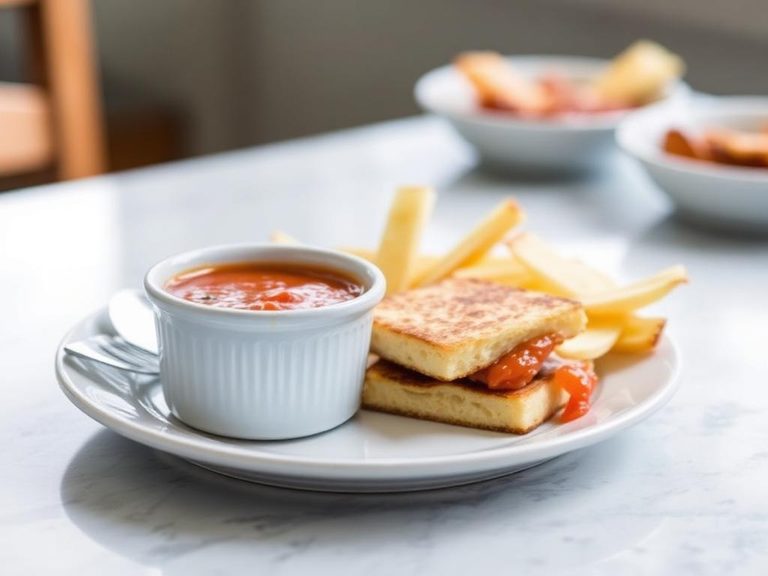
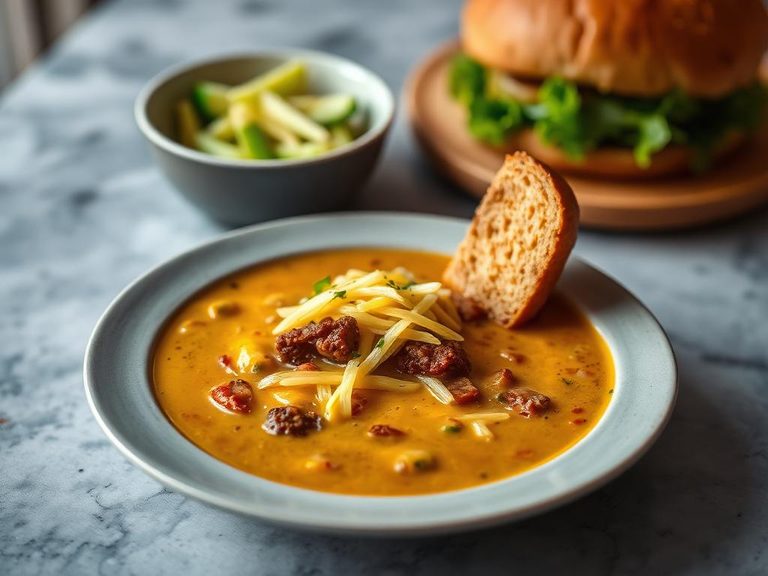
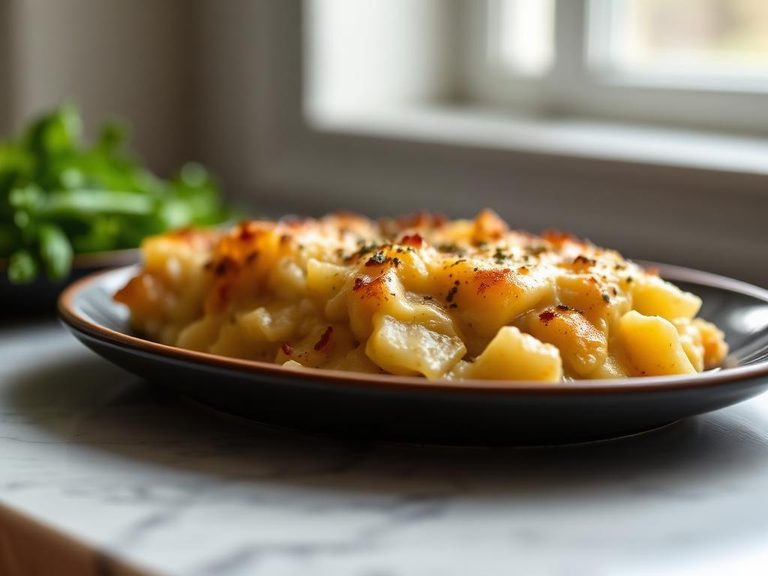
🌍 Where it's eaten
💡 Did you know?
During World War II, canned condensed soups, including cheese varieties, were included in U.S. military rations (K-rations) as a non-perishable, calorie-dense food source for troops.
Full nutrition (USDA data · scales with serving)
| Water | 81.7 g |
| Energy | 82.0 kcal |
| Energy | 342 kj |
| Protein | 0.80 g |
| Total lipid (fat) | 3.9 g |
| Ash | 2.3 g |
| Carbohydrate, by difference | 11.3 g |
| Fiber, total dietary | 2.2 g |
| Total Sugars | 3.7 g |
| Calcium, Ca | 36.0 mg |
| Iron, Fe | 0.15 mg |
| Magnesium, Mg | 12.0 mg |
| Phosphorus, P | 33.0 mg |
| Potassium, K | 37.0 mg |
| Sodium, Na | 692 mg |
| Zinc, Zn | 0.15 mg |
| Copper, Cu | 0.10 mg |
| Manganese, Mn | 0.20 mg |
| Selenium, Se | 3.6 ug |
| Vitamin C, total ascorbic acid | 0.20 mg |
| Thiamin | 0.01 mg |
| Riboflavin | 0.10 mg |
| Niacin | 0.31 mg |
| Pantothenic acid | 0.07 mg |
| Vitamin B-6 | 0.02 mg |
| Folate, total | 3.0 ug |
| Folic acid | 0.00 ug |
| Folate, food | 3.0 ug |
| Folate, DFE | 3.0 ug |
| Choline, total | 13.3 mg |
| Vitamin B-12 | 0.00 ug |
| Vitamin B-12, added | 0.00 ug |
| Vitamin A, RAE | 69.0 ug |
| Retinol | 69.0 ug |
| Carotene, beta | 2.0 ug |
| Carotene, alpha | 0.00 ug |
| Cryptoxanthin, beta | 0.00 ug |
| Vitamin A, IU | 235 iu |
| Lycopene | 0.00 ug |
| Lutein + zeaxanthin | 1.0 ug |
| Vitamin E (alpha-tocopherol) | 0.56 mg |
| Vitamin E, added | 0.00 mg |
| Vitamin D (D2 + D3), International Units | 0.00 iu |
| Vitamin D (D2 + D3) | 0.00 ug |
| Vitamin K (phylloquinone) | 4.7 ug |
| Alcohol, ethyl | 0.00 g |
| Caffeine | 0.00 mg |
| Theobromine | 0.00 mg |
Fat & fatty acid profile (per 100g)
| Fatty acids, total saturated | 2.5 g |
| SFA 4:0 | 0.13 g |
| SFA 6:0 | 0.06 g |
| SFA 8:0 | 0.04 g |
| SFA 10:0 | 0.07 g |
| SFA 12:0 | 0.06 g |
| SFA 14:0 | 0.41 g |
| SFA 16:0 | 1.2 g |
| SFA 18:0 | 0.49 g |
| Fatty acids, total monounsaturated | 1.1 g |
| MUFA 16:1 | 0.12 g |
| MUFA 18:1 | 0.96 g |
| MUFA 20:1 | 0.00 g |
| MUFA 22:1 | 0.00 g |
| Fatty acids, total polyunsaturated | 0.11 g |
| PUFA 18:2 | 0.07 g |
| PUFA 18:3 | 0.04 g |
| PUFA 18:4 | 0.00 g |
| PUFA 20:4 | 0.00 g |
| PUFA 20:5 n-3 (EPA) | 0.00 g |
| PUFA 22:5 n-3 (DPA) | 0.00 g |
| PUFA 22:6 n-3 (DHA) | 0.00 g |
| Cholesterol | 3.0 mg |
Amino acid profile (per 100g)
Estimated from Soup, bean with pork, canned, condensed — USDA does not publish this profile for Soup.
| Tryptophan | 0.06 g |
| Threonine | 0.24 g |
| Isoleucine | 0.29 g |
| Leucine | 0.48 g |
| Lysine | 0.40 g |
| Methionine | 0.07 g |
| Cystine | 0.07 g |
| Phenylalanine | 0.33 g |
| Tyrosine | 0.18 g |
| Valine | 0.32 g |
| Arginine | 0.31 g |
| Histidine | 0.15 g |
| Alanine | 0.29 g |
| Aspartic acid | 0.66 g |
| Glutamic acid | 1.1 g |
| Glycine | 0.28 g |
| Proline | 0.27 g |
| Serine | 0.29 g |
FAQ
How do I prepare canned condensed cheese soup?
Typically, you empty the can into a saucepan and stir in an equal volume of milk or water (about 1 cup per can). Heat gently over medium-low heat, stirring frequently, until hot and smooth. Do not boil.
Can I use it as a sauce straight from the can?
It's very thick and salty straight from the can. It's best used as a base or ingredient, diluted and seasoned to taste. Using it undiluted can overpower a dish with salt and richness.
Is it gluten-free?
Not always. Some brands may use wheat flour as a thickener. You must check the specific product's ingredient list and allergen information to be certain.
Nutrient density (calculated · NRF9.3)
Nutrient Rich Foods index: beneficial nutrients (protein, fiber, vitamins, minerals) minus saturated fat, added sugar & sodium, per 100 kcal.
NRF9.3 index — Fulgoni, Keast & Drewnowski, 2009. Computed from USDA nutrients.
Weight-loss friendliness (composite index)
Energy density 0.82 kcal/g · 4% calories from protein · 2.2 g fiber · 3.7 g sugar per 100 g.
Composite of energy density (Rolls et al., 1999), protein & fiber satiety, minus sugar. A calculated heuristic — ranks satiety-per-calorie, not a clinical measure.
Dietary load (calculated from USDA values)
Potential renal acid load. Positive = acid-forming, negative = alkaline-forming.
Sodium-to-potassium ratio: 18.70 (lower is better — aim for ≤ 1)
Sodium:potassium per WHO potassium guidance. Computed from USDA nutrients.