

Soup, borscht
Common food

Photo: Wikipedia
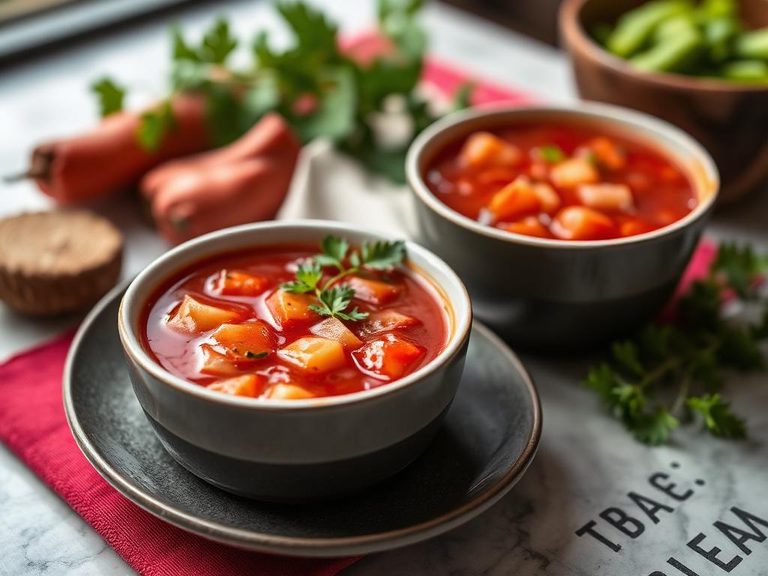
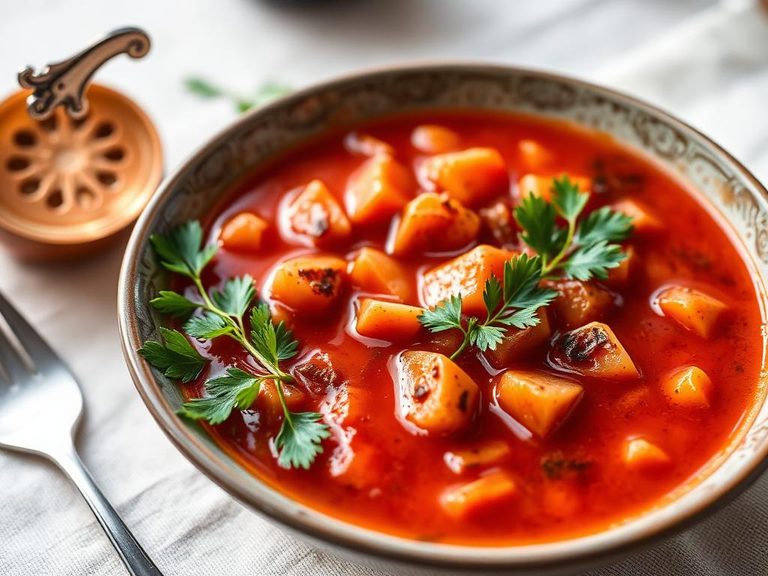
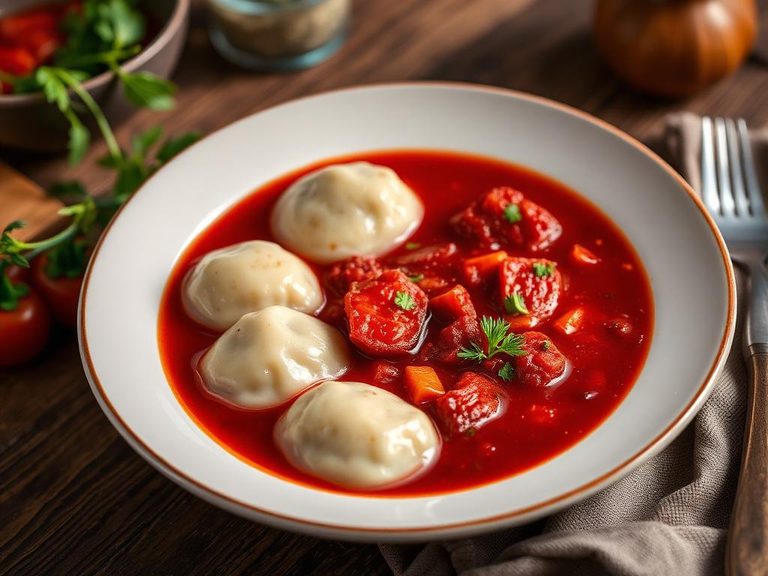
Borscht is a vibrant, ruby-red soup traditionally centered on fermented beetroot, offering a sweet-sour, earthy flavor profile with a hearty, chunky texture from vegetables like cabbage, potatoes, and carrots. Its striking color comes from betalain pigments in beets, and it's remarkably low in calories, providing a fiber-rich, hydrating meal with minimal fat.
Calorie split: 10% protein · 74% carbs · 16% fat
↓ Full nutrition💚 Why it's loved
People cherish borscht for its comforting, complex sweet-sour balance and deep cultural roots in Eastern European households, where it's often a centerpiece of family meals and traditions.
⚠️ Watch-outs & how to enjoy it better
Some commercial or canned versions can be high in sodium, which may concern those monitoring blood pressure; to mitigate this, opt for low-sodium broths or homemade recipes and pair the soup with a protein source like a dollop of sour cream or a side of lean meat to balance the meal. Beets are also high in natural sugars, so individuals managing blood sugar should watch portion sizes.
Key benefits
- Excellent source of dietary fiber for digestive health
- Rich in antioxidants like betalains from beets
- Very low in calories and fat, supporting weight management
- Provides essential vitamins like vitamin C and folate
- Hydrating due to its high water content
🍽️ Popular dishes
🌍 Where it's eaten
💡 Did you know?
The word 'borscht' derives from the Slavic word for the cow parsnip plant (Heracleum sphondylium), whose fermented stems were an early souring agent before beets became the primary ingredient.
Full nutrition (USDA data · scales with serving)
| Water | 94.2 g |
| Energy | 20.0 kcal |
| Protein | 0.52 g |
| Total lipid (fat) | 0.37 g |
| Carbohydrate, by difference | 3.9 g |
| Fiber, total dietary | 0.80 g |
| Total Sugars | 2.2 g |
| Calcium, Ca | 11.0 mg |
| Iron, Fe | 0.25 mg |
| Magnesium, Mg | 9.0 mg |
| Phosphorus, P | 13.0 mg |
| Potassium, K | 98.0 mg |
| Sodium, Na | 245 mg |
| Zinc, Zn | 0.13 mg |
| Copper, Cu | 0.04 mg |
| Selenium, Se | 0.20 ug |
| Vitamin C, total ascorbic acid | 3.5 mg |
| Thiamin | 0.01 mg |
| Riboflavin | 0.02 mg |
| Niacin | 0.19 mg |
| Vitamin B-6 | 0.04 mg |
| Folate, total | 14.0 ug |
| Folic acid | 0.00 ug |
| Folate, food | 14.0 ug |
| Folate, DFE | 14.0 ug |
| Choline, total | 4.1 mg |
| Vitamin B-12 | 0.00 ug |
| Vitamin B-12, added | 0.00 ug |
| Vitamin A, RAE | 25.0 ug |
| Retinol | 0.00 ug |
| Carotene, beta | 257 ug |
| Carotene, alpha | 89.0 ug |
| Cryptoxanthin, beta | 1.0 ug |
| Lycopene | 76.0 ug |
| Lutein + zeaxanthin | 95.0 ug |
| Vitamin E (alpha-tocopherol) | 0.12 mg |
| Vitamin E, added | 0.00 mg |
| Vitamin D (D2 + D3) | 0.00 ug |
| Vitamin K (phylloquinone) | 5.4 ug |
| Alcohol, ethyl | 0.00 g |
| Caffeine | 0.00 mg |
| Theobromine | 0.00 mg |
Fat & fatty acid profile (per 100g)
| Fatty acids, total saturated | 0.05 g |
| SFA 4:0 | 0.00 g |
| SFA 6:0 | 0.00 g |
| SFA 8:0 | 0.00 g |
| SFA 10:0 | 0.00 g |
| SFA 12:0 | 0.00 g |
| SFA 14:0 | 0.00 g |
| SFA 16:0 | 0.04 g |
| SFA 18:0 | 0.01 g |
| Fatty acids, total monounsaturated | 0.14 g |
| MUFA 16:1 | 0.00 g |
| MUFA 18:1 | 0.13 g |
| MUFA 20:1 | 0.00 g |
| MUFA 22:1 | 0.00 g |
| Fatty acids, total polyunsaturated | 0.14 g |
| PUFA 18:2 | 0.12 g |
| PUFA 18:3 | 0.02 g |
| PUFA 18:4 | 0.00 g |
| PUFA 20:4 | 0.00 g |
| PUFA 20:5 n-3 (EPA) | 0.00 g |
| PUFA 22:5 n-3 (DPA) | 0.00 g |
| PUFA 22:6 n-3 (DHA) | 0.00 g |
| Cholesterol | 0.00 mg |
Amino acid profile (per 100g)
Estimated from Restaurant, Latino, black bean soup — USDA does not publish this profile for Soup.
| Tryptophan | 0.04 g |
| Threonine | 0.17 g |
| Isoleucine | 0.16 g |
| Leucine | 0.32 g |
| Lysine | 0.27 g |
| Methionine | 0.10 g |
| Cystine | 0.04 g |
| Phenylalanine | 0.16 g |
| Tyrosine | 0.13 g |
| Valine | 0.20 g |
| Arginine | 0.35 g |
| Histidine | 0.09 g |
| Alanine | 0.35 g |
| Aspartic acid | 0.38 g |
| Glutamic acid | 0.72 g |
| Glycine | 0.58 g |
| Proline | 0.36 g |
| Serine | 0.20 g |
FAQ
Is borscht always made with beets?
While modern versions are beet-centric, traditional recipes used fermented cow parsnip or other souring agents. Beets became the standard ingredient in the 18th–19th centuries, giving the soup its iconic color.
Can borscht be served cold?
Yes, especially in summer. The Lithuanian version, Šaltibarščiai, is traditionally chilled and often served with a side of hot potatoes.
What gives borscht its sour taste?
The tanginess comes from acidic ingredients like vinegar, lemon juice, tomato paste, or traditionally, fermented beet juice (kvass) or fermented cabbage (sauerkraut).
Nutrient density (calculated · NRF9.3)
Nutrient Rich Foods index: beneficial nutrients (protein, fiber, vitamins, minerals) minus saturated fat, added sugar & sodium, per 100 kcal.
NRF9.3 index — Fulgoni, Keast & Drewnowski, 2009. Computed from USDA nutrients.
Weight-loss friendliness (composite index)
Energy density 0.20 kcal/g · 10% calories from protein · 0.8 g fiber · 2.2 g sugar per 100 g.
Composite of energy density (Rolls et al., 1999), protein & fiber satiety, minus sugar. A calculated heuristic — ranks satiety-per-calorie, not a clinical measure.
Dietary load (calculated from USDA values)
Potential renal acid load. Positive = acid-forming, negative = alkaline-forming.
Sodium-to-potassium ratio: 2.50 (lower is better — aim for ≤ 1)
Sodium:potassium per WHO potassium guidance. Computed from USDA nutrients.