

Snacks, popcorn, caramel-coated, with peanuts
Whole food · Snacks

Photo: Wikipedia
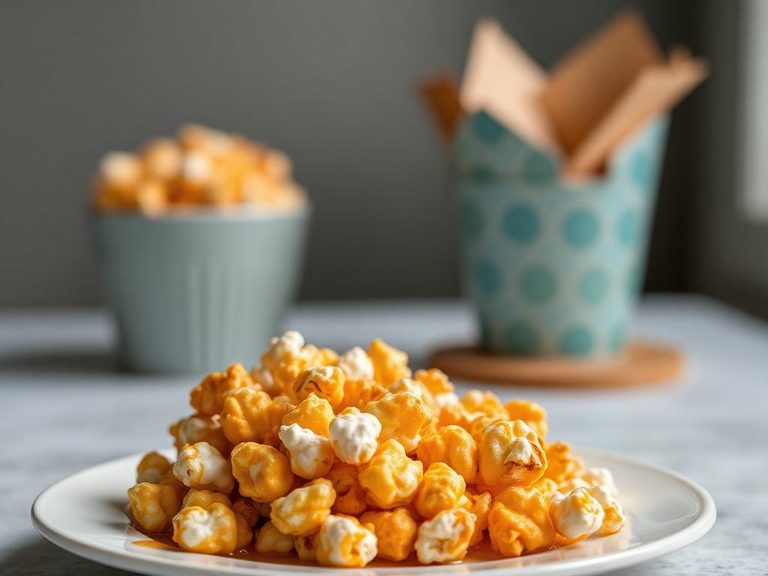
This is a classic movie-theater treat: fluffy popcorn kernels coated in a glossy, buttery caramel shell and studded with crunchy, salty peanuts. The texture is a delightful contrast between the crisp, airy popcorn and the dense, chewy caramel, with a nutty bite from the peanuts. Nutritionally, it's a high-energy snack, delivering a significant amount of carbohydrates and sugar primarily from the caramel coating.
Calorie split: 6% protein · 77% carbs · 17% fat
↓ Full nutrition💚 Why it's loved
People adore this snack for its perfect marriage of sweet, salty, and buttery flavors, along with the satisfying textural contrast. It's deeply tied to the nostalgic, communal experience of movie-watching and casual gatherings.
⚠️ Watch-outs & how to enjoy it better
The high sugar content (over 45g per 100g) can cause rapid blood-sugar spikes, and peanuts are a common allergen. To enjoy it, practice strict portion control—measure out a single serving—and pair it with a source of protein or fat (like a handful of plain nuts or a glass of milk) to slow sugar absorption.
Key benefits
- Provides quick energy from carbohydrates.
- Contains dietary fiber from the whole-grain popcorn.
- Offers plant-based protein from peanuts.
- Satisfies sweet and salty cravings simultaneously.
- Peanuts contribute some healthy monounsaturated fats.
🍽️ Popular dishes


🌍 Where it's eaten
💡 Did you know?
The original Cracker Jack, a famous brand of caramel-coated popcorn with peanuts, was the first junk food to include a prize inside the box, starting in 1912.
Full nutrition (USDA data · scales with serving)
| Water | 3.3 g |
| Energy | 400 kcal |
| Energy | 1674 kj |
| Protein | 6.4 g |
| Total lipid (fat) | 7.8 g |
| Ash | 1.8 g |
| Carbohydrate, by difference | 80.7 g |
| Fiber, total dietary | 3.8 g |
| Total Sugars | 45.4 g |
| Calcium, Ca | 66.0 mg |
| Iron, Fe | 3.9 mg |
| Magnesium, Mg | 80.0 mg |
| Phosphorus, P | 127 mg |
| Potassium, K | 355 mg |
| Sodium, Na | 177 mg |
| Zinc, Zn | 1.2 mg |
| Copper, Cu | 0.30 mg |
| Manganese, Mn | 0.76 mg |
| Selenium, Se | 3.9 ug |
| Vitamin C, total ascorbic acid | 0.00 mg |
| Thiamin | 0.05 mg |
| Riboflavin | 0.13 mg |
| Niacin | 2.0 mg |
| Pantothenic acid | 0.23 mg |
| Vitamin B-6 | 0.18 mg |
| Folate, total | 16.0 ug |
| Folic acid | 0.00 ug |
| Folate, food | 16.0 ug |
| Folate, DFE | 16.0 ug |
| Choline, total | 17.3 mg |
| Vitamin B-12 | 0.00 ug |
| Vitamin B-12, added | 0.00 ug |
| Vitamin A, RAE | 4.0 ug |
| Retinol | 0.00 ug |
| Carotene, beta | 35.0 ug |
| Carotene, alpha | 23.0 ug |
| Cryptoxanthin, beta | 0.00 ug |
| Vitamin A, IU | 78.0 iu |
| Lycopene | 0.00 ug |
| Lutein + zeaxanthin | 580 ug |
| Vitamin E (alpha-tocopherol) | 0.85 mg |
| Vitamin E, added | 0.00 mg |
| Vitamin D (D2 + D3), International Units | 0.00 iu |
| Vitamin D (D2 + D3) | 0.00 ug |
| Vitamin K (phylloquinone) | 3.9 ug |
| Alcohol, ethyl | 0.00 g |
| Caffeine | 0.00 mg |
| Theobromine | 0.00 mg |
Fat & fatty acid profile (per 100g)
| Fatty acids, total saturated | 1.0 g |
| SFA 4:0 | 0.00 g |
| SFA 6:0 | 0.00 g |
| SFA 8:0 | 0.00 g |
| SFA 10:0 | 0.00 g |
| SFA 12:0 | 0.00 g |
| SFA 14:0 | 0.00 g |
| SFA 16:0 | 0.82 g |
| SFA 18:0 | 0.16 g |
| Fatty acids, total monounsaturated | 2.7 g |
| MUFA 16:1 | 0.01 g |
| MUFA 18:1 | 2.7 g |
| MUFA 20:1 | 0.05 g |
| MUFA 22:1 | 0.00 g |
| Fatty acids, total polyunsaturated | 3.3 g |
| PUFA 18:2 | 3.2 g |
| PUFA 18:3 | 0.06 g |
| PUFA 18:4 | 0.00 g |
| PUFA 20:4 | 0.00 g |
| PUFA 20:5 n-3 (EPA) | 0.00 g |
| PUFA 22:5 n-3 (DPA) | 0.00 g |
| PUFA 22:6 n-3 (DHA) | 0.00 g |
| Fatty acids, total trans | 0.00 g |
| Cholesterol | 0.00 mg |
Amino acid profile (per 100g)
| Tryptophan | 0.05 g |
| Threonine | 0.23 g |
| Isoleucine | 0.23 g |
| Leucine | 0.64 g |
| Lysine | 0.20 g |
| Methionine | 0.11 g |
| Cystine | 0.10 g |
| Phenylalanine | 0.32 g |
| Tyrosine | 0.26 g |
| Valine | 0.30 g |
| Arginine | 0.49 g |
| Histidine | 0.18 g |
| Alanine | 0.39 g |
| Aspartic acid | 0.57 g |
| Glutamic acid | 1.3 g |
| Glycine | 0.31 g |
| Proline | 0.45 g |
| Serine | 0.31 g |
FAQ
Is caramel-coated popcorn with peanuts a healthy snack?
It's best considered an occasional treat. While it contains whole-grain popcorn and some protein from peanuts, it is very high in added sugar and calories. Enjoying it in small portions is key.
Why does it make me so thirsty?
The caramel coating often contains a significant amount of sodium, which can increase your need for water. The high sugar content can also contribute to a feeling of dryness.
Can I make a version with less sugar?
Yes, homemade recipes allow you to control the ingredients. You can reduce the sugar in the caramel, use a sugar substitute, or simply make a lightly buttered popcorn and sprinkle with a small amount of crushed peanuts.
Nutrient density (calculated · NRF9.3)
Nutrient Rich Foods index: beneficial nutrients (protein, fiber, vitamins, minerals) minus saturated fat, added sugar & sodium, per 100 kcal.
NRF9.3 index — Fulgoni, Keast & Drewnowski, 2009. Computed from USDA nutrients.
Weight-loss friendliness (composite index)
Energy density 4.00 kcal/g · 6% calories from protein · 3.8 g fiber · 45.4 g sugar per 100 g.
Composite of energy density (Rolls et al., 1999), protein & fiber satiety, minus sugar. A calculated heuristic — ranks satiety-per-calorie, not a clinical measure.
Dietary load (calculated from USDA values)
Potential renal acid load. Positive = acid-forming, negative = alkaline-forming.
Sodium-to-potassium ratio: 0.50 (lower is better — aim for ≤ 1)
Sodium:potassium per WHO potassium guidance. Computed from USDA nutrients.