

Snacks, granola bar, with coconut, chocolate coated
Whole food · Snacks

Photo: Wikipedia
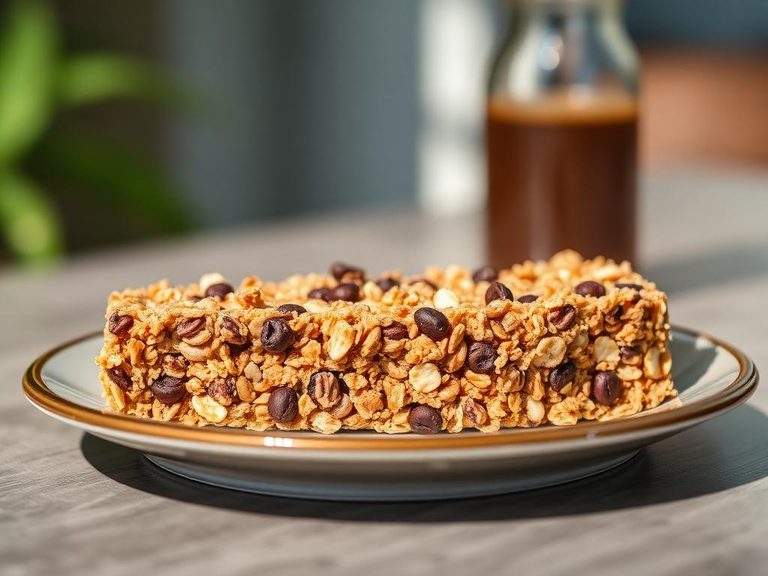
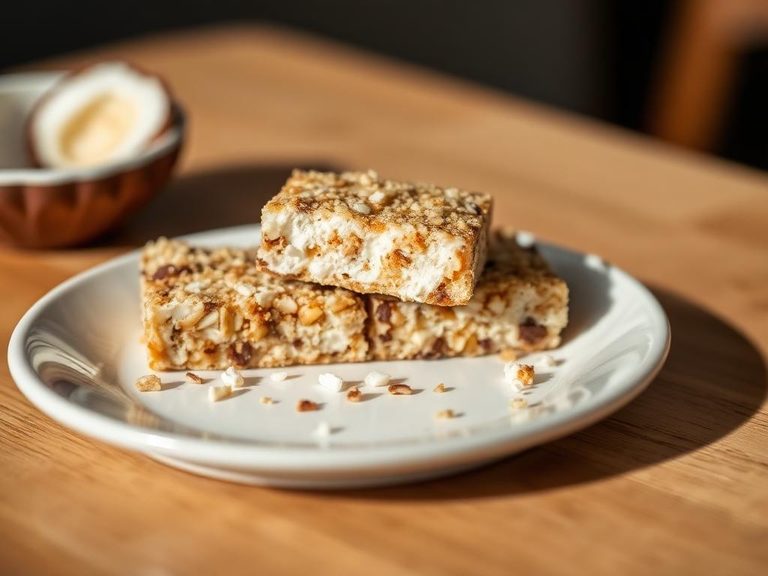
This is a dense, chewy snack bar where a crispy, oat-based granola core is generously enrobed in a smooth, sweet chocolate coating. The interior often features shredded coconut, adding a tropical, nutty flavor and a satisfying textural contrast between the crunchy oats, chewy binder, and soft chocolate shell. Nutritionally, it's a high-energy, calorie-dense treat, with over half its calories coming from fat and a significant portion of its carbohydrates from sugar.
Calorie split: 4% protein · 42% carbs · 55% fat
↓ Full nutrition💚 Why it's loved
People love it for the indulgent, comforting combination of rich chocolate and tropical coconut, which delivers a satisfying sweet and slightly salty flavor profile. It's a beloved on-the-go treat that bridges the gap between a candy bar and a breakfast item, offering a moment of indulgence in a portable form.
⚠️ Watch-outs & how to enjoy it better
The high sugar and fat content can lead to blood sugar spikes and crashes, making it a poor choice for sustained energy or for those monitoring blood glucose. It is also calorie-dense, so portion control is key. To counteract this, pair it with a source of protein (like Greek yogurt or a handful of nuts) to slow sugar absorption, and stick to a single, small bar as an occasional treat rather than a daily snack.
Key benefits
- Provides a quick, dense source of energy from carbohydrates and fats.
- Offers a small amount of dietary fiber from oats and coconut.
- Convenient, portable, and requires no preparation.
- Can satisfy a sweet craving with a combination of chocolate and coconut flavors.
🍽️ Popular dishes

🌍 Where it's eaten
💡 Did you know?
The chocolate coating on these bars is often a 'compound chocolate,' which uses vegetable oils instead of cocoa butter, allowing it to set firmly at room temperature without tempering and giving it a distinct, smooth melt.
Full nutrition (USDA data · scales with serving)
| Water | 6.1 g |
| Energy | 531 kcal |
| Energy | 2223 kj |
| Protein | 5.2 g |
| Total lipid (fat) | 32.2 g |
| Ash | 1.3 g |
| Carbohydrate, by difference | 55.2 g |
| Fiber, total dietary | 6.2 g |
| Total Sugars | 34.3 g |
| Calcium, Ca | 42.0 mg |
| Iron, Fe | 1.8 mg |
| Magnesium, Mg | 56.0 mg |
| Phosphorus, P | 154 mg |
| Potassium, K | 254 mg |
| Sodium, Na | 152 mg |
| Zinc, Zn | 1.2 mg |
| Copper, Cu | 0.32 mg |
| Selenium, Se | 16.4 ug |
| Vitamin C, total ascorbic acid | 0.50 mg |
| Thiamin | 0.14 mg |
| Riboflavin | 0.08 mg |
| Niacin | 0.42 mg |
| Vitamin B-6 | 0.12 mg |
| Folate, total | 9.0 ug |
| Folic acid | 0.00 ug |
| Folate, food | 9.0 ug |
| Folate, DFE | 9.0 ug |
| Choline, total | 12.8 mg |
| Vitamin B-12 | 0.07 ug |
| Vitamin B-12, added | 0.00 ug |
| Vitamin A, RAE | 0.00 ug |
| Retinol | 0.00 ug |
| Carotene, beta | 0.00 ug |
| Carotene, alpha | 0.00 ug |
| Cryptoxanthin, beta | 0.00 ug |
| Vitamin A, IU | 0.00 iu |
| Lycopene | 0.00 ug |
| Lutein + zeaxanthin | 48.0 ug |
| Vitamin E (alpha-tocopherol) | 0.30 mg |
| Vitamin E, added | 0.00 mg |
| Vitamin D (D2 + D3), International Units | 0.00 iu |
| Vitamin D (D2 + D3) | 0.00 ug |
| Vitamin K (phylloquinone) | 1.4 ug |
| Vitamin K (Dihydrophylloquinone) | 0.00 ug |
| Alcohol, ethyl | 0.00 g |
| Caffeine | 3.0 mg |
| Theobromine | 41.0 mg |
Fat & fatty acid profile (per 100g)
| Fatty acids, total saturated | 22.7 g |
| SFA 4:0 | 0.00 g |
| SFA 6:0 | 0.16 g |
| SFA 8:0 | 2.0 g |
| SFA 10:0 | 1.6 g |
| SFA 12:0 | 11.7 g |
| SFA 14:0 | 4.4 g |
| SFA 16:0 | 2.1 g |
| SFA 18:0 | 0.74 g |
| Fatty acids, total monounsaturated | 5.0 g |
| MUFA 16:1 | 0.00 g |
| MUFA 18:1 | 5.0 g |
| MUFA 20:1 | 0.00 g |
| MUFA 22:1 | 0.00 g |
| Fatty acids, total polyunsaturated | 3.1 g |
| PUFA 18:2 | 3.1 g |
| PUFA 18:3 | 0.00 g |
| PUFA 18:4 | 0.00 g |
| PUFA 20:4 | 0.00 g |
| PUFA 20:5 n-3 (EPA) | 0.00 g |
| PUFA 22:5 n-3 (DPA) | 0.00 g |
| PUFA 22:6 n-3 (DHA) | 0.00 g |
| Cholesterol | 0.00 mg |
Amino acid profile (per 100g)
Estimated from Snacks, corn-based, extruded, chips, plain — USDA does not publish this profile for Snacks.
| Tryptophan | 0.05 g |
| Threonine | 0.25 g |
| Isoleucine | 0.23 g |
| Leucine | 0.80 g |
| Lysine | 0.18 g |
| Methionine | 0.14 g |
| Cystine | 0.12 g |
| Phenylalanine | 0.32 g |
| Tyrosine | 0.27 g |
| Valine | 0.33 g |
| Arginine | 0.33 g |
| Histidine | 0.20 g |
| Alanine | 0.49 g |
| Aspartic acid | 0.46 g |
| Glutamic acid | 1.2 g |
| Glycine | 0.27 g |
| Proline | 0.57 g |
| Serine | 0.31 g |
FAQ
Is this a healthy breakfast option?
While marketed as a 'breakfast bar,' its high sugar and fat content make it more akin to a dessert. For a balanced breakfast, it would need to be paired with protein (like eggs or yogurt) and fruit to provide sustained energy and nutrients.
Why does it have so much fat?
The high fat content comes from multiple sources: the chocolate coating (which may contain palm kernel oil), added oils in the granola mixture, and naturally occurring fats in the coconut and any nuts or seeds included.
Can it be part of a weight management plan?
It can be included in moderation due to its high calorie density. A small bar (around 40g) should be accounted for as a treat within your daily calorie goals, and it's best not to eat it straight from the package to avoid overconsumption.
Nutrient density (calculated · NRF9.3)
Nutrient Rich Foods index: beneficial nutrients (protein, fiber, vitamins, minerals) minus saturated fat, added sugar & sodium, per 100 kcal.
NRF9.3 index — Fulgoni, Keast & Drewnowski, 2009. Computed from USDA nutrients.
Weight-loss friendliness (composite index)
Energy density 5.31 kcal/g · 4% calories from protein · 6.2 g fiber · 34.3 g sugar per 100 g.
Composite of energy density (Rolls et al., 1999), protein & fiber satiety, minus sugar. A calculated heuristic — ranks satiety-per-calorie, not a clinical measure.
Dietary load (calculated from USDA values)
Potential renal acid load. Positive = acid-forming, negative = alkaline-forming.
Sodium-to-potassium ratio: 0.60 (lower is better — aim for ≤ 1)
Sodium:potassium per WHO potassium guidance. Computed from USDA nutrients.