

Snacks, corn-based, extruded, onion-flavor
Whole food · Snacks

Photo: Wikipedia
This is a crunchy, airy, extruded corn snack, typically shaped like rings or sticks, with a savory, umami-rich onion flavor. Its texture is light yet satisfyingly crisp, dissolving quickly on the tongue. Nutritionally, it's a high-energy, carb-dense treat with a notable fat content from the frying or baking process.
Calorie split: 6% protein · 53% carbs · 41% fat
↓ Full nutrition💚 Why it's loved
People love it for the addictive combination of savory onion seasoning and satisfying crunch, making it a go-to for casual snacking. It's a versatile companion for movie nights, parties, or as a quick bite between meals.
⚠️ Watch-outs & how to enjoy it better
Its high carbohydrate and fat content can contribute to blood sugar spikes and excess calorie intake if consumed in large quantities. To counteract this, practice portion control by serving a single portion (about 1 cup) and pair it with a protein source like hummus or a handful of nuts to slow digestion.
Key benefits
- Provides a quick source of energy from carbohydrates
- Offers a small amount of plant-based protein
- Contains dietary fiber, aiding in digestive health
- Convenient, shelf-stable, and portable snack
🍽️ Popular dishes
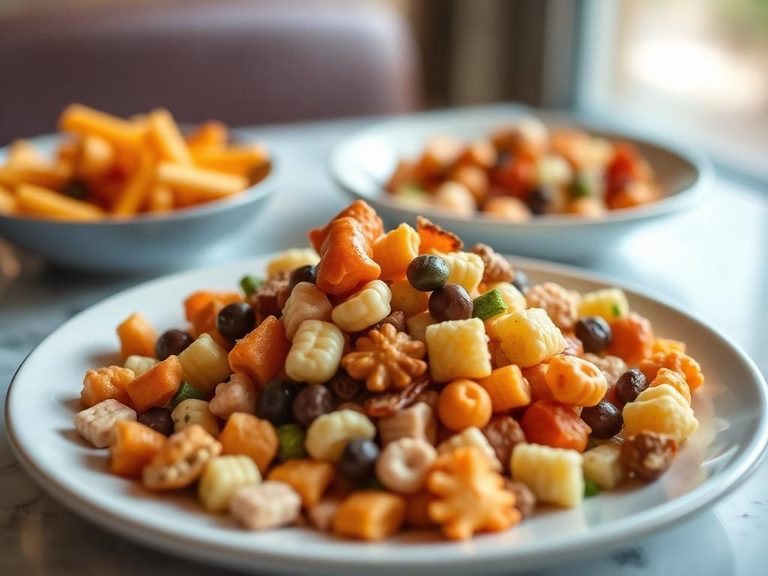
🌍 Where it's eaten
💡 Did you know?
The extrusion process that creates these snacks involves forcing a corn dough through a die under high pressure and temperature, causing it to puff dramatically as it exits, much like a miniature, edible version of volcanic rock formation.
Full nutrition (USDA data · scales with serving)
| Water | 2.0 g |
| Energy | 499 kcal |
| Energy | 2089 kj |
| Protein | 7.7 g |
| Total lipid (fat) | 22.6 g |
| Ash | 2.6 g |
| Carbohydrate, by difference | 65.1 g |
| Fiber, total dietary | 3.9 g |
| Total Sugars | 4.8 g |
| Calcium, Ca | 29.0 mg |
| Iron, Fe | 3.7 mg |
| Magnesium, Mg | 28.0 mg |
| Phosphorus, P | 72.0 mg |
| Potassium, K | 143 mg |
| Sodium, Na | 950 mg |
| Zinc, Zn | 0.33 mg |
| Copper, Cu | 0.12 mg |
| Manganese, Mn | 0.20 mg |
| Selenium, Se | 10.6 ug |
| Vitamin C, total ascorbic acid | 1.8 mg |
| Thiamin | 0.22 mg |
| Riboflavin | 0.31 mg |
| Niacin | 3.2 mg |
| Pantothenic acid | 0.26 mg |
| Vitamin B-6 | 0.15 mg |
| Folate, total | 110 ug |
| Folic acid | 94.0 ug |
| Folate, food | 16.0 ug |
| Folate, DFE | 176 ug |
| Choline, total | 21.3 mg |
| Vitamin B-12 | 0.00 ug |
| Vitamin B-12, added | 0.00 ug |
| Vitamin A, RAE | 8.0 ug |
| Retinol | 2.0 ug |
| Carotene, beta | 51.0 ug |
| Carotene, alpha | 33.0 ug |
| Cryptoxanthin, beta | 0.00 ug |
| Vitamin A, IU | 120 iu |
| Lycopene | 0.00 ug |
| Lutein + zeaxanthin | 879 ug |
| Vitamin E (alpha-tocopherol) | 2.7 mg |
| Vitamin E, added | 0.00 mg |
| Vitamin D (D2 + D3), International Units | 0.00 iu |
| Vitamin D (D2 + D3) | 0.00 ug |
| Vitamin K (phylloquinone) | 5.1 ug |
| Alcohol, ethyl | 0.00 g |
| Caffeine | 0.00 mg |
| Theobromine | 0.00 mg |
Fat & fatty acid profile (per 100g)
| Fatty acids, total saturated | 4.3 g |
| SFA 4:0 | 0.02 g |
| SFA 6:0 | 0.00 g |
| SFA 8:0 | 0.00 g |
| SFA 10:0 | 0.00 g |
| SFA 12:0 | 0.04 g |
| SFA 14:0 | 0.16 g |
| SFA 16:0 | 2.8 g |
| SFA 18:0 | 1.3 g |
| Fatty acids, total monounsaturated | 13.4 g |
| MUFA 16:1 | 0.08 g |
| MUFA 18:1 | 13.3 g |
| MUFA 20:1 | 0.00 g |
| MUFA 22:1 | 0.00 g |
| Fatty acids, total polyunsaturated | 3.1 g |
| PUFA 18:2 | 3.0 g |
| PUFA 18:3 | 0.13 g |
| PUFA 18:4 | 0.00 g |
| PUFA 20:4 | 0.00 g |
| PUFA 20:5 n-3 (EPA) | 0.00 g |
| PUFA 22:5 n-3 (DPA) | 0.00 g |
| PUFA 22:6 n-3 (DHA) | 0.00 g |
| Cholesterol | 0.00 mg |
Amino acid profile (per 100g)
| Tryptophan | 0.06 g |
| Threonine | 0.29 g |
| Isoleucine | 0.28 g |
| Leucine | 0.91 g |
| Lysine | 0.24 g |
| Methionine | 0.15 g |
| Cystine | 0.13 g |
| Phenylalanine | 0.38 g |
| Tyrosine | 0.31 g |
| Valine | 0.39 g |
| Arginine | 0.40 g |
| Histidine | 0.23 g |
| Alanine | 0.55 g |
| Aspartic acid | 0.57 g |
| Glutamic acid | 1.4 g |
| Glycine | 0.31 g |
| Proline | 0.65 g |
| Serine | 0.37 g |
FAQ
What does 'extruded' mean for a snack food?
Extrusion is a manufacturing process where ingredients are forced through a shaped die under heat and pressure. For corn snacks, this cooks the dough and causes it to puff up instantly as it expands, creating the light, airy texture.
Is this snack gluten-free?
It can be, as its primary ingredient is corn. However, you must check the label, as some brands may process it in facilities that handle wheat or add wheat-based ingredients for flavor or texture.
Why is the fat content relatively high?
The fat comes primarily from the oil used in the frying or coating process after extrusion, which adds flavor, richness, and helps the onion seasoning adhere to the snack's surface.
Nutrient density (calculated · NRF9.3)
Nutrient Rich Foods index: beneficial nutrients (protein, fiber, vitamins, minerals) minus saturated fat, added sugar & sodium, per 100 kcal.
NRF9.3 index — Fulgoni, Keast & Drewnowski, 2009. Computed from USDA nutrients.
Weight-loss friendliness (composite index)
Energy density 4.99 kcal/g · 6% calories from protein · 3.9 g fiber · 4.8 g sugar per 100 g.
Composite of energy density (Rolls et al., 1999), protein & fiber satiety, minus sugar. A calculated heuristic — ranks satiety-per-calorie, not a clinical measure.
Dietary load (calculated from USDA values)
Potential renal acid load. Positive = acid-forming, negative = alkaline-forming.
Sodium-to-potassium ratio: 6.64 (lower is better — aim for ≤ 1)
Sodium:potassium per WHO potassium guidance. Computed from USDA nutrients.