

Rice, fried, with beef
Common food

Photo: Wikipedia
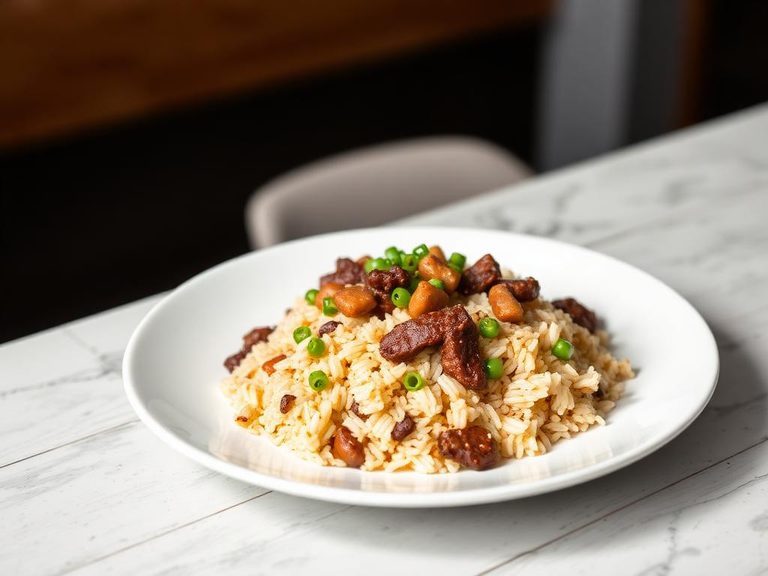
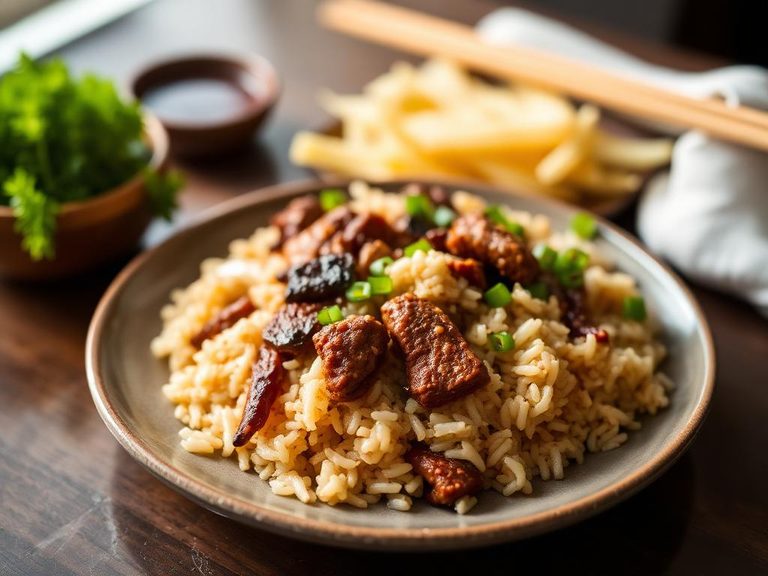
A savory, aromatic dish of cooked rice stir-fried with tender beef, often featuring a rich, savory sauce and crisp vegetables. The texture is typically a satisfying mix of fluffy rice grains and chewy beef, with a deep, umami-rich flavor profile. Nutritionally, it's a balanced meal providing a good source of protein and energy-dense carbohydrates.
Calorie split: 18% protein · 62% carbs · 20% fat
↓ Full nutrition💚 Why it's loved
People love it for its deep, savory umami flavor and the satisfying combination of textures. It's a beloved comfort food and a versatile one-pot meal that can be customized with countless vegetables and sauces.
⚠️ Watch-outs & how to enjoy it better
It can be high in sodium from soy sauce and other seasonings, and the refined carbohydrates may cause a blood-sugar spike for some. To counteract this, use low-sodium soy sauce, add extra non-starchy vegetables like broccoli or bell peppers, and ensure a balanced portion with the beef and veggies.
Key benefits
- Good source of protein for muscle maintenance.
- Provides quick energy from carbohydrates.
- Contains iron from beef, important for blood health.
- Often includes vegetables for added vitamins and fiber.
- A complete, calorie-efficient meal in one dish.
🍽️ Popular dishes

🌍 Where it's eaten
💡 Did you know?
The 'wok hei' or 'breath of the wok'—the smoky, charred flavor from high-heat stir-frying—is considered the hallmark of a masterfully prepared fried rice dish in Cantonese cuisine.
Full nutrition (USDA data · scales with serving)
| Water | 59.3 g |
| Energy | 178 kcal |
| Protein | 7.9 g |
| Total lipid (fat) | 4.1 g |
| Carbohydrate, by difference | 27.6 g |
| Fiber, total dietary | 0.90 g |
| Total Sugars | 0.53 g |
| Calcium, Ca | 10.0 mg |
| Iron, Fe | 0.77 mg |
| Magnesium, Mg | 12.0 mg |
| Phosphorus, P | 66.0 mg |
| Potassium, K | 96.0 mg |
| Sodium, Na | 313 mg |
| Zinc, Zn | 1.4 mg |
| Copper, Cu | 0.08 mg |
| Selenium, Se | 11.8 ug |
| Vitamin C, total ascorbic acid | 3.2 mg |
| Thiamin | 0.02 mg |
| Riboflavin | 0.05 mg |
| Niacin | 1.3 mg |
| Vitamin B-6 | 0.09 mg |
| Folate, total | 7.0 ug |
| Folic acid | 0.00 ug |
| Folate, food | 7.0 ug |
| Folate, DFE | 7.0 ug |
| Choline, total | 22.2 mg |
| Vitamin B-12 | 0.26 ug |
| Vitamin B-12, added | 0.00 ug |
| Vitamin A, RAE | 19.0 ug |
| Retinol | 8.0 ug |
| Carotene, beta | 109 ug |
| Carotene, alpha | 32.0 ug |
| Cryptoxanthin, beta | 0.00 ug |
| Lycopene | 3.0 ug |
| Lutein + zeaxanthin | 88.0 ug |
| Vitamin E (alpha-tocopherol) | 0.18 mg |
| Vitamin E, added | 0.00 mg |
| Vitamin D (D2 + D3) | 0.00 ug |
| Vitamin K (phylloquinone) | 2.6 ug |
| Alcohol, ethyl | 0.00 g |
| Caffeine | 0.00 mg |
| Theobromine | 0.00 mg |
Fat & fatty acid profile (per 100g)
| Fatty acids, total saturated | 0.93 g |
| SFA 4:0 | 0.00 g |
| SFA 6:0 | 0.00 g |
| SFA 8:0 | 0.00 g |
| SFA 10:0 | 0.00 g |
| SFA 12:0 | 0.00 g |
| SFA 14:0 | 0.05 g |
| SFA 16:0 | 0.61 g |
| SFA 18:0 | 0.24 g |
| Fatty acids, total monounsaturated | 1.1 g |
| MUFA 16:1 | 0.06 g |
| MUFA 18:1 | 1.0 g |
| MUFA 20:1 | 0.01 g |
| MUFA 22:1 | 0.00 g |
| Fatty acids, total polyunsaturated | 1.0 g |
| PUFA 18:2 | 0.89 g |
| PUFA 18:3 | 0.12 g |
| PUFA 18:4 | 0.00 g |
| PUFA 20:4 | 0.01 g |
| PUFA 20:5 n-3 (EPA) | 0.00 g |
| PUFA 22:5 n-3 (DPA) | 0.00 g |
| PUFA 22:6 n-3 (DHA) | 0.00 g |
| Cholesterol | 29.0 mg |
Amino acid profile (per 100g)
Estimated from Snacks, rice cakes, brown rice, sesame seed — USDA does not publish this profile for Rice.
| Tryptophan | 0.10 g |
| Threonine | 0.28 g |
| Isoleucine | 0.32 g |
| Leucine | 0.63 g |
| Lysine | 0.29 g |
| Methionine | 0.17 g |
| Cystine | 0.09 g |
| Phenylalanine | 0.39 g |
| Tyrosine | 0.29 g |
| Valine | 0.44 g |
| Arginine | 0.59 g |
| Histidine | 0.19 g |
| Alanine | 0.44 g |
| Aspartic acid | 0.71 g |
| Glutamic acid | 1.6 g |
| Glycine | 0.38 g |
| Proline | 0.35 g |
| Serine | 0.39 g |
FAQ
Is beef fried rice a healthy meal?
It can be part of a balanced diet. Its healthiness depends on the ratio of rice to protein/vegetables and the amount of oil and sodium used. Opting for lean beef, lots of veggies, and controlled sauce helps.
Why is my fried rice mushy instead of having separate grains?
The key is using day-old, refrigerated rice, which is drier. Freshly cooked rice has too much moisture and will steam instead of fry, leading to a mushy texture.
Can I make this dish gluten-free?
Yes, by substituting regular soy sauce with tamari or a gluten-free soy sauce alternative. Ensure any other sauces or marinades used are also certified gluten-free.
Nutrient density (calculated · NRF9.3)
Nutrient Rich Foods index: beneficial nutrients (protein, fiber, vitamins, minerals) minus saturated fat, added sugar & sodium, per 100 kcal.
NRF9.3 index — Fulgoni, Keast & Drewnowski, 2009. Computed from USDA nutrients.
Weight-loss friendliness (composite index)
Energy density 1.78 kcal/g · 18% calories from protein · 0.9 g fiber · 0.5 g sugar per 100 g.
Composite of energy density (Rolls et al., 1999), protein & fiber satiety, minus sugar. A calculated heuristic — ranks satiety-per-calorie, not a clinical measure.
Dietary load (calculated from USDA values)
Potential renal acid load. Positive = acid-forming, negative = alkaline-forming.
Sodium-to-potassium ratio: 3.26 (lower is better — aim for ≤ 1)
Sodium:potassium per WHO potassium guidance. Computed from USDA nutrients.