

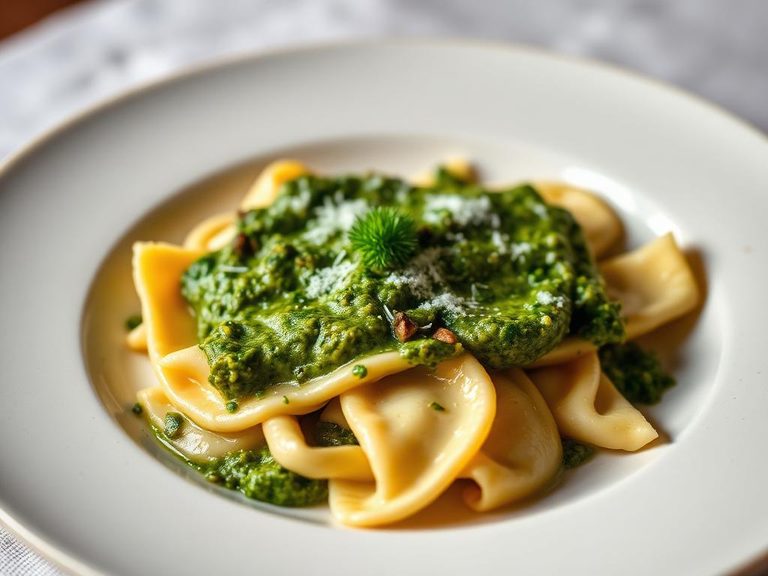
Ravioli, NS as to filling, with cream sauce
Common food

Photo: Wikipedia
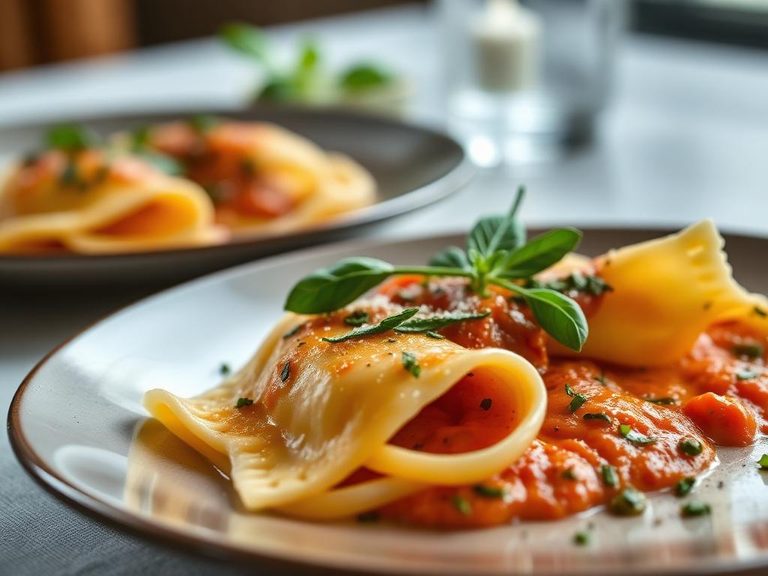
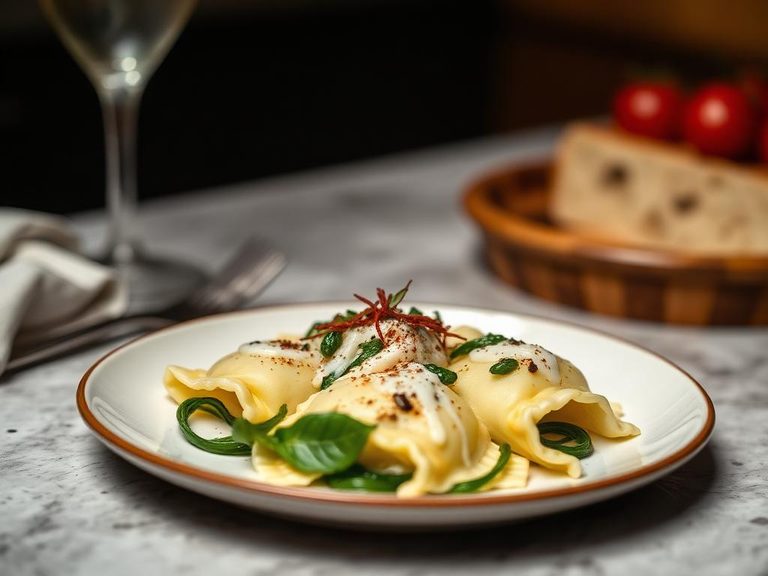
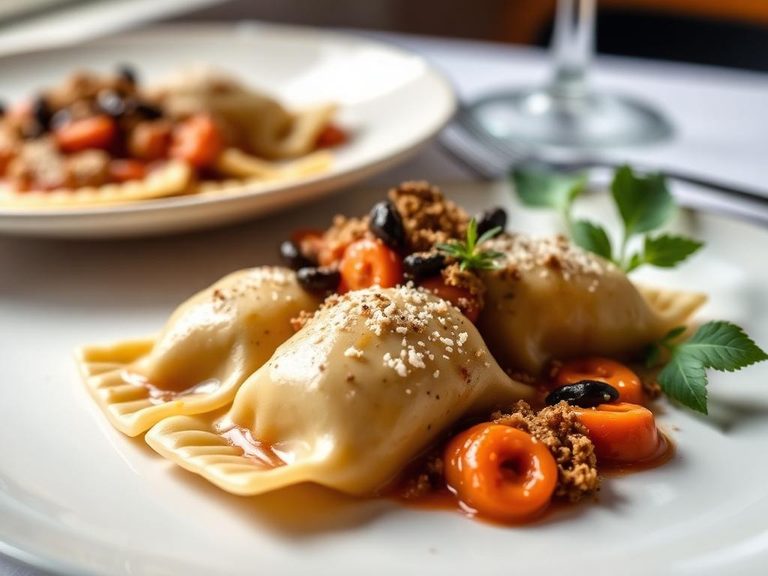
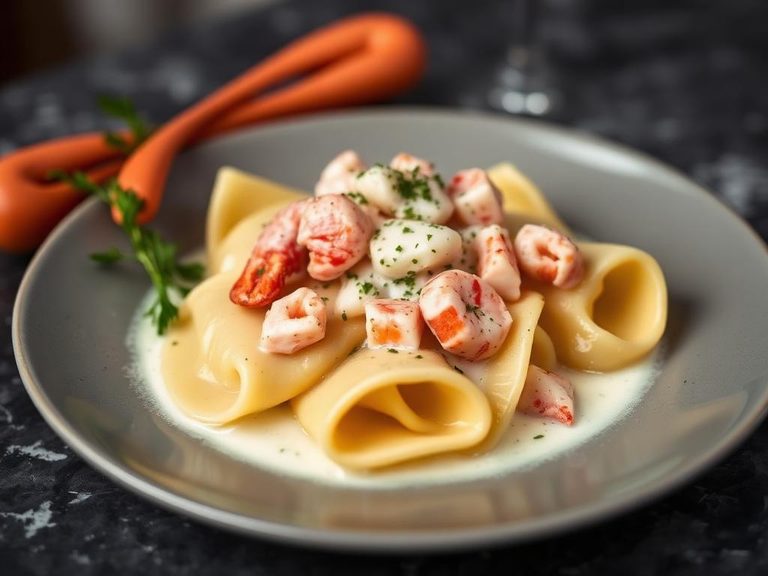
Ravioli with cream sauce is a classic Italian comfort dish: tender pasta pillows, often filled with cheese or meat, blanketed in a rich, velvety sauce. The texture is a delightful contrast between the soft, yielding pasta and the smooth, coating cream. Nutritionally, it's a dense source of energy, with a balanced profile of protein and fats per serving.
Calorie split: 19% protein · 36% carbs · 45% fat
↓ Full nutrition💚 Why it's loved
People adore it for its luxurious, indulgent mouthfeel and the comforting, savory flavors of the cream sauce melding with the filling. It's a versatile dish that can be a hearty main or an elegant starter, deeply rooted in Italian culinary tradition.
⚠️ Watch-outs & how to enjoy it better
The cream sauce is high in saturated fat and calories, which may concern those monitoring heart health or weight. The refined pasta can cause a rapid rise in blood sugar. To counteract this, pair a smaller portion with a large side of fibrous vegetables (like roasted broccoli or a green salad) to slow digestion and add nutrients.
Key benefits
- Provides a concentrated source of energy from carbohydrates and fats.
- Offers a moderate amount of protein from the pasta and filling.
- Contains calcium and phosphorus, especially if the filling and sauce are dairy-based.
- Can be a satisfying and comforting meal, supporting psychological well-being.
🍽️ Popular dishes
🌍 Where it's eaten
💡 Did you know?
The word 'ravioli' may derive from the Italian 'riavvolgere,' meaning 'to wrap,' and early versions were sometimes baked in broth rather than boiled and sauced.
Full nutrition (USDA data · scales with serving)
| Water | 67.2 g |
| Energy | 169 kcal |
| Protein | 8.1 g |
| Total lipid (fat) | 8.4 g |
| Carbohydrate, by difference | 15.2 g |
| Fiber, total dietary | 0.50 g |
| Total Sugars | 1.7 g |
| Calcium, Ca | 83.0 mg |
| Iron, Fe | 1.4 mg |
| Magnesium, Mg | 14.0 mg |
| Phosphorus, P | 116 mg |
| Potassium, K | 147 mg |
| Sodium, Na | 234 mg |
| Zinc, Zn | 1.2 mg |
| Copper, Cu | 0.04 mg |
| Selenium, Se | 10.0 ug |
| Vitamin C, total ascorbic acid | 0.10 mg |
| Thiamin | 0.16 mg |
| Riboflavin | 0.21 mg |
| Niacin | 1.6 mg |
| Vitamin B-6 | 0.09 mg |
| Folate, total | 27.0 ug |
| Folic acid | 16.0 ug |
| Folate, food | 11.0 ug |
| Folate, DFE | 38.0 ug |
| Choline, total | 49.9 mg |
| Vitamin B-12 | 0.58 ug |
| Vitamin B-12, added | 0.00 ug |
| Vitamin A, RAE | 85.0 ug |
| Retinol | 83.0 ug |
| Carotene, beta | 25.0 ug |
| Carotene, alpha | 0.00 ug |
| Cryptoxanthin, beta | 2.0 ug |
| Lycopene | 0.00 ug |
| Lutein + zeaxanthin | 64.0 ug |
| Vitamin E (alpha-tocopherol) | 0.56 mg |
| Vitamin E, added | 0.00 mg |
| Vitamin D (D2 + D3) | 0.70 ug |
| Vitamin K (phylloquinone) | 4.0 ug |
| Alcohol, ethyl | 0.00 g |
| Caffeine | 0.00 mg |
| Theobromine | 0.00 mg |
Fat & fatty acid profile (per 100g)
| Fatty acids, total saturated | 3.0 g |
| SFA 4:0 | 0.04 g |
| SFA 6:0 | 0.04 g |
| SFA 8:0 | 0.02 g |
| SFA 10:0 | 0.06 g |
| SFA 12:0 | 0.07 g |
| SFA 14:0 | 0.27 g |
| SFA 16:0 | 1.6 g |
| SFA 18:0 | 0.75 g |
| Fatty acids, total monounsaturated | 3.2 g |
| MUFA 16:1 | 0.14 g |
| MUFA 18:1 | 3.0 g |
| MUFA 20:1 | 0.01 g |
| MUFA 22:1 | 0.00 g |
| Fatty acids, total polyunsaturated | 1.3 g |
| PUFA 18:2 | 1.2 g |
| PUFA 18:3 | 0.10 g |
| PUFA 18:4 | 0.00 g |
| PUFA 20:4 | 0.01 g |
| PUFA 20:5 n-3 (EPA) | 0.00 g |
| PUFA 22:5 n-3 (DPA) | 0.00 g |
| PUFA 22:6 n-3 (DHA) | 0.00 g |
| Cholesterol | 70.0 mg |
Amino acid profile (per 100g)
Estimated from OLIVE GARDEN, cheese ravioli with marinara sauce — USDA does not publish this profile for Ravioli.
| Tryptophan | 0.17 g |
| Threonine | 0.28 g |
| Isoleucine | 0.32 g |
| Leucine | 0.67 g |
| Lysine | 0.51 g |
| Methionine | 0.18 g |
| Cystine | 0.12 g |
| Phenylalanine | 0.36 g |
| Tyrosine | 0.26 g |
| Valine | 0.38 g |
| Arginine | 0.31 g |
| Histidine | 0.17 g |
| Alanine | 0.26 g |
| Aspartic acid | 0.54 g |
| Glutamic acid | 2.0 g |
| Glycine | 0.20 g |
| Proline | 1.0 g |
| Serine | 0.40 g |
| Hydroxyproline | 0.00 g |
FAQ
Is ravioli with cream sauce a good source of protein?
It provides a moderate amount of protein, primarily from the wheat in the pasta and the filling (like cheese or meat). It's not as protein-dense as a lean meat or legume dish, but contributes to daily intake.
How can I make it a healthier meal?
Choose a vegetable-based filling (like spinach or mushroom), use a lighter cream sauce with broth, and serve it with a large portion of steamed or roasted vegetables to increase fiber and volume without excess calories.
What is the best wine to pair with it?
A crisp, acidic white wine like Pinot Grigio or a light, fruity red like Barbera d'Asti cuts through the richness of the cream sauce and complements the pasta's flavor.
Nutrient density (calculated · NRF9.3)
Nutrient Rich Foods index: beneficial nutrients (protein, fiber, vitamins, minerals) minus saturated fat, added sugar & sodium, per 100 kcal.
NRF9.3 index — Fulgoni, Keast & Drewnowski, 2009. Computed from USDA nutrients.
Weight-loss friendliness (composite index)
Energy density 1.69 kcal/g · 19% calories from protein · 0.5 g fiber · 1.7 g sugar per 100 g.
Composite of energy density (Rolls et al., 1999), protein & fiber satiety, minus sugar. A calculated heuristic — ranks satiety-per-calorie, not a clinical measure.
Dietary load (calculated from USDA values)
Potential renal acid load. Positive = acid-forming, negative = alkaline-forming.
Sodium-to-potassium ratio: 1.59 (lower is better — aim for ≤ 1)
Sodium:potassium per WHO potassium guidance. Computed from USDA nutrients.