

Pizza with meat and vegetables, from restaurant or fast food, thick crust
Common food
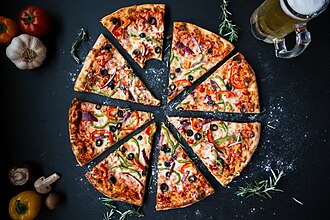
Photo: Wikipedia
This is a hearty, thick-crust pizza loaded with savory meats and vegetables, offering a satisfying chew from its bready base and a rich, umami-packed topping. Each 100g provides a balanced mix of protein and carbs, making it a more substantial meal than thinner-crust alternatives. The combination of melted cheese, seasoned meats, and roasted vegetables creates a complex, comforting flavor profile.
Calorie split: 17% protein · 47% carbs · 37% fat
↓ Full nutrition💚 Why it's loved
People adore it for the perfect balance of crispy, chewy crust and the rich, savory blend of melted cheese, savory meats, and sweet or earthy vegetables. It's a universally loved comfort food that brings people together, symbolizing casual dining and celebration across many cultures.
⚠️ Watch-outs & how to enjoy it better
The thick crust and refined flour can lead to blood-sugar spikes, and it's often high in sodium and saturated fat from cheese and processed meats. To counteract this, pair a slice with a large, vinegar-dressed side salad to increase fiber and slow digestion, practice mindful portion control (e.g., one slice with a protein-rich side), and opt for vegetable-heavy toppings.
Key benefits
- Provides a good source of protein for muscle maintenance.
- Offers a mix of carbohydrates for energy and vegetables for some vitamins.
- The thick crust is more filling, which can aid in portion control.
- Convenient and widely available as a complete meal.
- Highly customizable to include various nutrient-dense toppings.
🍽️ Popular dishes




🌍 Where it's eaten
💡 Did you know?
The modern pizza with tomato sauce is believed to have been invented in Naples, Italy, but the concept of flatbread with toppings dates back thousands of years to ancient civilizations in the Mediterranean and Middle East.
Full nutrition (USDA data · scales with serving)
| Water | 46.1 g |
| Energy | 259 kcal |
| Protein | 10.9 g |
| Total lipid (fat) | 10.5 g |
| Carbohydrate, by difference | 30.1 g |
| Fiber, total dietary | 2.0 g |
| Total Sugars | 3.2 g |
| Calcium, Ca | 161 mg |
| Iron, Fe | 2.4 mg |
| Magnesium, Mg | 22.0 mg |
| Phosphorus, P | 198 mg |
| Potassium, K | 179 mg |
| Sodium, Na | 505 mg |
| Zinc, Zn | 1.4 mg |
| Copper, Cu | 0.10 mg |
| Selenium, Se | 17.3 ug |
| Vitamin C, total ascorbic acid | 2.9 mg |
| Thiamin | 0.34 mg |
| Riboflavin | 0.19 mg |
| Niacin | 3.5 mg |
| Vitamin B-6 | 0.08 mg |
| Folate, total | 96.0 ug |
| Folic acid | 59.0 ug |
| Folate, food | 37.0 ug |
| Folate, DFE | 137 ug |
| Choline, total | 19.2 mg |
| Vitamin B-12 | 0.41 ug |
| Vitamin B-12, added | 0.00 ug |
| Vitamin A, RAE | 63.0 ug |
| Retinol | 55.0 ug |
| Carotene, beta | 90.0 ug |
| Carotene, alpha | 1.0 ug |
| Cryptoxanthin, beta | 0.00 ug |
| Lycopene | 1719 ug |
| Lutein + zeaxanthin | 31.0 ug |
| Vitamin E (alpha-tocopherol) | 0.77 mg |
| Vitamin E, added | 0.00 mg |
| Vitamin D (D2 + D3) | 0.00 ug |
| Vitamin K (phylloquinone) | 9.2 ug |
| Alcohol, ethyl | 0.00 g |
| Caffeine | 0.00 mg |
| Theobromine | 0.00 mg |
Fat & fatty acid profile (per 100g)
| Fatty acids, total saturated | 4.2 g |
| SFA 4:0 | 0.09 g |
| SFA 6:0 | 0.07 g |
| SFA 8:0 | 0.05 g |
| SFA 10:0 | 0.12 g |
| SFA 12:0 | 0.15 g |
| SFA 14:0 | 0.53 g |
| SFA 16:0 | 2.1 g |
| SFA 18:0 | 0.89 g |
| Fatty acids, total monounsaturated | 2.8 g |
| MUFA 16:1 | 0.13 g |
| MUFA 18:1 | 2.6 g |
| MUFA 20:1 | 0.05 g |
| MUFA 22:1 | 0.00 g |
| Fatty acids, total polyunsaturated | 2.6 g |
| PUFA 18:2 | 2.3 g |
| PUFA 18:3 | 0.28 g |
| PUFA 18:4 | 0.00 g |
| PUFA 20:4 | 0.01 g |
| PUFA 20:5 n-3 (EPA) | 0.00 g |
| PUFA 22:5 n-3 (DPA) | 0.00 g |
| PUFA 22:6 n-3 (DHA) | 0.00 g |
| Cholesterol | 20.0 mg |
Amino acid profile (per 100g)
Estimated from Fast Food, Pizza Chain, 14" pizza, meat and vegetable topping, regular crust — USDA does not publish this profile for Pizza with meat and vegetables.
| Tryptophan | 0.11 g |
| Threonine | 0.40 g |
| Isoleucine | 0.48 g |
| Leucine | 0.92 g |
| Lysine | 0.61 g |
| Methionine | 0.22 g |
| Cystine | 0.18 g |
| Phenylalanine | 0.55 g |
| Tyrosine | 0.39 g |
| Valine | 0.58 g |
| Arginine | 0.51 g |
| Histidine | 0.33 g |
| Alanine | 0.45 g |
| Aspartic acid | 0.86 g |
| Glutamic acid | 2.9 g |
| Glycine | 0.42 g |
| Proline | 1.1 g |
| Serine | 0.60 g |
| Hydroxyproline | 0.01 g |
FAQ
Is thick-crust pizza less healthy than thin-crust?
Generally, yes. The thick, bready crust significantly increases the calorie and carbohydrate content per slice compared to a thin-crust pizza with the same toppings, making it more energy-dense.
How can I make this pizza a more balanced meal?
Enjoy one or two slices alongside a large portion of non-starchy vegetables (like a green salad or roasted broccoli) and a lean protein source (like grilled chicken) to increase fiber, nutrients, and satiety.
What does '259 kcal per 100g' mean in practical terms?
It means a typical slice weighing about 118g would contain roughly 305 calories. This density comes from the combination of flour, cheese, and oils in the crust and toppings.
Nutrient density (calculated · NRF9.3)
Nutrient Rich Foods index: beneficial nutrients (protein, fiber, vitamins, minerals) minus saturated fat, added sugar & sodium, per 100 kcal.
NRF9.3 index — Fulgoni, Keast & Drewnowski, 2009. Computed from USDA nutrients.
Weight-loss friendliness (composite index)
Energy density 2.59 kcal/g · 17% calories from protein · 2.0 g fiber · 3.2 g sugar per 100 g.
Composite of energy density (Rolls et al., 1999), protein & fiber satiety, minus sugar. A calculated heuristic — ranks satiety-per-calorie, not a clinical measure.
Dietary load (calculated from USDA values)
Potential renal acid load. Positive = acid-forming, negative = alkaline-forming.
Sodium-to-potassium ratio: 2.82 (lower is better — aim for ≤ 1)
Sodium:potassium per WHO potassium guidance. Computed from USDA nutrients.