

Pizza, cheese, gluten-free thin crust
Common food

Photo: Wikipedia
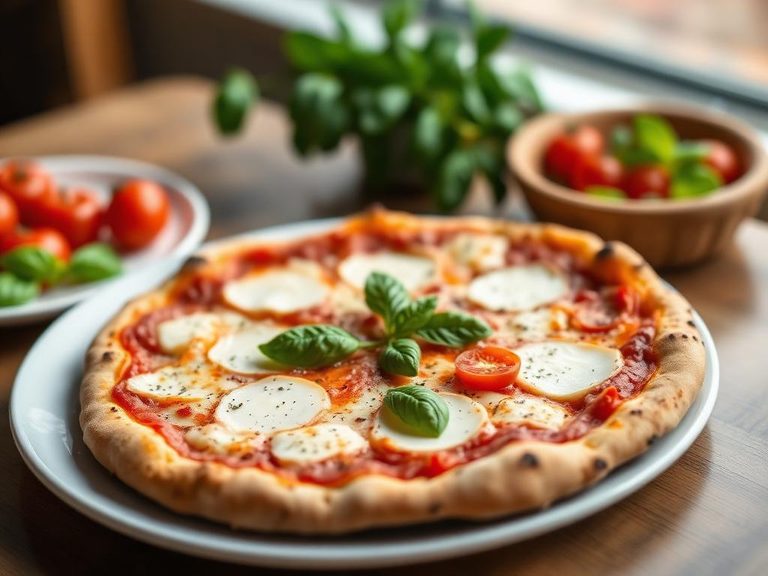
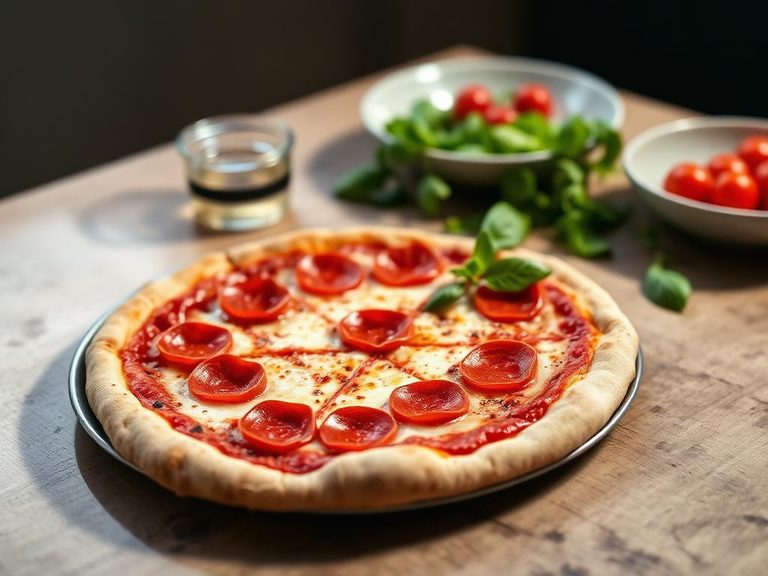
A gluten-free thin crust pizza is a crisp, cracker-like base that provides a satisfying crunch without wheat, topped with a generous layer of melted cheese. Its texture is light and sturdy, supporting classic toppings while the cheese delivers a rich, savory, and slightly salty flavor. Nutritionally, it offers a good protein punch from the cheese, making it a more substantial option than many gluten-free alternatives.
Calorie split: 13% protein · 40% carbs · 46% fat
↓ Full nutrition💚 Why it's loved
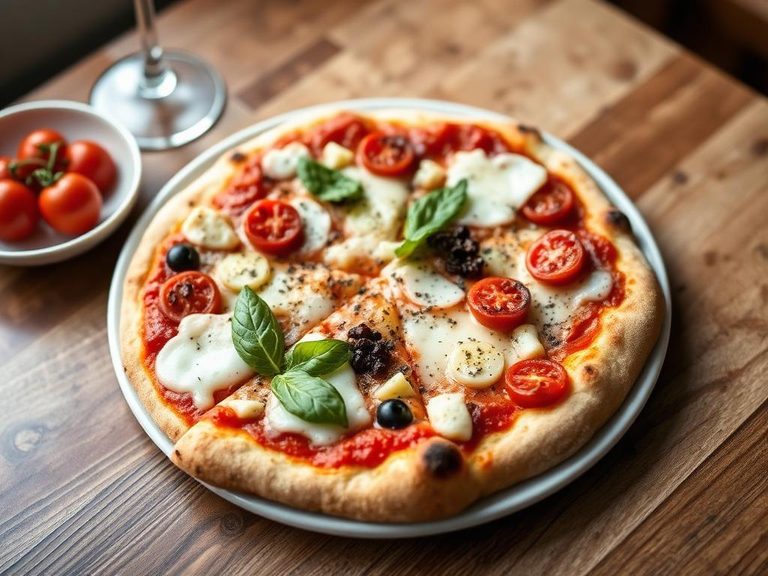
People love it for delivering the classic, comforting pizza experience—gooey cheese and savory sauce—without the gluten. Its versatility allows for endless topping combinations, from classic Margherita to veggie-loaded, making it a crowd-pleaser for diverse dietary needs.
⚠️ Watch-outs & how to enjoy it better
The cheese topping is high in saturated fat and sodium, which can be a concern for heart health or blood pressure. The refined starch in many gluten-free crusts can still cause a rapid blood-sugar spike. To counteract this, pair a slice with a large side salad or non-starchy vegetables to slow digestion, and practice portion control by sticking to one or two slices.
Key benefits
- Gluten-free, suitable for celiac disease or gluten sensitivity.
- Higher protein per 100g than many standard pizza crusts.
- Thin crust often means fewer total carbohydrates per slice.
- Provides a good source of calcium from the cheese topping.
- Can be a lower-calorie alternative to deep-dish or pan pizzas.
🍽️ Popular dishes
🌍 Where it's eaten
💡 Did you know?
The world's largest gluten-free pizza, made in 2012 in Rome, had a diameter of 1.31 meters (over 4 feet) and used over 1,000 kg of gluten-free flour.
Full nutrition (USDA data · scales with serving)
| Water | 49.0 g |
| Energy | 264 kcal |
| Protein | 8.7 g |
| Total lipid (fat) | 13.6 g |
| Carbohydrate, by difference | 26.5 g |
| Fiber, total dietary | 2.5 g |
| Total Sugars | 3.2 g |
| Calcium, Ca | 259 mg |
| Iron, Fe | 1.6 mg |
| Magnesium, Mg | 16.0 mg |
| Phosphorus, P | 172 mg |
| Potassium, K | 120 mg |
| Sodium, Na | 485 mg |
| Zinc, Zn | 1.2 mg |
| Copper, Cu | 0.06 mg |
| Selenium, Se | 7.5 ug |
| Vitamin C, total ascorbic acid | 0.30 mg |
| Thiamin | 0.17 mg |
| Riboflavin | 0.37 mg |
| Niacin | 2.1 mg |
| Vitamin B-6 | 0.08 mg |
| Folate, total | 24.0 ug |
| Folic acid | 0.00 ug |
| Folate, food | 24.0 ug |
| Folate, DFE | 24.0 ug |
| Choline, total | 11.5 mg |
| Vitamin B-12 | 0.24 ug |
| Vitamin B-12, added | 0.00 ug |
| Vitamin A, RAE | 58.0 ug |
| Retinol | 53.0 ug |
| Carotene, beta | 62.0 ug |
| Carotene, alpha | 0.00 ug |
| Cryptoxanthin, beta | 0.00 ug |
| Lycopene | 2005 ug |
| Lutein + zeaxanthin | 30.0 ug |
| Vitamin E (alpha-tocopherol) | 1.9 mg |
| Vitamin E, added | 0.00 mg |
| Vitamin D (D2 + D3) | 0.10 ug |
| Vitamin K (phylloquinone) | 4.1 ug |
| Alcohol, ethyl | 0.00 g |
| Caffeine | 0.00 mg |
| Theobromine | 0.00 mg |
Fat & fatty acid profile (per 100g)
| Fatty acids, total saturated | 4.4 g |
| SFA 4:0 | 0.10 g |
| SFA 6:0 | 0.09 g |
| SFA 8:0 | 0.07 g |
| SFA 10:0 | 0.14 g |
| SFA 12:0 | 0.16 g |
| SFA 14:0 | 0.52 g |
| SFA 16:0 | 2.5 g |
| SFA 18:0 | 0.75 g |
| Fatty acids, total monounsaturated | 5.9 g |
| MUFA 16:1 | 0.15 g |
| MUFA 18:1 | 5.5 g |
| MUFA 20:1 | 0.03 g |
| MUFA 22:1 | 0.00 g |
| Fatty acids, total polyunsaturated | 1.0 g |
| PUFA 18:2 | 0.98 g |
| PUFA 18:3 | 0.07 g |
| PUFA 18:4 | 0.00 g |
| PUFA 20:4 | 0.01 g |
| PUFA 20:5 n-3 (EPA) | 0.00 g |
| PUFA 22:5 n-3 (DPA) | 0.00 g |
| PUFA 22:6 n-3 (DHA) | 0.00 g |
| Cholesterol | 17.0 mg |
Amino acid profile (per 100g)
Estimated from Fast Food, Pizza Chain, 14" pizza, cheese topping, stuffed crust — USDA does not publish this profile for Pizza.
| Tryptophan | 0.12 g |
| Threonine | 0.39 g |
| Isoleucine | 0.57 g |
| Leucine | 1.1 g |
| Lysine | 0.59 g |
| Methionine | 0.27 g |
| Phenylalanine | 0.64 g |
| Tyrosine | 0.40 g |
| Valine | 0.71 g |
| Arginine | 0.44 g |
| Histidine | 0.32 g |
| Alanine | 0.38 g |
| Aspartic acid | 0.81 g |
| Glutamic acid | 3.4 g |
| Glycine | 0.31 g |
| Proline | 1.7 g |
| Serine | 0.58 g |
| Hydroxyproline | 0.00 g |
FAQ
Is gluten-free thin crust pizza healthier than regular pizza?
Not necessarily. While it's essential for those avoiding gluten, the crust is often made from refined rice or potato starch, which can be low in fiber and cause blood sugar spikes. The cheese topping remains high in saturated fat and sodium. A regular wheat-crust pizza may offer more fiber and nutrients.
What is a typical gluten-free thin crust made from?
Common bases include a blend of rice flour (white or brown), potato starch, tapioca starch, and sometimes xanthan gum for binding. Some premium versions incorporate almond flour or chickpea flour for added protein and fiber.
How can I make this pizza more balanced?
Load it with vegetable toppings like bell peppers, spinach, mushrooms, and onions to add fiber, vitamins, and volume. Serve it with a side of lean protein like grilled chicken or a bean salad to create a more complete and satisfying meal.
Nutrient density (calculated · NRF9.3)
Nutrient Rich Foods index: beneficial nutrients (protein, fiber, vitamins, minerals) minus saturated fat, added sugar & sodium, per 100 kcal.
NRF9.3 index — Fulgoni, Keast & Drewnowski, 2009. Computed from USDA nutrients.
Weight-loss friendliness (composite index)
Energy density 2.64 kcal/g · 13% calories from protein · 2.5 g fiber · 3.2 g sugar per 100 g.
Composite of energy density (Rolls et al., 1999), protein & fiber satiety, minus sugar. A calculated heuristic — ranks satiety-per-calorie, not a clinical measure.
Dietary load (calculated from USDA values)
Potential renal acid load. Positive = acid-forming, negative = alkaline-forming.
Sodium-to-potassium ratio: 4.04 (lower is better — aim for ≤ 1)
Sodium:potassium per WHO potassium guidance. Computed from USDA nutrients.