

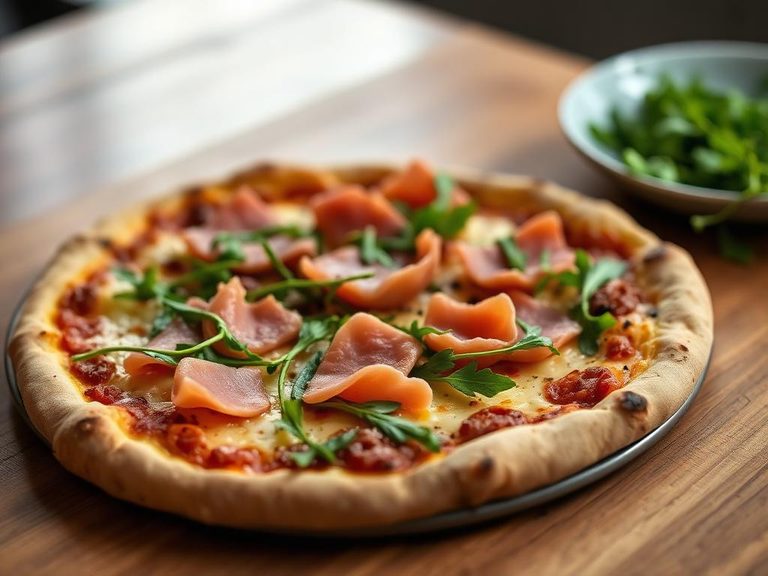
Pizza, with meat, gluten-free thin crust
Common food

Photo: Wikipedia
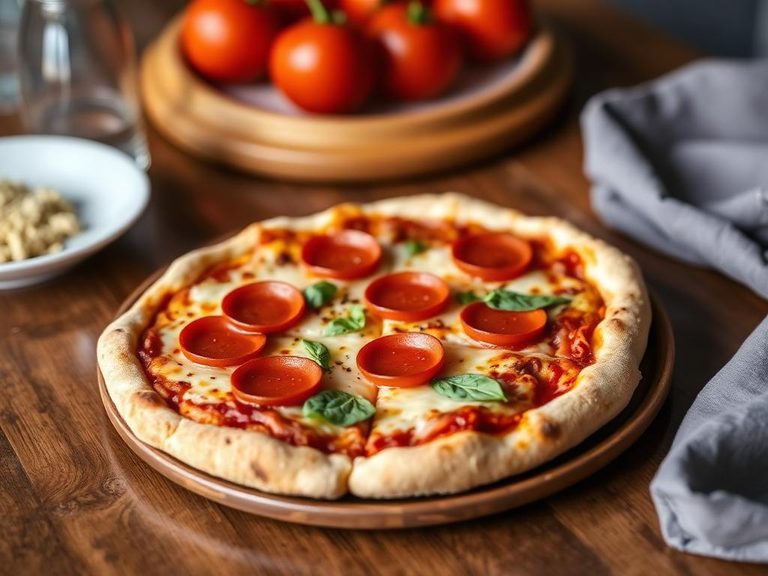
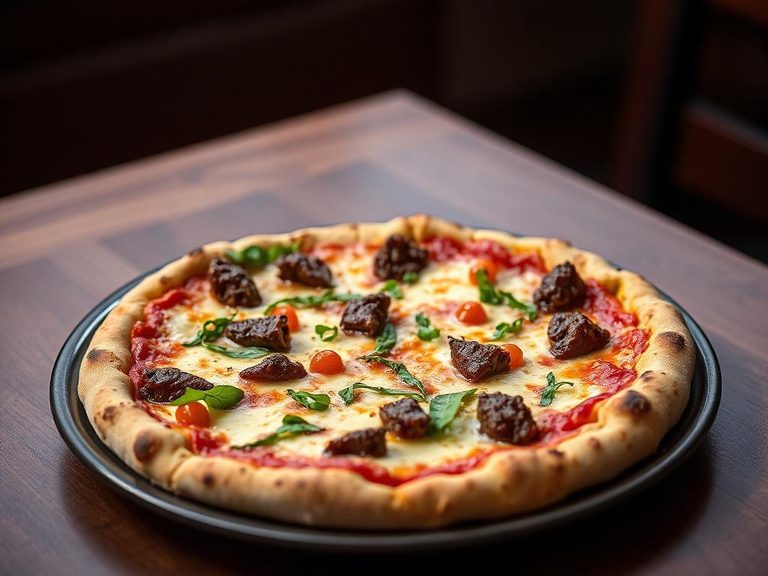
This is a modern take on the classic pizza, featuring a crisp, gluten-free thin crust topped with savory meats like pepperoni or sausage. The texture is a delightful contrast: a cracker-like, sturdy base that doesn't get soggy, supporting a layer of melted cheese and rich, umami-packed toppings. Nutritionally, it offers a solid protein punch from the meat, making it more satiating than a plain cheese version.
Calorie split: 15% protein · 31% carbs · 55% fat
↓ Full nutrition💚 Why it's loved
People love it for delivering the quintessential pizza experience—the savory, salty, fatty harmony of meat and cheese—without the gluten. It's a versatile crowd-pleaser that accommodates dietary restrictions while still feeling like an indulgent treat, perfect for movie nights or casual gatherings.
⚠️ Watch-outs & how to enjoy it better
The combination of processed meats and cheese can be high in sodium and saturated fat, which may concern those monitoring heart health or blood pressure. The gluten-free crust, while convenient, can sometimes be denser or more expensive. To counteract, pair a slice with a large, leafy green salad dressed with lemon juice to add fiber and volume, and practice portion control by limiting yourself to one or two slices alongside vegetable-based sides.
Key benefits
- Gluten-free crust allows those with celiac disease or gluten sensitivity to enjoy pizza.
- Higher protein content from meat toppings supports muscle maintenance.
- Thin crust reduces overall carbohydrate load compared to traditional thick-crust pizzas.
- Can be a source of calcium from the cheese topping.
- Offers a satisfying meal that aligns with lower-carb dietary preferences.
🍽️ Popular dishes
🌍 Where it's eaten
💡 Did you know?
The first recorded pizza-like dish with a gluten-free crust was developed in the early 2000s, but the real surge in quality and popularity came after 2010 with the widespread use of alternative flour blends like rice, tapioca, and potato starch.
Full nutrition (USDA data · scales with serving)
| Water | 47.8 g |
| Energy | 287 kcal |
| Protein | 10.6 g |
| Total lipid (fat) | 17.4 g |
| Carbohydrate, by difference | 21.9 g |
| Fiber, total dietary | 2.1 g |
| Total Sugars | 2.8 g |
| Calcium, Ca | 213 mg |
| Iron, Fe | 1.5 mg |
| Magnesium, Mg | 17.0 mg |
| Phosphorus, P | 168 mg |
| Potassium, K | 154 mg |
| Sodium, Na | 594 mg |
| Zinc, Zn | 1.5 mg |
| Copper, Cu | 0.07 mg |
| Selenium, Se | 10.5 ug |
| Vitamin C, total ascorbic acid | 0.30 mg |
| Thiamin | 0.19 mg |
| Riboflavin | 0.35 mg |
| Niacin | 2.7 mg |
| Vitamin B-6 | 0.13 mg |
| Folate, total | 20.0 ug |
| Folic acid | 0.00 ug |
| Folate, food | 20.0 ug |
| Folate, DFE | 20.0 ug |
| Choline, total | 20.6 mg |
| Vitamin B-12 | 0.40 ug |
| Vitamin B-12, added | 0.00 ug |
| Vitamin A, RAE | 50.0 ug |
| Retinol | 46.0 ug |
| Carotene, beta | 50.0 ug |
| Carotene, alpha | 0.00 ug |
| Cryptoxanthin, beta | 0.00 ug |
| Lycopene | 1628 ug |
| Lutein + zeaxanthin | 24.0 ug |
| Vitamin E (alpha-tocopherol) | 1.7 mg |
| Vitamin E, added | 0.00 mg |
| Vitamin D (D2 + D3) | 0.30 ug |
| Vitamin K (phylloquinone) | 3.7 ug |
| Alcohol, ethyl | 0.00 g |
| Caffeine | 0.00 mg |
| Theobromine | 0.00 mg |
Fat & fatty acid profile (per 100g)
| Fatty acids, total saturated | 5.9 g |
| SFA 4:0 | 0.09 g |
| SFA 6:0 | 0.07 g |
| SFA 8:0 | 0.05 g |
| SFA 10:0 | 0.12 g |
| SFA 12:0 | 0.14 g |
| SFA 14:0 | 0.53 g |
| SFA 16:0 | 3.4 g |
| SFA 18:0 | 1.3 g |
| Fatty acids, total monounsaturated | 7.6 g |
| MUFA 16:1 | 0.28 g |
| MUFA 18:1 | 7.0 g |
| MUFA 20:1 | 0.08 g |
| MUFA 22:1 | 0.00 g |
| Fatty acids, total polyunsaturated | 1.7 g |
| PUFA 18:2 | 1.6 g |
| PUFA 18:3 | 0.09 g |
| PUFA 18:4 | 0.00 g |
| PUFA 20:4 | 0.03 g |
| PUFA 20:5 n-3 (EPA) | 0.00 g |
| PUFA 22:5 n-3 (DPA) | 0.01 g |
| PUFA 22:6 n-3 (DHA) | 0.00 g |
| Cholesterol | 30.0 mg |
Amino acid profile (per 100g)
Estimated from Fast Food, Pizza Chain, 14" pizza, cheese topping, stuffed crust — USDA does not publish this profile for Pizza.
| Tryptophan | 0.12 g |
| Threonine | 0.39 g |
| Isoleucine | 0.57 g |
| Leucine | 1.1 g |
| Lysine | 0.59 g |
| Methionine | 0.27 g |
| Phenylalanine | 0.64 g |
| Tyrosine | 0.40 g |
| Valine | 0.71 g |
| Arginine | 0.44 g |
| Histidine | 0.32 g |
| Alanine | 0.38 g |
| Aspartic acid | 0.81 g |
| Glutamic acid | 3.4 g |
| Glycine | 0.31 g |
| Proline | 1.7 g |
| Serine | 0.58 g |
| Hydroxyproline | 0.00 g |
FAQ
How does the nutrition compare to regular thin-crust pizza?
The gluten-free crust often has a similar calorie count but can be slightly higher in fat and lower in fiber. The meat topping adds more protein but also more sodium and saturated fat than a vegetable-topped version.
Is the gluten-free crust healthier?
It's essential for those with gluten-related disorders but not inherently 'healthier' for everyone. The nutritional profile depends heavily on the specific crust ingredients (e.g., almond flour vs. rice flour) and toppings used.
Can I make this at home easily?
Yes, many stores sell pre-made gluten-free thin crusts. For homemade, a simple blend of rice flour, tapioca starch, and a binder like xanthan gum works well. The key is to pre-bake the crust slightly before adding toppings to prevent sogginess.
Nutrient density (calculated · NRF9.3)
Nutrient Rich Foods index: beneficial nutrients (protein, fiber, vitamins, minerals) minus saturated fat, added sugar & sodium, per 100 kcal.
NRF9.3 index — Fulgoni, Keast & Drewnowski, 2009. Computed from USDA nutrients.
Weight-loss friendliness (composite index)
Energy density 2.87 kcal/g · 15% calories from protein · 2.1 g fiber · 2.8 g sugar per 100 g.
Composite of energy density (Rolls et al., 1999), protein & fiber satiety, minus sugar. A calculated heuristic — ranks satiety-per-calorie, not a clinical measure.
Dietary load (calculated from USDA values)
Potential renal acid load. Positive = acid-forming, negative = alkaline-forming.
Sodium-to-potassium ratio: 3.86 (lower is better — aim for ≤ 1)
Sodium:potassium per WHO potassium guidance. Computed from USDA nutrients.