

Pie, NFS
Common food
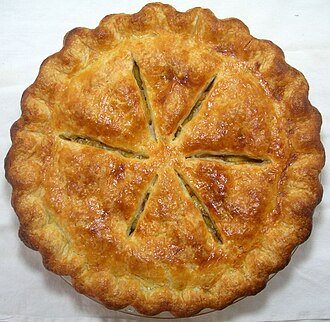
Photo: Wikipedia
Pie, NFS (Not Further Specified) is a broad category of baked dishes featuring a pastry crust, typically filled with sweet or savory ingredients. The texture ranges from flaky and buttery to tender and crumbly, with the filling providing a contrasting soft or juicy center. Nutritionally, it is a calorie-dense food, with a significant portion of its energy coming from carbohydrates and fats.
Calorie split: 4% protein · 50% carbs · 46% fat
↓ Full nutrition💚 Why it's loved
People love pie for its comforting, nostalgic appeal and the delightful contrast between a crisp, buttery crust and a flavorful filling. Its versatility allows it to be a centerpiece dessert or a hearty main course, fitting into countless cultural traditions.
⚠️ Watch-outs & how to enjoy it better
Pie, especially sweet varieties, can cause rapid blood-sugar spikes due to its high refined carbohydrate and sugar content. To counteract this, pair a slice with a source of protein (like Greek yogurt or nuts) or healthy fat (like a handful of almonds) to slow digestion. For savory pies, be mindful of high sodium in processed meat fillings; choosing versions with vegetables or lean meats can help.
Key benefits
- Provides quick energy from carbohydrates
- Can be a source of dietary fat for satiety
- Offers versatility for both sweet and savory meals
- Often a comforting, culturally significant food
- Can be adapted with various fillings for different nutrients
🍽️ Popular dishes
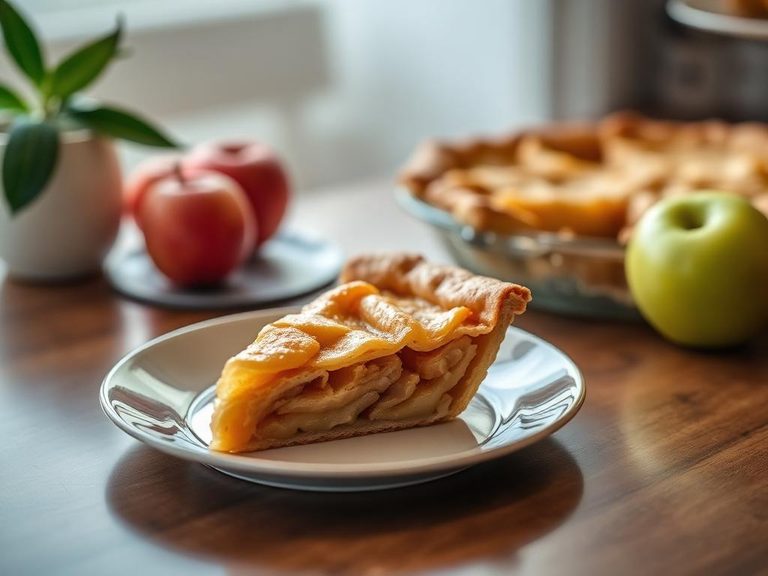


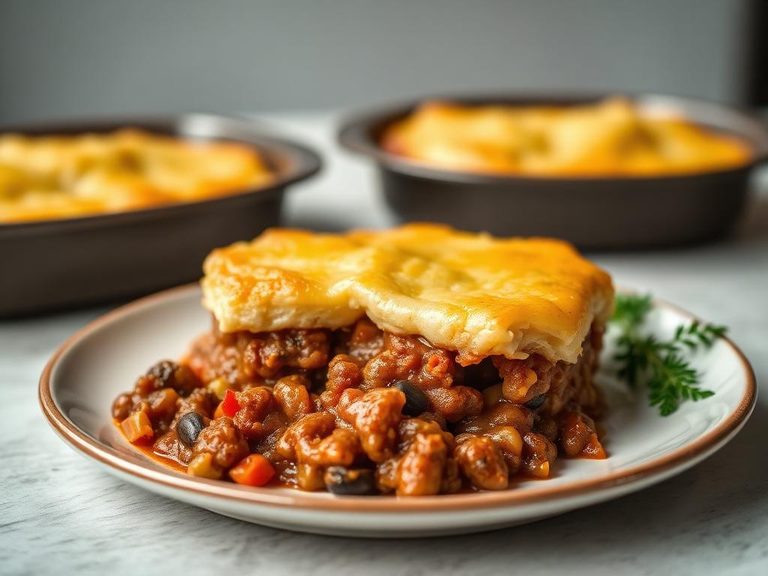


🌍 Where it's eaten
💡 Did you know?
The phrase 'as American as apple pie' is a common idiom, yet the concept of fruit-filled pastry crusts originated in ancient Greece and Rome.
Full nutrition (USDA data · scales with serving)
| Water | 43.7 g |
| Energy | 296 kcal |
| Protein | 2.7 g |
| Total lipid (fat) | 15.3 g |
| Carbohydrate, by difference | 37.5 g |
| Fiber, total dietary | 1.8 g |
| Total Sugars | 15.9 g |
| Calcium, Ca | 11.0 mg |
| Iron, Fe | 1.2 mg |
| Magnesium, Mg | 8.0 mg |
| Phosphorus, P | 36.0 mg |
| Potassium, K | 80.0 mg |
| Sodium, Na | 217 mg |
| Zinc, Zn | 0.22 mg |
| Copper, Cu | 0.05 mg |
| Selenium, Se | 2.9 ug |
| Vitamin C, total ascorbic acid | 0.50 mg |
| Thiamin | 0.13 mg |
| Riboflavin | 0.08 mg |
| Niacin | 1.4 mg |
| Vitamin B-6 | 0.09 mg |
| Folate, total | 29.0 ug |
| Folic acid | 20.0 ug |
| Folate, food | 9.0 ug |
| Folate, DFE | 42.0 ug |
| Choline, total | 7.1 mg |
| Vitamin B-12 | 0.00 ug |
| Vitamin B-12, added | 0.00 ug |
| Vitamin A, RAE | 40.0 ug |
| Retinol | 38.0 ug |
| Carotene, beta | 23.0 ug |
| Carotene, alpha | 0.00 ug |
| Cryptoxanthin, beta | 4.0 ug |
| Lycopene | 0.00 ug |
| Lutein + zeaxanthin | 8.0 ug |
| Vitamin E (alpha-tocopherol) | 0.65 mg |
| Vitamin E, added | 0.00 mg |
| Vitamin D (D2 + D3) | 0.10 ug |
| Vitamin K (phylloquinone) | 5.5 ug |
| Alcohol, ethyl | 0.00 g |
| Caffeine | 0.00 mg |
| Theobromine | 0.00 mg |
Fat & fatty acid profile (per 100g)
| Fatty acids, total saturated | 5.3 g |
| SFA 4:0 | 0.06 g |
| SFA 6:0 | 0.04 g |
| SFA 8:0 | 0.03 g |
| SFA 10:0 | 0.06 g |
| SFA 12:0 | 0.07 g |
| SFA 14:0 | 0.33 g |
| SFA 16:0 | 2.9 g |
| SFA 18:0 | 1.7 g |
| Fatty acids, total monounsaturated | 6.4 g |
| MUFA 16:1 | 0.20 g |
| MUFA 18:1 | 6.1 g |
| MUFA 20:1 | 0.07 g |
| MUFA 22:1 | 0.00 g |
| Fatty acids, total polyunsaturated | 2.0 g |
| PUFA 18:2 | 1.9 g |
| PUFA 18:3 | 0.12 g |
| PUFA 18:4 | 0.00 g |
| PUFA 20:4 | 0.01 g |
| PUFA 20:5 n-3 (EPA) | 0.00 g |
| PUFA 22:5 n-3 (DPA) | 0.00 g |
| PUFA 22:6 n-3 (DHA) | 0.00 g |
| Cholesterol | 7.0 mg |
Amino acid profile (per 100g)
Estimated from Pie Crust, Cookie-type, Chocolate, Ready Crust — USDA does not publish this profile for Pie.
| Tryptophan | 0.08 g |
| Threonine | 0.20 g |
| Isoleucine | 0.23 g |
| Leucine | 0.38 g |
| Lysine | 0.24 g |
| Methionine | 0.07 g |
| Cystine | 0.11 g |
| Phenylalanine | 0.28 g |
| Tyrosine | 0.16 g |
| Valine | 0.32 g |
| Arginine | 0.29 g |
| Histidine | 0.11 g |
| Alanine | 0.24 g |
| Aspartic acid | 0.45 g |
| Glutamic acid | 1.3 g |
| Glycine | 0.24 g |
| Proline | 0.42 g |
| Serine | 0.26 g |
FAQ
What does 'NFS' mean in 'Pie, NFS'?
NFS stands for 'Not Further Specified.' It's a generic term used in food databases to represent the average nutritional profile of pies without specifying a particular type (like apple or chicken pot pie).
Is pie a healthy food?
Pie is generally considered an indulgence rather than a health food due to its high calorie, fat, and sugar content. However, its nutritional value varies greatly depending on the filling and crust recipe. Savory pies with vegetable fillings can offer more nutrients than sweet dessert pies.
How can I make a pie healthier at home?
You can use whole-wheat flour for the crust, reduce sugar in the filling, incorporate more fruits or vegetables, and use healthier fats like olive oil in savory versions. Adding nuts or seeds to the crust can also boost fiber and protein.
Nutrient density (calculated · NRF9.3)
Nutrient Rich Foods index: beneficial nutrients (protein, fiber, vitamins, minerals) minus saturated fat, added sugar & sodium, per 100 kcal.
NRF9.3 index — Fulgoni, Keast & Drewnowski, 2009. Computed from USDA nutrients.
Weight-loss friendliness (composite index)
Energy density 2.96 kcal/g · 4% calories from protein · 1.8 g fiber · 15.9 g sugar per 100 g.
Composite of energy density (Rolls et al., 1999), protein & fiber satiety, minus sugar. A calculated heuristic — ranks satiety-per-calorie, not a clinical measure.
Dietary load (calculated from USDA values)
Potential renal acid load. Positive = acid-forming, negative = alkaline-forming.
Sodium-to-potassium ratio: 2.71 (lower is better — aim for ≤ 1)
Sodium:potassium per WHO potassium guidance. Computed from USDA nutrients.