

Pecans, unroasted
Common food

Photo: Wikipedia
Unroasted pecans are the raw, buttery kernels of the hickory tree, prized for their smooth, creamy texture and a sweet, subtly grassy flavor that lacks the deep, toasted notes of their roasted counterparts. Nutritionally, they are a powerhouse of monounsaturated fats, providing a dense source of energy with a notable amount of plant-based protein and fiber.
Calorie split: 5% protein · 7% carbs · 88% fat
↓ Full nutrition💚 Why it's loved
People adore pecans for their rich, buttery flavor that enhances both sweet and savory dishes, and for their cultural significance in Southern U.S. cuisine, especially in holiday classics like pecan pie.
⚠️ Watch-outs & how to enjoy it better
As a tree nut, pecans are a common allergen and should be avoided by those with nut allergies. Their high fat and calorie density (750 kcal per 100g) means portion control is key for weight management; a small handful (about 15-19 halves) is a standard serving.
Key benefits
- Excellent source of heart-healthy monounsaturated fats.
- Provides plant-based protein and dietary fiber.
- Rich in antioxidants, including ellagic acid and gamma-tocopherol.
- Contains essential minerals like manganese and copper.
- Naturally gluten-free and low in sugar.
🍽️ Popular dishes


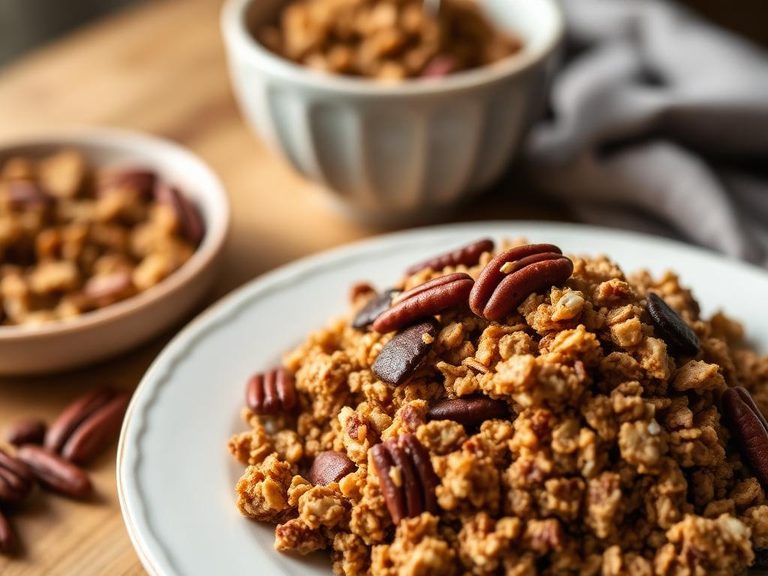

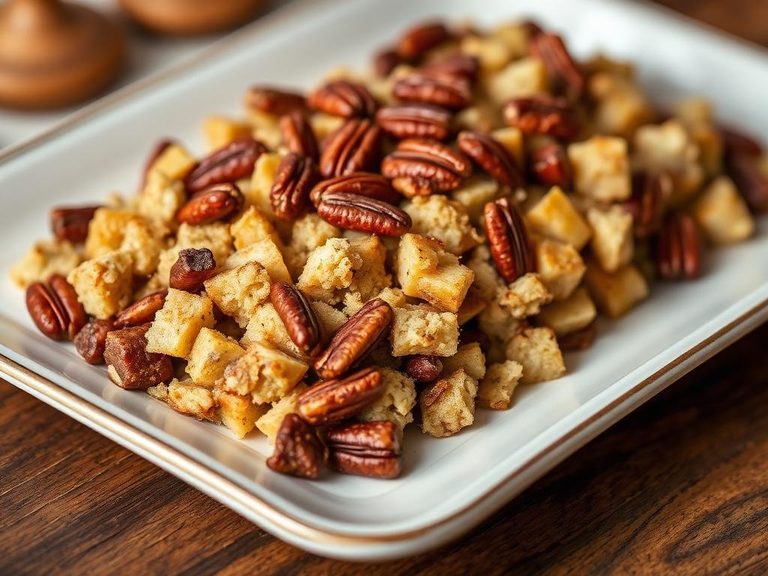
🌍 Where it's eaten
💡 Did you know?
The word 'pecan' is an Algonquian word meaning 'a nut too hard to be cracked by a stone tool,' referring to the Native American practice of using rocks to break the shells.
Full nutrition (USDA data · scales with serving)
| Water | 2.6 g |
| Energy | 750 kcal |
| Protein | 10.0 g |
| Total lipid (fat) | 73.3 g |
| Carbohydrate, by difference | 12.7 g |
| Fiber, total dietary | 5.8 g |
| Total Sugars | 4.0 g |
| Calcium, Ca | 55.0 mg |
| Iron, Fe | 2.4 mg |
| Magnesium, Mg | 103 mg |
| Phosphorus, P | 253 mg |
| Potassium, K | 360 mg |
| Sodium, Na | 0.00 mg |
| Zinc, Zn | 3.9 mg |
| Copper, Cu | 0.91 mg |
| Selenium, Se | 3.8 ug |
| Vitamin C, total ascorbic acid | 1.1 mg |
| Thiamin | 0.55 mg |
| Riboflavin | 0.13 mg |
| Niacin | 0.95 mg |
| Vitamin B-6 | 0.17 mg |
| Folate, total | 22.0 ug |
| Folic acid | 0.00 ug |
| Folate, food | 22.0 ug |
| Folate, DFE | 22.0 ug |
| Choline, total | 40.5 mg |
| Vitamin B-12 | 0.00 ug |
| Vitamin B-12, added | 0.00 ug |
| Vitamin A, RAE | 3.0 ug |
| Retinol | 0.00 ug |
| Carotene, beta | 29.0 ug |
| Carotene, alpha | 0.00 ug |
| Cryptoxanthin, beta | 9.0 ug |
| Lycopene | 0.00 ug |
| Lutein + zeaxanthin | 17.0 ug |
| Vitamin E (alpha-tocopherol) | 1.4 mg |
| Vitamin E, added | 0.00 mg |
| Vitamin D (D2 + D3) | 0.00 ug |
| Vitamin K (phylloquinone) | 4.1 ug |
| Alcohol, ethyl | 0.00 g |
| Caffeine | 0.00 mg |
| Theobromine | 0.00 mg |
Fat & fatty acid profile (per 100g)
| Fatty acids, total saturated | 6.5 g |
| SFA 4:0 | 0.00 g |
| SFA 6:0 | 0.00 g |
| SFA 8:0 | 0.00 g |
| SFA 10:0 | 0.00 g |
| SFA 12:0 | 0.00 g |
| SFA 14:0 | 0.00 g |
| SFA 16:0 | 4.4 g |
| SFA 18:0 | 1.7 g |
| Fatty acids, total monounsaturated | 39.3 g |
| MUFA 16:1 | 0.00 g |
| MUFA 18:1 | 40.6 g |
| MUFA 20:1 | 0.21 g |
| MUFA 22:1 | 0.00 g |
| Fatty acids, total polyunsaturated | 22.9 g |
| PUFA 18:2 | 20.6 g |
| PUFA 18:3 | 0.99 g |
| PUFA 18:4 | 0.00 g |
| PUFA 20:4 | 0.00 g |
| PUFA 20:5 n-3 (EPA) | 0.00 g |
| PUFA 22:5 n-3 (DPA) | 0.00 g |
| PUFA 22:6 n-3 (DHA) | 0.00 g |
| Cholesterol | 0.00 mg |
Amino acid profile (per 100g)
Estimated from Nuts, pecans, dry roasted, with salt added — USDA does not publish this profile for Pecans.
| Tryptophan | 0.10 g |
| Threonine | 0.32 g |
| Isoleucine | 0.35 g |
| Leucine | 0.62 g |
| Lysine | 0.30 g |
| Methionine | 0.19 g |
| Cystine | 0.16 g |
| Phenylalanine | 0.44 g |
| Tyrosine | 0.22 g |
| Valine | 0.43 g |
| Arginine | 1.2 g |
| Histidine | 0.27 g |
| Alanine | 0.41 g |
| Aspartic acid | 0.96 g |
| Glutamic acid | 1.9 g |
| Glycine | 0.47 g |
| Proline | 0.38 g |
| Serine | 0.49 g |
FAQ
What's the difference between raw and roasted pecans?
Raw (unroasted) pecans have a milder, grassier flavor and softer texture. Roasting deepens their flavor, enhances nuttiness, and makes them crunchier.
How should I store unroasted pecans?
To preserve their delicate fats and prevent rancidity, store them in an airtight container in the refrigerator for up to 6 months or the freezer for up to a year.
Can I use unroasted pecans in baking?
Yes, but their flavor will be milder. For recipes like pie or cookies where a pronounced nutty taste is desired, many bakers prefer to lightly toast them first.
Nutrient density (calculated · NRF9.3)
Nutrient Rich Foods index: beneficial nutrients (protein, fiber, vitamins, minerals) minus saturated fat, added sugar & sodium, per 100 kcal.
NRF9.3 index — Fulgoni, Keast & Drewnowski, 2009. Computed from USDA nutrients.
Weight-loss friendliness (composite index)
Energy density 7.50 kcal/g · 5% calories from protein · 5.8 g fiber · 4.0 g sugar per 100 g.
Composite of energy density (Rolls et al., 1999), protein & fiber satiety, minus sugar. A calculated heuristic — ranks satiety-per-calorie, not a clinical measure.
Dietary load (calculated from USDA values)
Potential renal acid load. Positive = acid-forming, negative = alkaline-forming.
Sodium-to-potassium ratio: 0.00 (lower is better — aim for ≤ 1)
Sodium:potassium per WHO potassium guidance. Computed from USDA nutrients.