

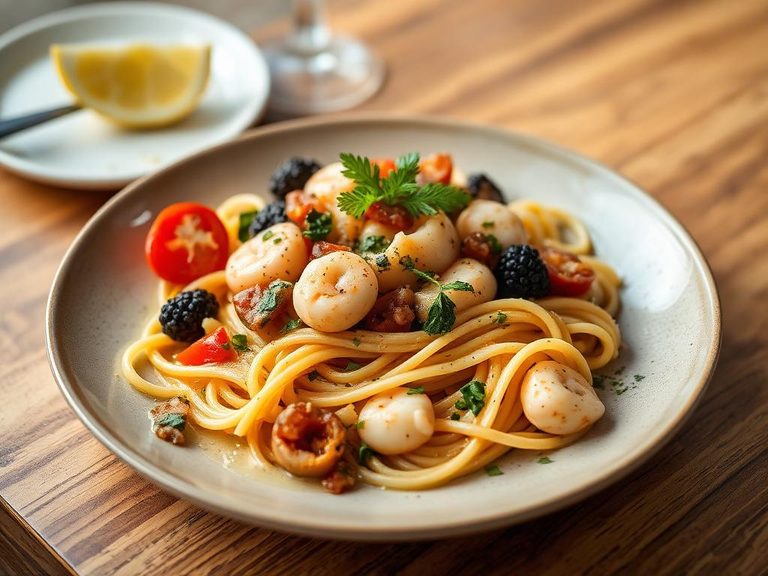
Pasta, whole grain, with tomato-based sauce and seafood, ready-to-heat
Common food

Photo: Wikipedia
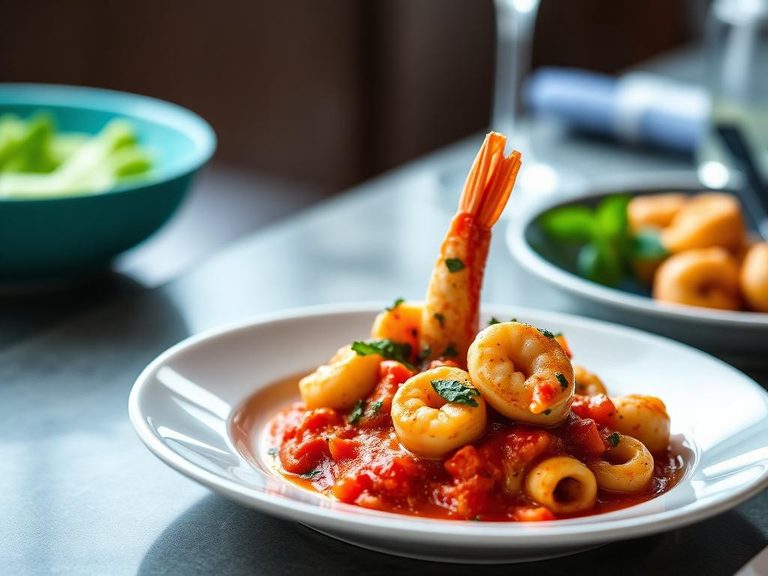
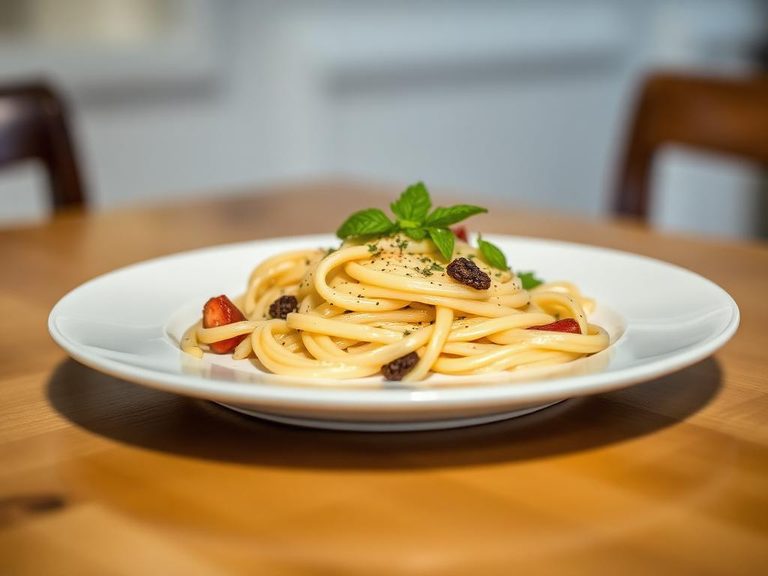
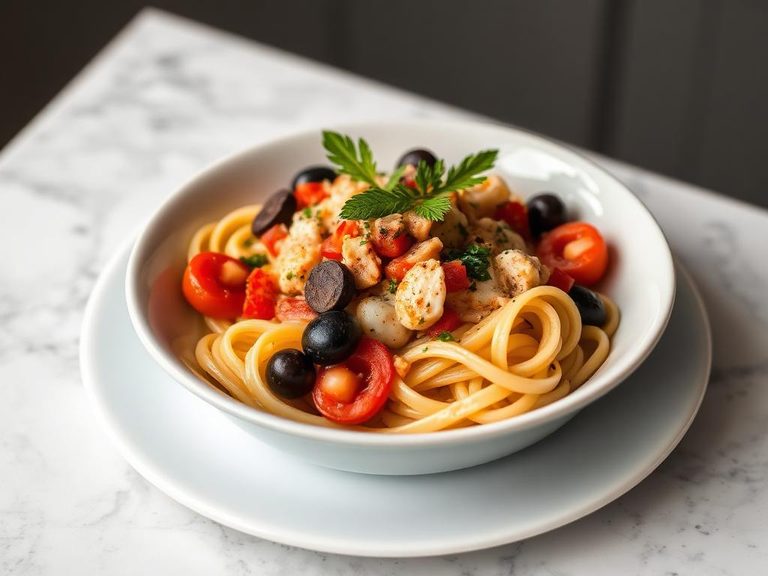
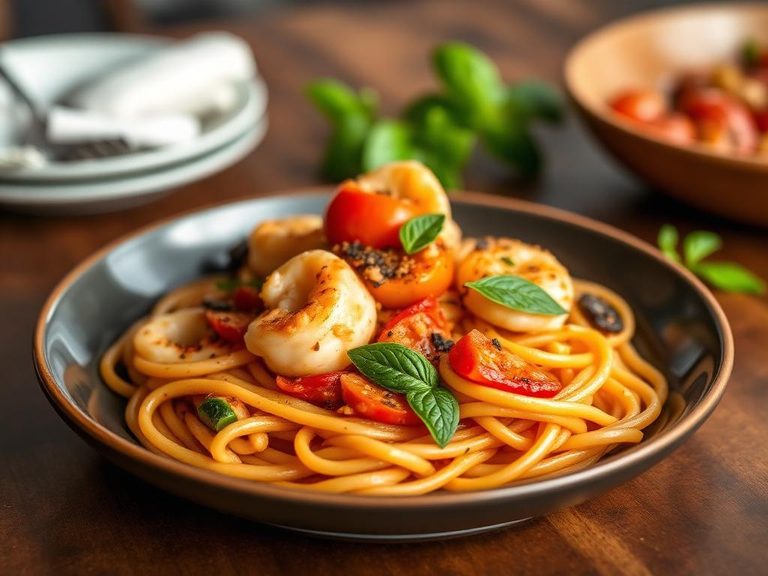
This is a convenient, ready-to-heat meal featuring tender whole grain pasta tossed in a savory tomato-based sauce with chunks of seafood like mussels, clams, or squid. It offers a satisfying, chewy texture from the whole grains, balanced by the briny sweetness of the seafood and the acidity of the tomatoes. Nutritionally, it provides a solid source of fiber and protein for a prepared meal, with a moderate calorie count.
Calorie split: 17% protein · 59% carbs · 24% fat
↓ Full nutrition💚 Why it's loved
People love it for the deep, savory umami from the seafood pairing with the bright, tangy tomato sauce, all in a quick, no-fuss package. It's a comforting taste of coastal cuisine that can be on the table in minutes.
⚠️ Watch-outs & how to enjoy it better
The sodium content can be high due to the sauce and seafood preservation, and it's a common allergen for those with shellfish or gluten sensitivities. To counteract sodium, pair with a fresh, potassium-rich side salad; for blood sugar management, consider a smaller portion and add extra vegetables or a drizzle of olive oil to slow digestion.
Key benefits
- Good source of dietary fiber from whole grain pasta
- Provides protein from both the pasta and seafood
- Convenient source of complex carbohydrates for energy
- Contains lycopene from the tomato-based sauce
- Lower in fat compared to cream-based pasta dishes
🍽️ Popular dishes
🌍 Where it's eaten
💡 Did you know?
The term 'frutti di mare' literally translates to 'fruits of the sea' in Italian, and while it often includes shellfish, the specific mix can vary dramatically by region and season.
Full nutrition (USDA data · scales with serving)
| Water | 71.0 g |
| Energy | 122 kcal |
| Protein | 5.5 g |
| Total lipid (fat) | 3.4 g |
| Carbohydrate, by difference | 18.6 g |
| Fiber, total dietary | 2.7 g |
| Total Sugars | 2.5 g |
| Calcium, Ca | 26.0 mg |
| Iron, Fe | 1.4 mg |
| Magnesium, Mg | 37.0 mg |
| Phosphorus, P | 100 mg |
| Potassium, K | 202 mg |
| Sodium, Na | 346 mg |
| Zinc, Zn | 0.88 mg |
| Copper, Cu | 0.16 mg |
| Selenium, Se | 23.3 ug |
| Vitamin C, total ascorbic acid | 0.90 mg |
| Thiamin | 0.09 mg |
| Riboflavin | 0.08 mg |
| Niacin | 3.1 mg |
| Vitamin B-6 | 0.12 mg |
| Folate, total | 16.0 ug |
| Folic acid | 0.00 ug |
| Folate, food | 16.0 ug |
| Folate, DFE | 16.0 ug |
| Choline, total | 16.9 mg |
| Vitamin B-12 | 0.86 ug |
| Vitamin B-12, added | 0.00 ug |
| Vitamin A, RAE | 19.0 ug |
| Retinol | 7.0 ug |
| Carotene, beta | 150 ug |
| Carotene, alpha | 0.00 ug |
| Cryptoxanthin, beta | 0.00 ug |
| Lycopene | 4860 ug |
| Lutein + zeaxanthin | 120 ug |
| Vitamin E (alpha-tocopherol) | 1.5 mg |
| Vitamin E, added | 0.00 mg |
| Vitamin D (D2 + D3) | 0.00 ug |
| Vitamin K (phylloquinone) | 7.5 ug |
| Alcohol, ethyl | 0.00 g |
| Caffeine | 0.00 mg |
| Theobromine | 0.00 mg |
Fat & fatty acid profile (per 100g)
| Fatty acids, total saturated | 0.45 g |
| SFA 4:0 | 0.00 g |
| SFA 6:0 | 0.00 g |
| SFA 8:0 | 0.00 g |
| SFA 10:0 | 0.00 g |
| SFA 12:0 | 0.00 g |
| SFA 14:0 | 0.00 g |
| SFA 16:0 | 0.33 g |
| SFA 18:0 | 0.08 g |
| Fatty acids, total monounsaturated | 1.0 g |
| MUFA 16:1 | 0.01 g |
| MUFA 18:1 | 0.98 g |
| MUFA 20:1 | 0.02 g |
| MUFA 22:1 | 0.00 g |
| Fatty acids, total polyunsaturated | 1.2 g |
| PUFA 18:2 | 1.1 g |
| PUFA 18:3 | 0.13 g |
| PUFA 18:4 | 0.00 g |
| PUFA 20:4 | 0.00 g |
| PUFA 20:5 n-3 (EPA) | 0.02 g |
| PUFA 22:5 n-3 (DPA) | 0.00 g |
| PUFA 22:6 n-3 (DHA) | 0.02 g |
| Cholesterol | 14.0 mg |
Amino acid profile (per 100g)
Estimated from Restaurant, Italian, chicken parmesan without pasta — USDA does not publish this profile for Pasta.
| Tryptophan | 0.20 g |
| Threonine | 0.66 g |
| Isoleucine | 0.72 g |
| Leucine | 1.3 g |
| Lysine | 1.3 g |
| Methionine | 0.41 g |
| Cystine | 0.20 g |
| Phenylalanine | 1.1 g |
| Tyrosine | 0.53 g |
| Valine | 0.81 g |
| Arginine | 0.93 g |
| Histidine | 0.50 g |
| Alanine | 0.79 g |
| Aspartic acid | 1.4 g |
| Glutamic acid | 2.8 g |
| Glycine | 0.61 g |
| Proline | 1.3 g |
| Serine | 0.70 g |
| Hydroxyproline | 0.04 g |
FAQ
Is this a good post-workout meal?
It can be, as it provides a mix of carbohydrates for glycogen replenishment and protein for muscle repair. The fiber content is also beneficial for sustained energy release.
How does the whole grain pasta affect the nutrition compared to regular pasta?
Whole grain pasta retains the bran and germ, providing more fiber, B vitamins, and minerals like magnesium and iron compared to refined white pasta, which leads to a slower digestion and more sustained energy.
What's the best way to heat it to preserve texture?
For best texture, stovetop heating in a covered pan with a splash of water is ideal to prevent the pasta from becoming mushy. If microwaving, use a lower power setting and stir halfway through.
Nutrient density (calculated · NRF9.3)
Nutrient Rich Foods index: beneficial nutrients (protein, fiber, vitamins, minerals) minus saturated fat, added sugar & sodium, per 100 kcal.
NRF9.3 index — Fulgoni, Keast & Drewnowski, 2009. Computed from USDA nutrients.
Weight-loss friendliness (composite index)
Energy density 1.22 kcal/g · 18% calories from protein · 2.7 g fiber · 2.5 g sugar per 100 g.
Composite of energy density (Rolls et al., 1999), protein & fiber satiety, minus sugar. A calculated heuristic — ranks satiety-per-calorie, not a clinical measure.
Dietary load (calculated from USDA values)
Potential renal acid load. Positive = acid-forming, negative = alkaline-forming.
Sodium-to-potassium ratio: 1.71 (lower is better — aim for ≤ 1)
Sodium:potassium per WHO potassium guidance. Computed from USDA nutrients.