

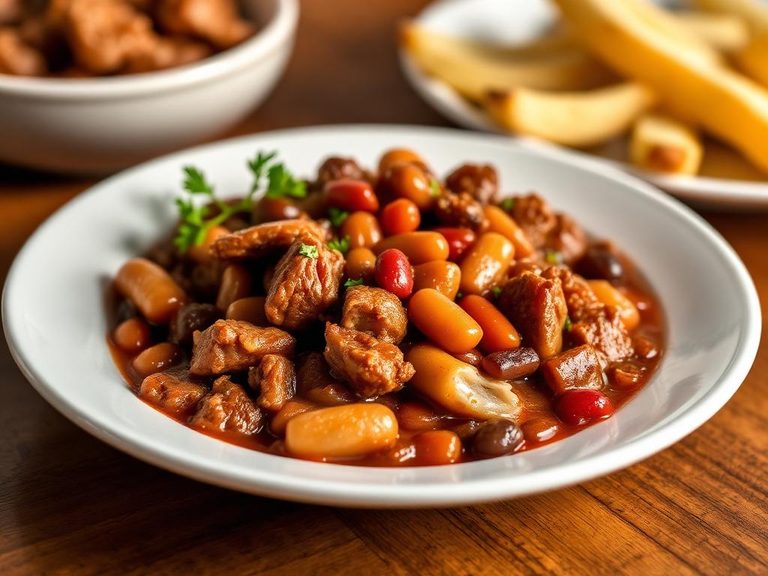
Kidney beans with meat
Common food

Photo: Wikipedia
Kidney beans with meat is a hearty, savory stew where tender, earthy beans are slow-cooked with savory, browned meat, creating a rich, comforting dish with a satisfying, thick texture. The beans absorb the meaty flavors while contributing a creamy bite, and the dish is a nutritional powerhouse, offering a balanced blend of plant-based and animal protein with substantial fiber.
Calorie split: 24% protein · 42% carbs · 35% fat
↓ Full nutrition💚 Why it's loved
People love it for its deep, savory umami flavor and the comforting, one-pot simplicity that makes it a versatile staple for family meals and gatherings across many cultures.
⚠️ Watch-outs & how to enjoy it better
The dish can be high in sodium if heavily salted or made with processed meats, and the combination of beans and meat may cause digestive discomfort for some. To counteract this, use low-sodium broth, rinse canned beans, and ensure the beans are thoroughly cooked; pairing with a fresh, acidic side like a salad can also aid digestion.
Key benefits
- High in plant-based and animal protein for muscle maintenance.
- Rich in dietary fiber, promoting digestive health and satiety.
- Provides complex carbohydrates for sustained energy release.
- Contains iron and B vitamins from the meat component.
- Low in sugar, making it a balanced meal option.
🍽️ Popular dishes
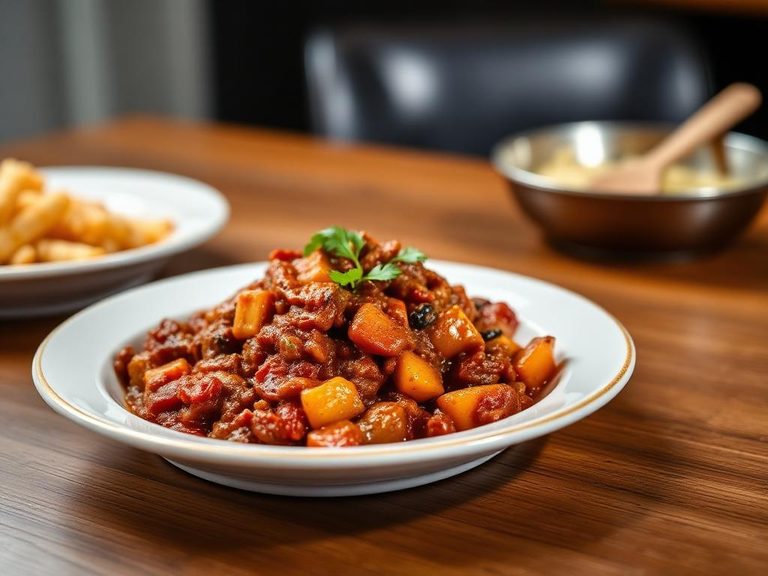
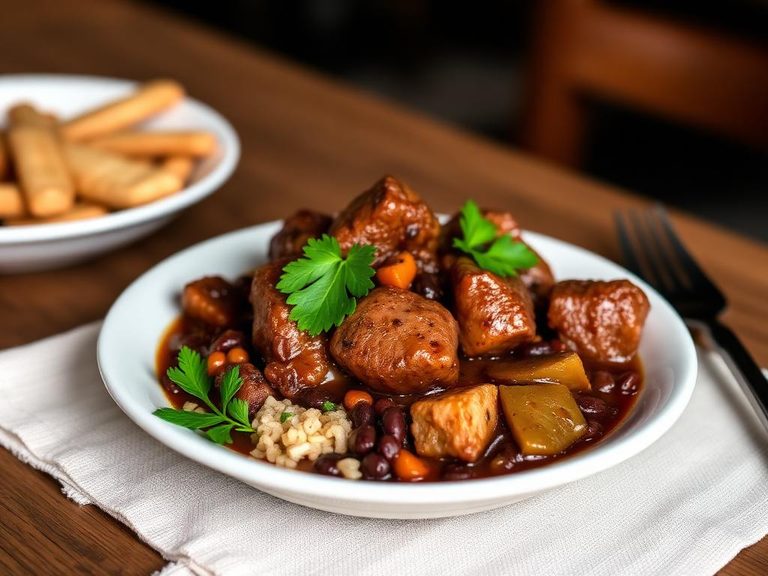
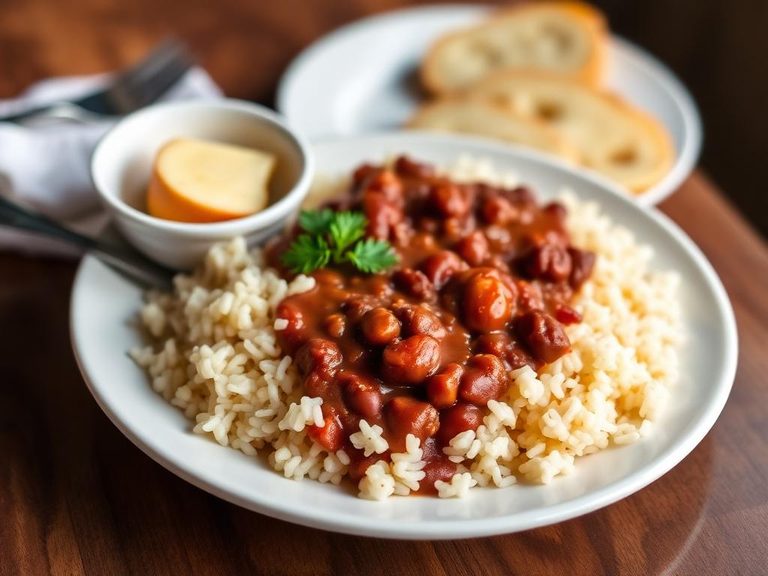
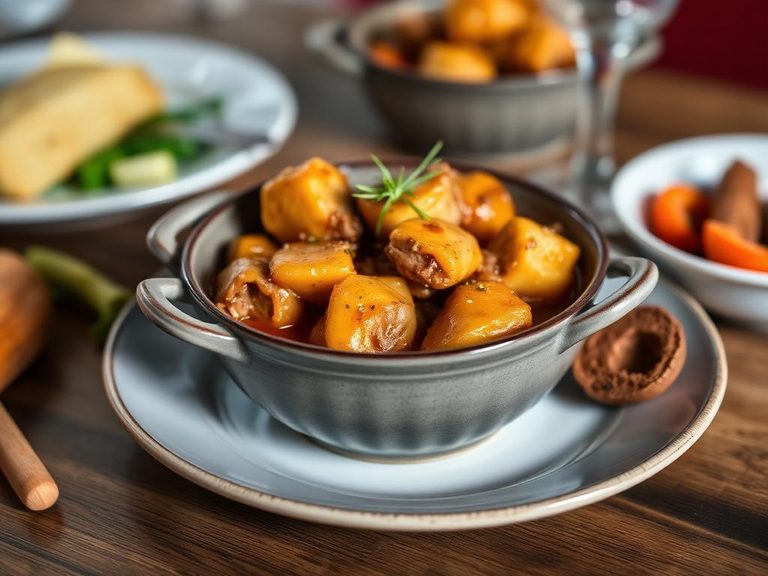
🌍 Where it's eaten
💡 Did you know?
Kidney beans contain a natural toxin called phytohaemagglutinin, which is destroyed by proper soaking and boiling but can cause severe nausea if beans are undercooked or slow-cooked at low temperatures.
Full nutrition (USDA data · scales with serving)
| Water | 62.8 g |
| Energy | 173 kcal |
| Protein | 10.5 g |
| Total lipid (fat) | 6.8 g |
| Carbohydrate, by difference | 18.3 g |
| Fiber, total dietary | 5.9 g |
| Total Sugars | 0.36 g |
| Calcium, Ca | 24.0 mg |
| Iron, Fe | 2.6 mg |
| Magnesium, Mg | 39.0 mg |
| Phosphorus, P | 148 mg |
| Potassium, K | 367 mg |
| Sodium, Na | 275 mg |
| Zinc, Zn | 1.6 mg |
| Copper, Cu | 0.21 mg |
| Selenium, Se | 5.8 ug |
| Vitamin C, total ascorbic acid | 0.90 mg |
| Thiamin | 0.15 mg |
| Riboflavin | 0.07 mg |
| Niacin | 1.1 mg |
| Vitamin B-6 | 0.15 mg |
| Folate, total | 99.0 ug |
| Folic acid | 0.00 ug |
| Folate, food | 99.0 ug |
| Folate, DFE | 99.0 ug |
| Choline, total | 36.8 mg |
| Vitamin B-12 | 0.22 ug |
| Vitamin B-12, added | 0.00 ug |
| Vitamin A, RAE | 1.0 ug |
| Retinol | 1.0 ug |
| Carotene, beta | 0.00 ug |
| Carotene, alpha | 0.00 ug |
| Cryptoxanthin, beta | 0.00 ug |
| Lycopene | 0.00 ug |
| Lutein + zeaxanthin | 0.00 ug |
| Vitamin E (alpha-tocopherol) | 1.1 mg |
| Vitamin E, added | 0.00 mg |
| Vitamin D (D2 + D3) | 0.10 ug |
| Vitamin K (phylloquinone) | 12.4 ug |
| Alcohol, ethyl | 0.00 g |
| Caffeine | 0.00 mg |
| Theobromine | 0.00 mg |
Fat & fatty acid profile (per 100g)
| Fatty acids, total saturated | 1.1 g |
| SFA 4:0 | 0.00 g |
| SFA 6:0 | 0.00 g |
| SFA 8:0 | 0.00 g |
| SFA 10:0 | 0.00 g |
| SFA 12:0 | 0.00 g |
| SFA 14:0 | 0.02 g |
| SFA 16:0 | 0.76 g |
| SFA 18:0 | 0.27 g |
| Fatty acids, total monounsaturated | 2.8 g |
| MUFA 16:1 | 0.04 g |
| MUFA 18:1 | 2.7 g |
| MUFA 20:1 | 0.04 g |
| MUFA 22:1 | 0.00 g |
| Fatty acids, total polyunsaturated | 2.4 g |
| PUFA 18:2 | 2.0 g |
| PUFA 18:3 | 0.38 g |
| PUFA 18:4 | 0.00 g |
| PUFA 20:4 | 0.01 g |
| PUFA 20:5 n-3 (EPA) | 0.00 g |
| PUFA 22:5 n-3 (DPA) | 0.00 g |
| PUFA 22:6 n-3 (DHA) | 0.00 g |
| Cholesterol | 11.0 mg |
Amino acid profile (per 100g)
Estimated from Beans, kidney, mature seeds, sprouted, cooked, boiled, drained, without salt — USDA does not publish this profile for Kidney beans with meat.
| Tryptophan | 0.05 g |
| Threonine | 0.20 g |
| Isoleucine | 0.21 g |
| Leucine | 0.35 g |
| Lysine | 0.28 g |
| Methionine | 0.05 g |
| Cystine | 0.06 g |
| Phenylalanine | 0.24 g |
| Tyrosine | 0.17 g |
| Valine | 0.25 g |
| Arginine | 0.26 g |
| Histidine | 0.14 g |
| Alanine | 0.20 g |
| Aspartic acid | 0.63 g |
| Glutamic acid | 0.59 g |
| Glycine | 0.17 g |
| Proline | 0.20 g |
| Serine | 0.26 g |
FAQ
Are kidney beans with meat a good source of protein?
Yes, it's an excellent source, combining the plant-based protein from kidney beans with the complete protein from meat, making it a highly complementary and filling meal.
How can I make this dish healthier?
Use lean cuts of meat like turkey or chicken breast, reduce added salt by using herbs and spices for flavor, and increase the bean-to-meat ratio for more fiber.
Can I make this dish vegetarian?
Absolutely. You can omit the meat and use vegetable broth, adding smoked paprika or mushrooms for a savory depth, or include other plant-based proteins like tofu.
Nutrient density (calculated · NRF9.3)
Nutrient Rich Foods index: beneficial nutrients (protein, fiber, vitamins, minerals) minus saturated fat, added sugar & sodium, per 100 kcal.
NRF9.3 index — Fulgoni, Keast & Drewnowski, 2009. Computed from USDA nutrients.
Weight-loss friendliness (composite index)
Energy density 1.73 kcal/g · 24% calories from protein · 5.9 g fiber · 0.4 g sugar per 100 g.
Composite of energy density (Rolls et al., 1999), protein & fiber satiety, minus sugar. A calculated heuristic — ranks satiety-per-calorie, not a clinical measure.
Dietary load (calculated from USDA values)
Potential renal acid load. Positive = acid-forming, negative = alkaline-forming.
Sodium-to-potassium ratio: 0.75 (lower is better — aim for ≤ 1)
Sodium:potassium per WHO potassium guidance. Computed from USDA nutrients.