

Hot dog, NFS
Common food
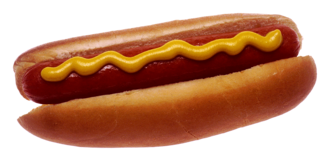
Photo: Wikipedia
A classic hot dog is a cooked, emulsified sausage—typically a blend of beef, pork, or poultry—served in a sliced bun. Its texture is uniquely smooth and juicy, with a signature 'snap' from the casing, delivering a savory, salty, and subtly smoky flavor. Nutritionally, it's a dense source of energy and fat, with a moderate protein content.
Calorie split: 15% protein · 4% carbs · 81% fat
↓ Full nutrition💚 Why it's loved
People adore the hot dog for its iconic, comforting flavor profile and the satisfying textural contrast between the soft bun and the juicy, snappy sausage. It's a cultural staple, evoking memories of baseball games, backyard barbecues, and summer street vendors.
⚠️ Watch-outs & how to enjoy it better
Hot dogs are typically high in sodium and saturated fat, and are classified as processed meat, which some health guidelines suggest limiting. To enjoy them mindfully, opt for a smaller portion, choose a whole-grain bun, and load up on fiber-rich toppings like sauerkraut, diced onions, and relish to balance the meal.
Key benefits
- Provides a quick and convenient source of energy and protein.
- Contains essential B vitamins like B12 and niacin for energy metabolism.
- A familiar, comforting food that's easy to prepare and eat.
- Highly customizable with a vast array of toppings and condiments.
🍽️ Popular dishes
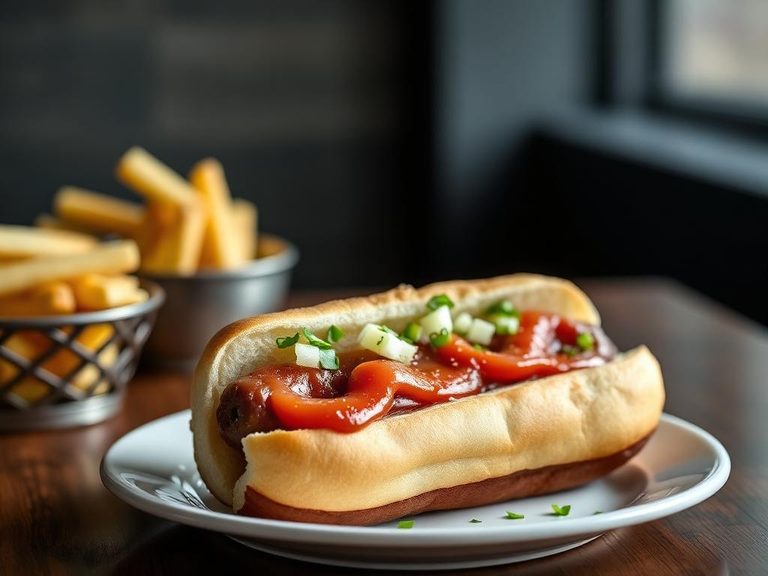




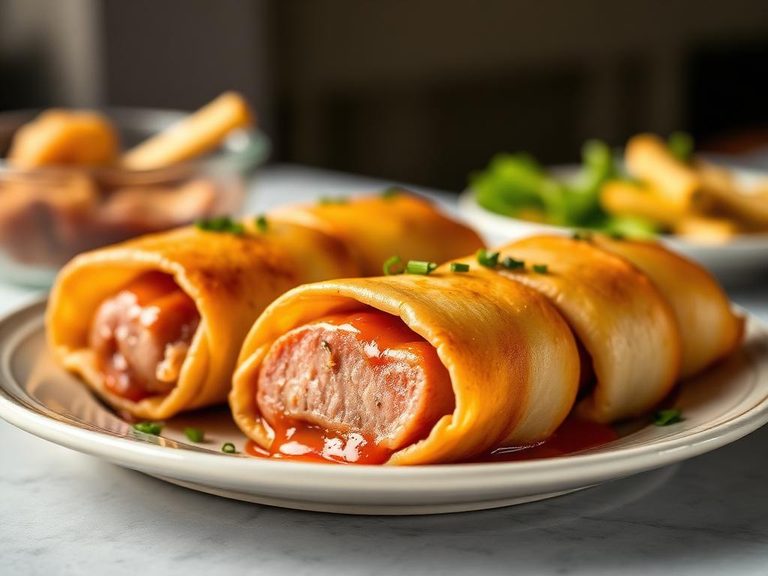
🌍 Where it's eaten
💡 Did you know?
The term 'hot dog' is believed to have originated from a cartoonist's joke in the early 1900s, who, unsure of the sausage's exact meat content, labeled a cartoon dachshund in a bun as a 'hot dog.'
Full nutrition (USDA data · scales with serving)
| Water | 54.6 g |
| Energy | 310 kcal |
| Protein | 11.7 g |
| Total lipid (fat) | 28.0 g |
| Carbohydrate, by difference | 2.9 g |
| Fiber, total dietary | 0.00 g |
| Total Sugars | 1.3 g |
| Calcium, Ca | 15.0 mg |
| Iron, Fe | 1.1 mg |
| Magnesium, Mg | 11.0 mg |
| Phosphorus, P | 122 mg |
| Potassium, K | 326 mg |
| Sodium, Na | 828 mg |
| Zinc, Zn | 2.1 mg |
| Copper, Cu | 0.05 mg |
| Selenium, Se | 10.3 ug |
| Vitamin C, total ascorbic acid | 0.00 mg |
| Thiamin | 0.03 mg |
| Riboflavin | 0.15 mg |
| Niacin | 2.0 mg |
| Vitamin B-6 | 0.10 mg |
| Folate, total | 0.00 ug |
| Folic acid | 0.00 ug |
| Folate, food | 0.00 ug |
| Folate, DFE | 0.00 ug |
| Choline, total | 31.9 mg |
| Vitamin B-12 | 0.82 ug |
| Vitamin B-12, added | 0.00 ug |
| Vitamin A, RAE | 3.0 ug |
| Retinol | 3.0 ug |
| Carotene, beta | 0.00 ug |
| Carotene, alpha | 0.00 ug |
| Cryptoxanthin, beta | 0.00 ug |
| Lycopene | 0.00 ug |
| Lutein + zeaxanthin | 0.00 ug |
| Vitamin E (alpha-tocopherol) | 0.51 mg |
| Vitamin E, added | 0.00 mg |
| Vitamin D (D2 + D3) | 0.90 ug |
| Vitamin K (phylloquinone) | 1.8 ug |
| Alcohol, ethyl | 0.00 g |
| Caffeine | 0.00 mg |
| Theobromine | 0.00 mg |
Fat & fatty acid profile (per 100g)
| Fatty acids, total saturated | 11.4 g |
| SFA 4:0 | 0.00 g |
| SFA 6:0 | 0.00 g |
| SFA 8:0 | 0.01 g |
| SFA 10:0 | 0.01 g |
| SFA 12:0 | 0.02 g |
| SFA 14:0 | 0.84 g |
| SFA 16:0 | 6.3 g |
| SFA 18:0 | 3.7 g |
| Fatty acids, total monounsaturated | 12.1 g |
| MUFA 16:1 | 1.1 g |
| MUFA 18:1 | 11.8 g |
| MUFA 20:1 | 0.12 g |
| MUFA 22:1 | 0.06 g |
| Fatty acids, total polyunsaturated | 0.95 g |
| PUFA 18:2 | 0.93 g |
| PUFA 18:3 | 0.09 g |
| PUFA 18:4 | 0.00 g |
| PUFA 20:4 | 0.03 g |
| PUFA 20:5 n-3 (EPA) | 0.00 g |
| PUFA 22:5 n-3 (DPA) | 0.01 g |
| PUFA 22:6 n-3 (DHA) | 0.00 g |
| Cholesterol | 58.0 mg |
Amino acid profile (per 100g)
Estimated from Pickle relish, hot dog — USDA does not publish this profile for Hot dog.
| Tryptophan | 0.02 g |
| Threonine | 0.05 g |
| Isoleucine | 0.05 g |
| Leucine | 0.07 g |
| Lysine | 0.07 g |
| Methionine | 0.02 g |
| Cystine | 0.02 g |
| Phenylalanine | 0.05 g |
| Tyrosine | 0.03 g |
| Valine | 0.06 g |
| Arginine | 0.10 g |
| Histidine | 0.03 g |
| Alanine | 0.06 g |
| Aspartic acid | 0.09 g |
| Glutamic acid | 0.33 g |
| Glycine | 0.06 g |
| Proline | 0.07 g |
| Serine | 0.05 g |
FAQ
What's the difference between a frankfurter and a wiener?
Traditionally, a frankfurter is made from beef, while a wiener is made from pork and beef. In practice, the terms are often used interchangeably, and the ingredients can vary by brand and recipe.
Why do hot dogs sometimes get wrinkly when boiled?
The wrinkles form when the hot dog is overcooked. The heat causes the proteins in the meat to contract and squeeze out moisture, leading to a shriveled appearance. For the best texture, heat them gently until just warmed through.
Is the casing on a hot dog edible?
Yes, all hot dog casings are edible. Natural casings (made from animal intestine) provide the classic 'snap,' while collagen casings are thinner and more uniform. Most standard hot dogs are casing-less.
Nutrient density (calculated · NRF9.3)
Nutrient Rich Foods index: beneficial nutrients (protein, fiber, vitamins, minerals) minus saturated fat, added sugar & sodium, per 100 kcal.
NRF9.3 index — Fulgoni, Keast & Drewnowski, 2009. Computed from USDA nutrients.
Weight-loss friendliness (composite index)
Energy density 3.10 kcal/g · 15% calories from protein · 0.0 g fiber · 1.3 g sugar per 100 g.
Composite of energy density (Rolls et al., 1999), protein & fiber satiety, minus sugar. A calculated heuristic — ranks satiety-per-calorie, not a clinical measure.
Dietary load (calculated from USDA values)
Potential renal acid load. Positive = acid-forming, negative = alkaline-forming.
Sodium-to-potassium ratio: 2.54 (lower is better — aim for ≤ 1)
Sodium:potassium per WHO potassium guidance. Computed from USDA nutrients.