

Frankfurter, pork
Whole food · Sausages and Luncheon Meats

Photo: Wikipedia
The classic pork frankfurter is a finely ground, emulsified sausage with a signature snappy casing and a rich, savory, smoky flavor. Nutritionally, it is a high-fat, low-carb protein source, delivering over 23g of fat and nearly 13g of protein per 100g. Its dense, juicy texture and distinctive pink hue make it a staple of casual dining worldwide.
Calorie split: 19% protein · 0% carbs · 80% fat
↓ Full nutrition💚 Why it's loved
People love it for its satisfyingly snappy bite and the deep, smoky umami that pairs perfectly with mustard, sauerkraut, or a soft bun. It is a cultural icon of comfort food, evoking memories of summer cookouts, baseball games, and quick, hearty meals.
⚠️ Watch-outs & how to enjoy it better
Due to its high fat and sodium content, it may not be suitable for those on strict heart-healthy or low-sodium diets. To counteract these, pair it with high-fiber sides like a large green salad or roasted vegetables, and practice strict portion control by sticking to a single link.
Key benefits
- High in protein for muscle maintenance
- Very low in carbohydrates and sugars
- Provides a dense, convenient source of energy
- Rich in B vitamins, particularly B12 and niacin
- Highly versatile for quick meal preparation
🍽️ Popular dishes



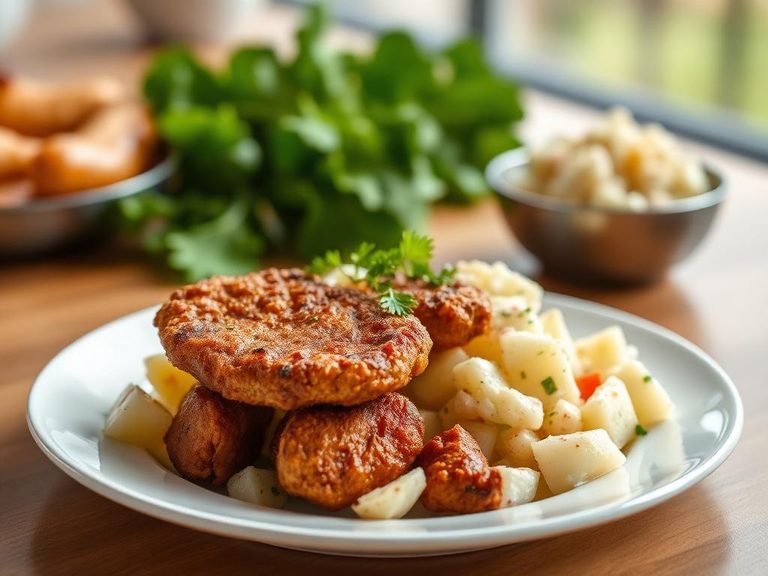


🌍 Where it's eaten
💡 Did you know?
The term 'frankfurter' actually refers to the city of Frankfurt, Germany, where the sausage was supposedly first created in the 13th century, though the neighboring city of Vienna (Wien) also claims its own version, the 'Wiener'.
Full nutrition (USDA data · scales with serving)
| Water | 59.9 g |
| Energy | 269 kcal |
| Energy | 1127 kj |
| Protein | 12.8 g |
| Total lipid (fat) | 23.7 g |
| Ash | 3.4 g |
| Carbohydrate, by difference | 0.28 g |
| Fiber, total dietary | 0.10 g |
| Total Sugars | 0.00 g |
| Calcium, Ca | 267 mg |
| Iron, Fe | 3.7 mg |
| Magnesium, Mg | 15.0 mg |
| Phosphorus, P | 171 mg |
| Potassium, K | 264 mg |
| Sodium, Na | 816 mg |
| Zinc, Zn | 2.1 mg |
| Copper, Cu | 0.07 mg |
| Manganese, Mn | 0.02 mg |
| Selenium, Se | 27.8 ug |
| Vitamin C, total ascorbic acid | 2.0 mg |
| Thiamin | 0.59 mg |
| Riboflavin | 0.18 mg |
| Niacin | 2.8 mg |
| Pantothenic acid | 0.51 mg |
| Vitamin B-6 | 0.32 mg |
| Folate, total | 3.0 ug |
| Folic acid | 0.00 ug |
| Folate, food | 3.0 ug |
| Folate, DFE | 3.0 ug |
| Vitamin B-12 | 0.49 ug |
| Vitamin A, RAE | 79.0 ug |
| Retinol | 79.0 ug |
| Carotene, beta | 0.00 ug |
| Carotene, alpha | 0.00 ug |
| Cryptoxanthin, beta | 0.00 ug |
| Vitamin A, IU | 263 iu |
| Lycopene | 0.00 ug |
| Lutein + zeaxanthin | 0.00 ug |
| Alcohol, ethyl | 0.00 g |
| Caffeine | 0.00 mg |
| Theobromine | 0.00 mg |
Fat & fatty acid profile (per 100g)
| Fatty acids, total saturated | 8.7 g |
| SFA 10:0 | 0.00 g |
| SFA 12:0 | 0.00 g |
| SFA 14:0 | 0.20 g |
| SFA 16:0 | 5.4 g |
| SFA 18:0 | 3.0 g |
| Fatty acids, total monounsaturated | 10.9 g |
| MUFA 16:1 | 0.41 g |
| MUFA 18:1 | 10.1 g |
| MUFA 20:1 | 0.28 g |
| MUFA 22:1 | 0.00 g |
| Fatty acids, total polyunsaturated | 2.2 g |
| PUFA 18:2 | 2.0 g |
| PUFA 18:3 | 0.15 g |
| PUFA 18:4 | 0.00 g |
| PUFA 20:4 | 0.04 g |
| PUFA 20:5 n-3 (EPA) | 0.00 g |
| PUFA 22:5 n-3 (DPA) | 0.00 g |
| PUFA 22:6 n-3 (DHA) | 0.00 g |
| Cholesterol | 66.0 mg |
| Phytosterols | 1.0 mg |
Amino acid profile (per 100g)
| Tryptophan | 0.15 g |
| Threonine | 0.56 g |
| Isoleucine | 0.57 g |
| Leucine | 1.0 g |
| Lysine | 1.1 g |
| Methionine | 0.32 g |
| Cystine | 0.15 g |
| Phenylalanine | 0.50 g |
| Tyrosine | 0.42 g |
| Valine | 0.68 g |
| Arginine | 0.81 g |
| Histidine | 0.47 g |
| Alanine | 0.75 g |
| Aspartic acid | 1.1 g |
| Glutamic acid | 1.9 g |
| Glycine | 0.74 g |
| Proline | 0.60 g |
| Serine | 0.53 g |
FAQ
What is the difference between a frankfurter and a hot dog?
While the terms are often used interchangeably, a frankfurter is traditionally made of pork and beef, while a hot dog can be made from various meats or even plant-based ingredients. In the US, 'frankfurter' often refers specifically to the German-style sausage, while 'hot dog' is the broader category for the sausage in a bun.
Are frankfurters pre-cooked?
Yes, most commercial frankfurters are fully cooked during the manufacturing process. They are typically sold fully cooked and only need to be heated through before eating.
How should I store leftover frankfurters?
Once opened, store them in an airtight container in the refrigerator for up to 7 days. For longer storage, they can be frozen for up to 2 months, though the texture may change slightly upon thawing.
Nutrient density (calculated · NRF9.3)
Nutrient Rich Foods index: beneficial nutrients (protein, fiber, vitamins, minerals) minus saturated fat, added sugar & sodium, per 100 kcal.
NRF9.3 index — Fulgoni, Keast & Drewnowski, 2009. Computed from USDA nutrients.
Weight-loss friendliness (composite index)
Energy density 2.69 kcal/g · 19% calories from protein · 0.1 g fiber · 0.0 g sugar per 100 g.
Composite of energy density (Rolls et al., 1999), protein & fiber satiety, minus sugar. A calculated heuristic — ranks satiety-per-calorie, not a clinical measure.
Dietary load (calculated from USDA values)
Potential renal acid load. Positive = acid-forming, negative = alkaline-forming.
Sodium-to-potassium ratio: 3.09 (lower is better — aim for ≤ 1)
Sodium:potassium per WHO potassium guidance. Computed from USDA nutrients.