

Fish sandwich, fried, from fast food, with cheese
Common food
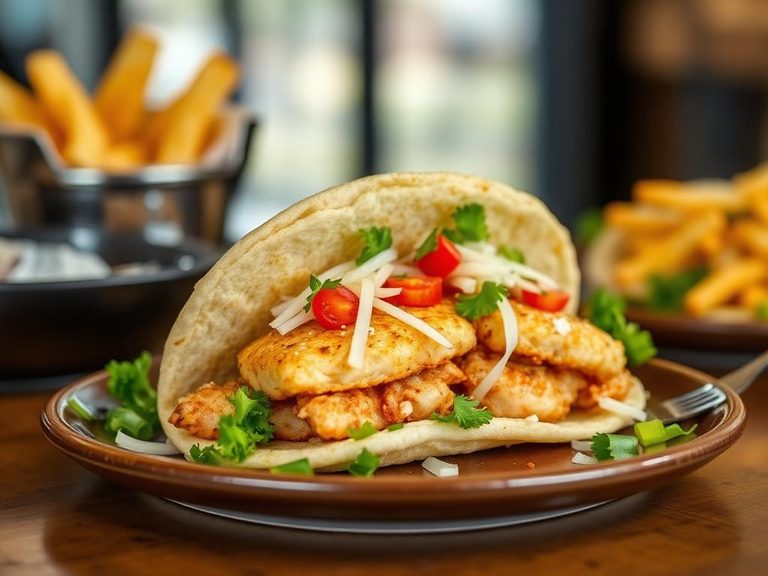
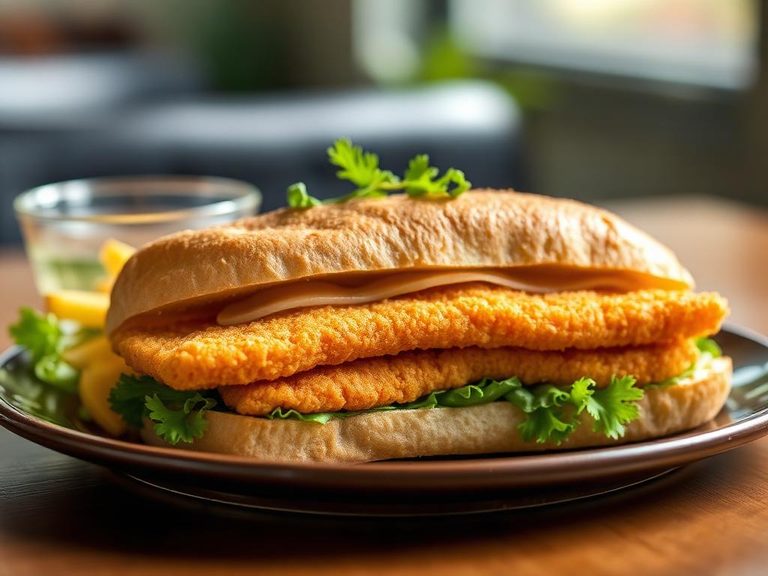
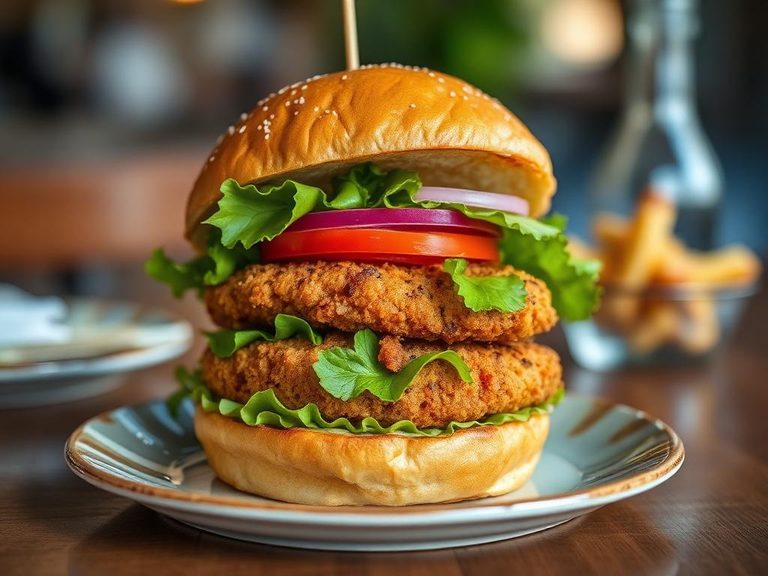
A golden, crispy fried fish fillet nestled in a soft bun, often with a slice of melted cheese. It offers a satisfying crunch giving way to tender, flaky fish, with a savory, salty profile. Nutritionally, it's a moderate-calorie meal with a solid protein base but is also notable for its carbohydrate and fat content from the breading and frying.
Calorie split: 24% protein · 36% carbs · 39% fat
↓ Full nutrition💚 Why it's loved
People adore the classic contrast of textures—the crispy, seasoned batter against the soft bun and tender fish. It's a beloved comfort food staple, offering a familiar, savory satisfaction that's both quick and filling.
⚠️ Watch-outs & how to enjoy it better
The deep-frying process adds significant calories and fats, and the refined bun can cause a rapid blood-sugar spike. To counteract, pair it with a side salad or steamed veggies to add fiber, and consider eating only half the bun to reduce refined carbs. Be mindful of sodium content, especially if watching blood pressure.
Key benefits
- Good source of protein for muscle maintenance
- Provides quick energy from carbohydrates
- Contains some calcium from cheese
- Offers a convenient, ready-to-eat meal
- Can be a source of omega-3s depending on the fish used
🍽️ Popular dishes


🌍 Where it's eaten
💡 Did you know?
The Filet-O-Fish was the first new sandwich introduced to the McDonald's menu in 1962, created specifically for Catholic customers who abstained from meat on Fridays.
Full nutrition (USDA data · scales with serving)
| Water | 49.1 g |
| Energy | 252 kcal |
| Protein | 15.3 g |
| Total lipid (fat) | 10.9 g |
| Carbohydrate, by difference | 22.9 g |
| Fiber, total dietary | 0.80 g |
| Total Sugars | 3.1 g |
| Calcium, Ca | 187 mg |
| Iron, Fe | 1.7 mg |
| Magnesium, Mg | 25.0 mg |
| Phosphorus, P | 239 mg |
| Potassium, K | 218 mg |
| Sodium, Na | 537 mg |
| Zinc, Zn | 0.90 mg |
| Copper, Cu | 0.06 mg |
| Selenium, Se | 27.1 ug |
| Vitamin C, total ascorbic acid | 0.50 mg |
| Thiamin | 0.26 mg |
| Riboflavin | 0.21 mg |
| Niacin | 3.6 mg |
| Vitamin B-6 | 0.17 mg |
| Folate, total | 50.0 ug |
| Folic acid | 26.0 ug |
| Folate, food | 24.0 ug |
| Folate, DFE | 68.0 ug |
| Choline, total | 43.7 mg |
| Vitamin B-12 | 1.1 ug |
| Vitamin B-12, added | 0.00 ug |
| Vitamin A, RAE | 45.0 ug |
| Retinol | 44.0 ug |
| Carotene, beta | 11.0 ug |
| Carotene, alpha | 0.00 ug |
| Cryptoxanthin, beta | 1.0 ug |
| Lycopene | 0.00 ug |
| Lutein + zeaxanthin | 8.0 ug |
| Vitamin E (alpha-tocopherol) | 0.98 mg |
| Vitamin E, added | 0.00 mg |
| Vitamin D (D2 + D3) | 0.80 ug |
| Vitamin K (phylloquinone) | 10.4 ug |
| Alcohol, ethyl | 0.00 g |
| Caffeine | 0.00 mg |
| Theobromine | 0.00 mg |
Fat & fatty acid profile (per 100g)
| Fatty acids, total saturated | 4.3 g |
| SFA 4:0 | 0.08 g |
| SFA 6:0 | 0.07 g |
| SFA 8:0 | 0.04 g |
| SFA 10:0 | 0.10 g |
| SFA 12:0 | 0.12 g |
| SFA 14:0 | 0.37 g |
| SFA 16:0 | 1.7 g |
| SFA 18:0 | 1.7 g |
| Fatty acids, total monounsaturated | 2.8 g |
| MUFA 16:1 | 0.08 g |
| MUFA 18:1 | 2.8 g |
| MUFA 20:1 | 0.04 g |
| MUFA 22:1 | 0.00 g |
| Fatty acids, total polyunsaturated | 2.6 g |
| PUFA 18:2 | 2.3 g |
| PUFA 18:3 | 0.18 g |
| PUFA 18:4 | 0.00 g |
| PUFA 20:4 | 0.01 g |
| PUFA 20:5 n-3 (EPA) | 0.02 g |
| PUFA 22:5 n-3 (DPA) | 0.01 g |
| PUFA 22:6 n-3 (DHA) | 0.05 g |
| Cholesterol | 42.0 mg |
Amino acid profile (per 100g)
Estimated from BURGER KING, Premium Fish Sandwich — USDA does not publish this profile for Fish sandwich.
| Tryptophan | 0.08 g |
| Threonine | 0.36 g |
| Isoleucine | 0.39 g |
| Leucine | 0.80 g |
| Lysine | 0.66 g |
| Methionine | 0.23 g |
| Cystine | 0.15 g |
| Phenylalanine | 0.48 g |
| Tyrosine | 0.34 g |
| Valine | 0.46 g |
| Arginine | 0.49 g |
| Histidine | 0.21 g |
| Alanine | 0.38 g |
| Aspartic acid | 0.71 g |
| Glutamic acid | 2.5 g |
| Glycine | 0.41 g |
| Proline | 0.71 g |
| Serine | 0.49 g |
| Hydroxyproline | 0.00 g |
FAQ
Is a fried fish sandwich healthier than a fried chicken sandwich?
Generally, the fish sandwich may have slightly less total fat and calories than a comparable fried chicken sandwich, as fish is often leaner. However, the difference can be minimal depending on the breading, oil, and condiments used. Fish can offer beneficial omega-3 fatty acids, which chicken does not.
What kind of fish is typically used?
Fast-food chains often use mild, white fish like pollock, cod, or haddock. These varieties have a neutral flavor that pairs well with breading and sauces, and they are sustainable and cost-effective choices.
Can I make a healthier version at home?
Absolutely. Use a lean white fish, coat it in whole-grain breadcrumbs or panko, and bake or air-fry it instead of deep-frying. Serve it on a whole-wheat bun with plenty of lettuce, tomato, and a yogurt-based sauce to boost fiber and reduce unhealthy fats.
Nutrient density (calculated · NRF9.3)
Nutrient Rich Foods index: beneficial nutrients (protein, fiber, vitamins, minerals) minus saturated fat, added sugar & sodium, per 100 kcal.
NRF9.3 index — Fulgoni, Keast & Drewnowski, 2009. Computed from USDA nutrients.
Weight-loss friendliness (composite index)
Energy density 2.52 kcal/g · 24% calories from protein · 0.8 g fiber · 3.1 g sugar per 100 g.
Composite of energy density (Rolls et al., 1999), protein & fiber satiety, minus sugar. A calculated heuristic — ranks satiety-per-calorie, not a clinical measure.
Dietary load (calculated from USDA values)
Potential renal acid load. Positive = acid-forming, negative = alkaline-forming.
Sodium-to-potassium ratio: 2.46 (lower is better — aim for ≤ 1)
Sodium:potassium per WHO potassium guidance. Computed from USDA nutrients.