

Egg, whole, fried, NS as to fat
Common food
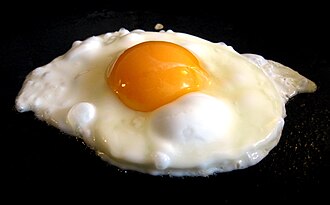
Photo: Wikipedia
A whole egg fried in a small amount of fat, yielding a crisp, golden-edged white and a rich, runny or set yolk. The texture is a delightful contrast between the slightly chewy, savory white and the creamy, fatty yolk. It's a calorie-dense, high-protein food with a significant portion of its energy coming from healthy fats.
Calorie split: 25% protein · 2% carbs · 73% fat
↓ Full nutrition💚 Why it's loved
People adore its savory, umami-rich flavor and the satisfying textural contrast between the crispy edges and the creamy yolk. It's a beloved, versatile staple for breakfast, lunch, or dinner across countless cultures.
⚠️ Watch-outs & how to enjoy it better
Frying adds significant calories and fat compared to boiling or poaching. Individuals monitoring cholesterol intake or with egg allergies should be cautious. To counteract, use a non-stick pan with minimal oil or an air fryer, and pair with fiber-rich vegetables to balance the meal.
Key benefits
- Excellent source of complete, high-quality protein for muscle repair.
- Rich in choline, essential for brain health and metabolism.
- Provides fat-soluble vitamins A, D, E, and K from the yolk.
- Contains lutein and zeaxanthin, antioxidants that support eye health.
- Highly satiating, helping with appetite control.
🍽️ Popular dishes




🌍 Where it's eaten
💡 Did you know?
The 'sunny-side up' vs. 'over easy' distinction is largely an American convention; in many parts of Asia, eggs are often fried on both sides until the yolk is fully set.
Full nutrition (USDA data · scales with serving)
| Water | 71.4 g |
| Energy | 185 kcal |
| Protein | 11.6 g |
| Total lipid (fat) | 15.0 g |
| Carbohydrate, by difference | 0.91 g |
| Fiber, total dietary | 0.00 g |
| Total Sugars | 0.20 g |
| Calcium, Ca | 46.0 mg |
| Iron, Fe | 1.6 mg |
| Magnesium, Mg | 10.0 mg |
| Phosphorus, P | 172 mg |
| Potassium, K | 124 mg |
| Sodium, Na | 248 mg |
| Zinc, Zn | 1.2 mg |
| Copper, Cu | 0.00 mg |
| Selenium, Se | 29.0 ug |
| Vitamin C, total ascorbic acid | 0.00 mg |
| Thiamin | 0.06 mg |
| Riboflavin | 0.37 mg |
| Niacin | 0.00 mg |
| Vitamin B-6 | 0.09 mg |
| Folate, total | 50.0 ug |
| Folic acid | 0.00 ug |
| Folate, food | 50.0 ug |
| Folate, DFE | 50.0 ug |
| Choline, total | 250 mg |
| Vitamin B-12 | 0.76 ug |
| Vitamin B-12, added | 0.00 ug |
| Vitamin A, RAE | 193 ug |
| Retinol | 191 ug |
| Carotene, beta | 11.0 ug |
| Carotene, alpha | 0.00 ug |
| Cryptoxanthin, beta | 12.0 ug |
| Lycopene | 0.00 ug |
| Lutein + zeaxanthin | 469 ug |
| Vitamin E (alpha-tocopherol) | 1.8 mg |
| Vitamin E, added | 0.00 mg |
| Vitamin D (D2 + D3) | 2.4 ug |
| Vitamin K (phylloquinone) | 5.0 ug |
| Alcohol, ethyl | 0.00 g |
| Caffeine | 0.00 mg |
| Theobromine | 0.00 mg |
Fat & fatty acid profile (per 100g)
| Fatty acids, total saturated | 4.5 g |
| SFA 4:0 | 0.04 g |
| SFA 6:0 | 0.03 g |
| SFA 8:0 | 0.02 g |
| SFA 10:0 | 0.04 g |
| SFA 12:0 | 0.04 g |
| SFA 14:0 | 0.17 g |
| SFA 16:0 | 3.0 g |
| SFA 18:0 | 1.1 g |
| Fatty acids, total monounsaturated | 5.4 g |
| MUFA 16:1 | 0.25 g |
| MUFA 18:1 | 5.1 g |
| MUFA 20:1 | 0.03 g |
| MUFA 22:1 | 0.00 g |
| Fatty acids, total polyunsaturated | 3.3 g |
| PUFA 18:2 | 2.8 g |
| PUFA 18:3 | 0.19 g |
| PUFA 18:4 | 0.00 g |
| PUFA 20:4 | 0.00 g |
| PUFA 20:5 n-3 (EPA) | 0.00 g |
| PUFA 22:5 n-3 (DPA) | 0.00 g |
| PUFA 22:6 n-3 (DHA) | 0.00 g |
| Cholesterol | 388 mg |
Amino acid profile (per 100g)
Estimated from Fish, whitefish, eggs (Alaska Native) — USDA does not publish this profile for Egg.
| Tryptophan | 0.28 g |
| Threonine | 1.0 g |
| Isoleucine | 1.1 g |
| Leucine | 1.6 g |
| Lysine | 1.6 g |
| Methionine | 0.56 g |
| Cystine | 0.23 g |
| Phenylalanine | 0.90 g |
| Tyrosine | 0.76 g |
| Valine | 1.3 g |
| Arginine | 1.1 g |
| Histidine | 0.53 g |
| Alanine | 1.6 g |
| Aspartic acid | 1.6 g |
| Glutamic acid | 2.2 g |
| Glycine | 0.50 g |
| Proline | 1.1 g |
| Serine | 1.2 g |
FAQ
Is the nutritional info for one egg or per 100g?
The provided data (185 kcal, 11.58g protein) is per 100 grams. A typical large fried egg weighs about 46-50 grams, so one egg would have roughly half those values.
How does frying affect the nutrition compared to boiling?
Frying increases the total calories and fat content due to the added cooking fat. It can also slightly reduce heat-sensitive vitamins like B12, but the protein and mineral content remains largely stable.
What's the best way to fry an egg for minimal added fat?
Use a quality non-stick skillet, preheat it properly, and use just a teaspoon of oil or a quick spray. You can also 'fry' an egg in a small amount of water or broth for a lower-fat result.
Nutrient density (calculated · NRF9.3)
Nutrient Rich Foods index: beneficial nutrients (protein, fiber, vitamins, minerals) minus saturated fat, added sugar & sodium, per 100 kcal.
NRF9.3 index — Fulgoni, Keast & Drewnowski, 2009. Computed from USDA nutrients.
Weight-loss friendliness (composite index)
Energy density 1.85 kcal/g · 25% calories from protein · 0.0 g fiber · 0.2 g sugar per 100 g.
Composite of energy density (Rolls et al., 1999), protein & fiber satiety, minus sugar. A calculated heuristic — ranks satiety-per-calorie, not a clinical measure.
Dietary load (calculated from USDA values)
Potential renal acid load. Positive = acid-forming, negative = alkaline-forming.
Sodium-to-potassium ratio: 2.00 (lower is better — aim for ≤ 1)
Sodium:potassium per WHO potassium guidance. Computed from USDA nutrients.