

Egg omelet or scrambled egg, with dark-green vegetables, no added fat
Common food

Photo: Wikipedia
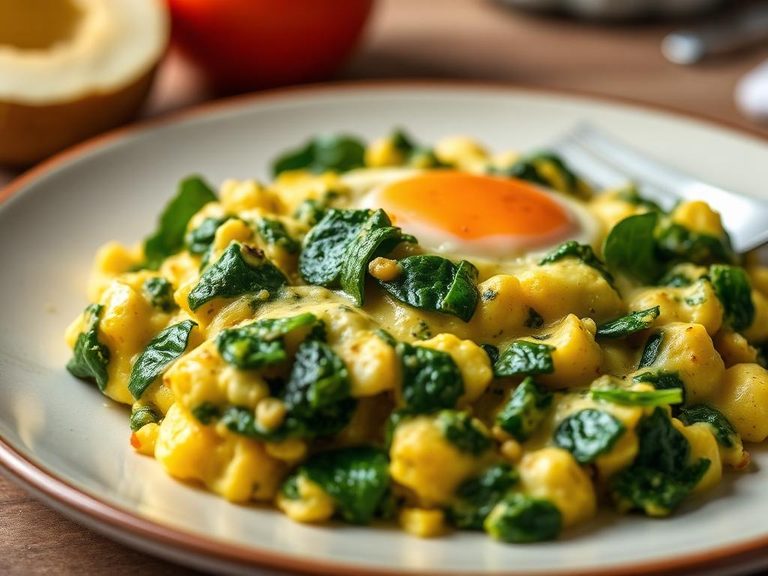
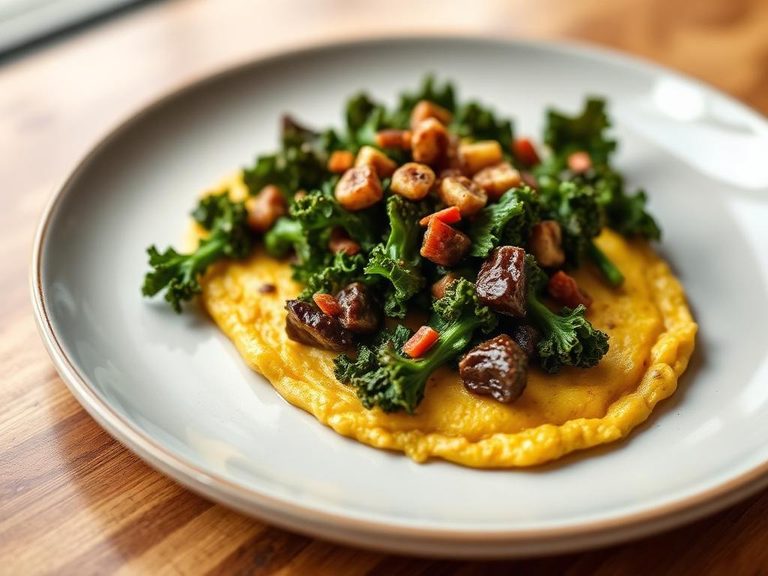
A fluffy, protein-packed scramble of eggs folded with vibrant dark-green vegetables like spinach or kale, cooked without a drop of added fat. The texture is tender and custardy, with the earthy greens providing a pleasant contrast. It's a lean, high-protein meal with minimal carbs, making it a staple for health-conscious eaters.
Calorie split: 35% protein · 4% carbs · 61% fat
↓ Full nutrition💚 Why it's loved
People love it for its quick, customizable nature—it's a canvas for herbs and spices—and its satisfying, savory flavor that feels both wholesome and indulgent. It's a universal comfort food that bridges breakfast, lunch, and dinner across cultures.
⚠️ Watch-outs & how to enjoy it better
The lack of added fat can make it drier or stick to the pan if not cooked carefully. Those watching cholesterol intake should be mindful of portion size. To counteract dryness, use a non-stick pan and cook on medium-low heat. For cholesterol concerns, balance with fiber-rich sides like whole-grain toast.
Key benefits
- Excellent source of high-quality protein for muscle maintenance.
- Rich in iron and folate from the dark-green vegetables.
- Very low in carbohydrates and sugars.
- Provides essential vitamins like A, C, and K from the greens.
- Naturally low in calories while being nutrient-dense.
🍽️ Popular dishes
🌍 Where it's eaten
💡 Did you know?
Cooking eggs with dark greens like spinach can actually increase the bioavailability of certain nutrients, like beta-carotene, because the fat in the yolk helps your body absorb them better.
Full nutrition (USDA data · scales with serving)
| Water | 77.5 g |
| Energy | 129 kcal |
| Protein | 11.1 g |
| Total lipid (fat) | 8.7 g |
| Carbohydrate, by difference | 1.4 g |
| Fiber, total dietary | 0.30 g |
| Total Sugars | 0.33 g |
| Calcium, Ca | 50.0 mg |
| Iron, Fe | 1.6 mg |
| Magnesium, Mg | 20.0 mg |
| Phosphorus, P | 166 mg |
| Potassium, K | 173 mg |
| Sodium, Na | 225 mg |
| Zinc, Zn | 1.1 mg |
| Copper, Cu | 0.01 mg |
| Selenium, Se | 27.0 ug |
| Vitamin C, total ascorbic acid | 4.5 mg |
| Thiamin | 0.06 mg |
| Riboflavin | 0.37 mg |
| Niacin | 0.07 mg |
| Vitamin B-6 | 0.08 mg |
| Folate, total | 57.0 ug |
| Folic acid | 0.00 ug |
| Folate, food | 57.0 ug |
| Folate, DFE | 57.0 ug |
| Choline, total | 235 mg |
| Vitamin B-12 | 0.71 ug |
| Vitamin B-12, added | 0.00 ug |
| Vitamin A, RAE | 188 ug |
| Retinol | 155 ug |
| Carotene, beta | 377 ug |
| Carotene, alpha | 0.00 ug |
| Cryptoxanthin, beta | 12.0 ug |
| Lycopene | 0.00 ug |
| Lutein + zeaxanthin | 1259 ug |
| Vitamin E (alpha-tocopherol) | 1.1 mg |
| Vitamin E, added | 0.00 mg |
| Vitamin D (D2 + D3) | 2.2 ug |
| Vitamin K (phylloquinone) | 54.1 ug |
| Alcohol, ethyl | 0.00 g |
| Caffeine | 0.00 mg |
| Theobromine | 0.00 mg |
Fat & fatty acid profile (per 100g)
| Fatty acids, total saturated | 2.8 g |
| SFA 4:0 | 0.00 g |
| SFA 6:0 | 0.00 g |
| SFA 8:0 | 0.00 g |
| SFA 10:0 | 0.00 g |
| SFA 12:0 | 0.00 g |
| SFA 14:0 | 0.03 g |
| SFA 16:0 | 2.0 g |
| SFA 18:0 | 0.71 g |
| Fatty acids, total monounsaturated | 3.1 g |
| MUFA 16:1 | 0.21 g |
| MUFA 18:1 | 2.9 g |
| MUFA 20:1 | 0.00 g |
| MUFA 22:1 | 0.00 g |
| Fatty acids, total polyunsaturated | 1.6 g |
| PUFA 18:2 | 1.3 g |
| PUFA 18:3 | 0.03 g |
| PUFA 18:4 | 0.00 g |
| PUFA 20:4 | 0.00 g |
| PUFA 20:5 n-3 (EPA) | 0.00 g |
| PUFA 22:5 n-3 (DPA) | 0.00 g |
| PUFA 22:6 n-3 (DHA) | 0.00 g |
| Cholesterol | 356 mg |
Amino acid profile (per 100g)
Estimated from Egg, whole, cooked, omelet — USDA does not publish this profile for Egg omelet or scrambled egg.
| Tryptophan | 0.14 g |
| Threonine | 0.47 g |
| Isoleucine | 0.56 g |
| Leucine | 0.91 g |
| Lysine | 0.77 g |
| Methionine | 0.32 g |
| Cystine | 0.23 g |
| Phenylalanine | 0.57 g |
| Tyrosine | 0.42 g |
| Valine | 0.72 g |
| Arginine | 0.69 g |
| Histidine | 0.26 g |
| Alanine | 0.62 g |
| Aspartic acid | 1.1 g |
| Glutamic acid | 1.4 g |
| Glycine | 0.36 g |
| Proline | 0.43 g |
| Serine | 0.82 g |
FAQ
How do I prevent it from being watery?
Wilt the greens first in the hot pan to release excess moisture, then add the beaten eggs. Avoid overcooking, which can squeeze out water from the vegetables.
Can I use frozen spinach?
Yes, but thaw it completely and squeeze out all excess water first to avoid a soggy result.
What greens work best besides spinach?
Kale, Swiss chard, collard greens, or finely chopped broccoli are excellent choices. Sturdier greens benefit from being chopped small and pre-cooked slightly.
Nutrient density (calculated · NRF9.3)
Nutrient Rich Foods index: beneficial nutrients (protein, fiber, vitamins, minerals) minus saturated fat, added sugar & sodium, per 100 kcal.
NRF9.3 index — Fulgoni, Keast & Drewnowski, 2009. Computed from USDA nutrients.
Weight-loss friendliness (composite index)
Energy density 1.29 kcal/g · 35% calories from protein · 0.3 g fiber · 0.3 g sugar per 100 g.
Composite of energy density (Rolls et al., 1999), protein & fiber satiety, minus sugar. A calculated heuristic — ranks satiety-per-calorie, not a clinical measure.
Dietary load (calculated from USDA values)
Potential renal acid load. Positive = acid-forming, negative = alkaline-forming.
Sodium-to-potassium ratio: 1.30 (lower is better — aim for ≤ 1)
Sodium:potassium per WHO potassium guidance. Computed from USDA nutrients.