

Doughnut, jelly
Common food
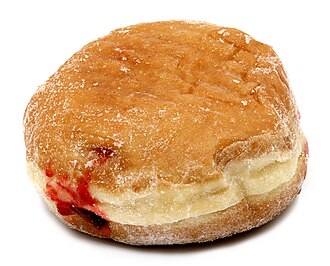
Photo: Wikipedia
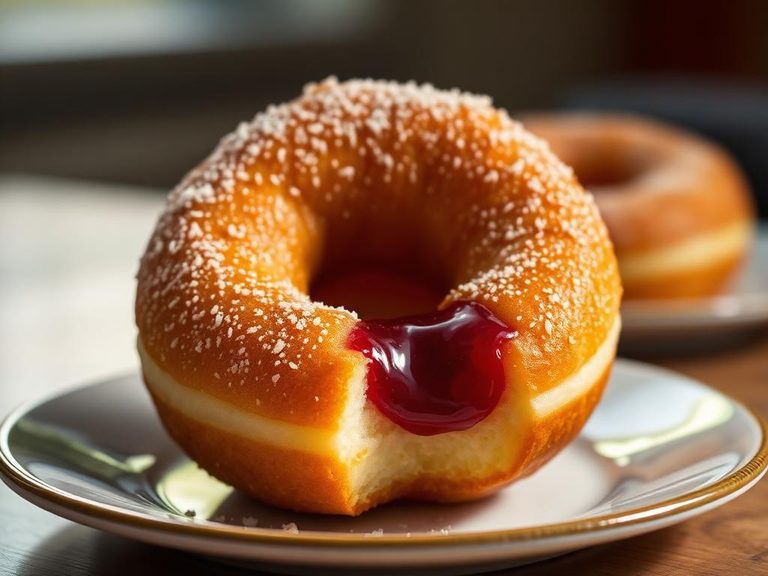
A golden, yeast-raised ring or shell, deep-fried to a tender crumb and filled with a vibrant, sweet fruit jam or jelly. The exterior offers a slight crispness giving way to a soft, airy interior, with a burst of fruity sweetness from the center. Nutritionally, it's a dense source of quick energy from carbohydrates and sugars, with a moderate fat content from frying.
Calorie split: 5% protein · 53% carbs · 42% fat
↓ Full nutrition💚 Why it's loved
People love the satisfying contrast between the warm, soft dough and the cool, sweet burst of jelly filling. It's a nostalgic comfort food often associated with weekend mornings, fairs, and indulgent treats.
⚠️ Watch-outs & how to enjoy it better
The high sugar and refined carbohydrate content can cause rapid blood-sugar spikes, followed by a crash. It is also calorie-dense with minimal fiber, making it easy to overconsume. To counteract, enjoy a small portion (one doughnut) alongside a source of protein or healthy fat (like a handful of nuts or a hard-boiled egg) to slow sugar absorption and increase satiety.
Key benefits
- Quick source of energy from carbohydrates
- Provides a small amount of protein from wheat flour
- Contains trace minerals from enriched flour
- Offers a psychological boost as a comfort food
- A traditional celebratory treat in many cultures
🍽️ Popular dishes
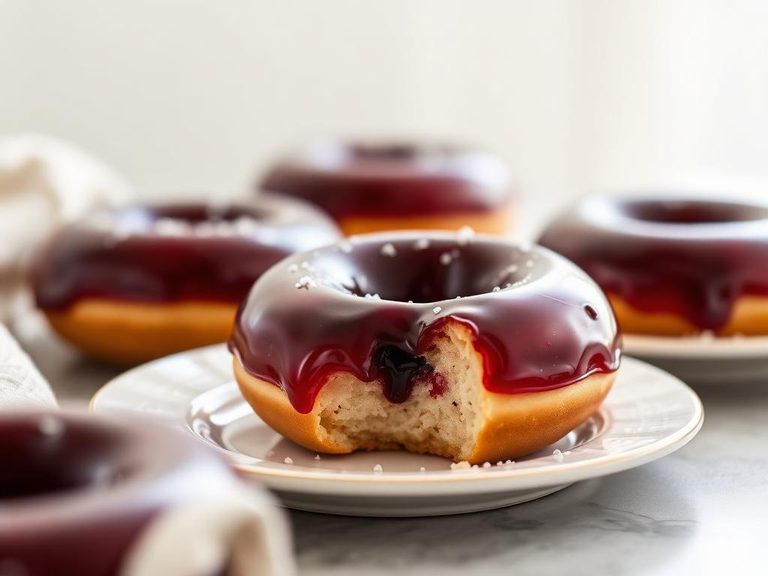


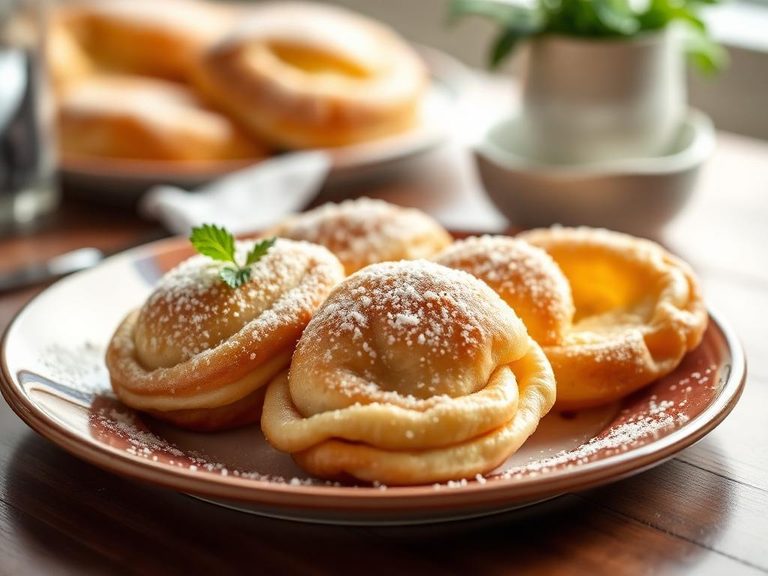
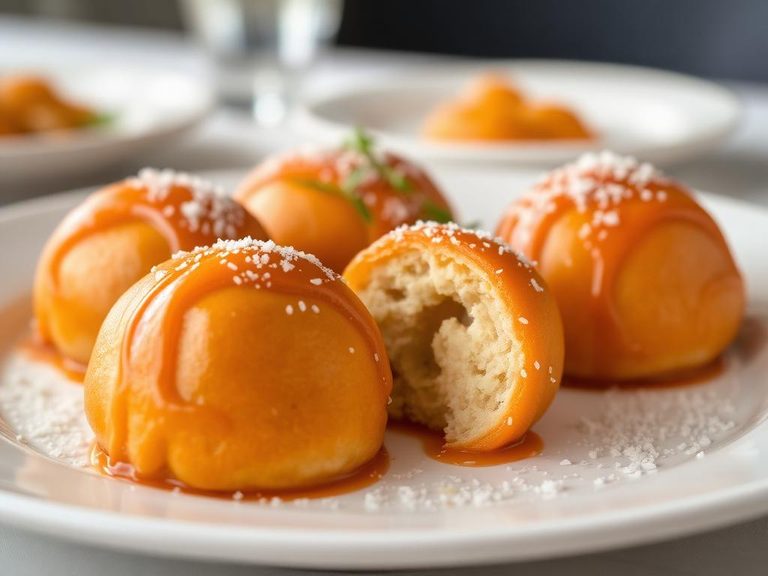
🌍 Where it's eaten
💡 Did you know?
The tradition of eating jelly doughnuts (sufganiyot) during Hanukkah is specifically tied to the oil used for frying, commemorating the miracle of the oil in the Temple that lasted eight days.
Full nutrition (USDA data · scales with serving)
| Water | 23.6 g |
| Energy | 390 kcal |
| Protein | 4.9 g |
| Total lipid (fat) | 18.2 g |
| Carbohydrate, by difference | 52.3 g |
| Fiber, total dietary | 1.9 g |
| Total Sugars | 28.4 g |
| Calcium, Ca | 82.0 mg |
| Iron, Fe | 1.9 mg |
| Magnesium, Mg | 15.0 mg |
| Phosphorus, P | 95.0 mg |
| Potassium, K | 92.0 mg |
| Sodium, Na | 259 mg |
| Zinc, Zn | 0.49 mg |
| Copper, Cu | 0.07 mg |
| Selenium, Se | 12.6 ug |
| Vitamin C, total ascorbic acid | 1.1 mg |
| Thiamin | 0.25 mg |
| Riboflavin | 0.15 mg |
| Niacin | 2.1 mg |
| Vitamin B-6 | 0.03 mg |
| Folate, total | 87.0 ug |
| Folic acid | 54.0 ug |
| Folate, food | 32.0 ug |
| Folate, DFE | 124 ug |
| Choline, total | 25.3 mg |
| Vitamin B-12 | 0.09 ug |
| Vitamin B-12, added | 0.00 ug |
| Vitamin A, RAE | 4.0 ug |
| Retinol | 4.0 ug |
| Carotene, beta | 3.0 ug |
| Carotene, alpha | 1.0 ug |
| Cryptoxanthin, beta | 1.0 ug |
| Lycopene | 0.00 ug |
| Lutein + zeaxanthin | 33.0 ug |
| Vitamin E (alpha-tocopherol) | 1.1 mg |
| Vitamin E, added | 0.00 mg |
| Vitamin D (D2 + D3) | 0.10 ug |
| Vitamin K (phylloquinone) | 9.3 ug |
| Alcohol, ethyl | 0.00 g |
| Caffeine | 0.00 mg |
| Theobromine | 0.00 mg |
Fat & fatty acid profile (per 100g)
| Fatty acids, total saturated | 7.6 g |
| SFA 4:0 | 0.00 g |
| SFA 6:0 | 0.00 g |
| SFA 8:0 | 0.01 g |
| SFA 10:0 | 0.01 g |
| SFA 12:0 | 0.09 g |
| SFA 14:0 | 0.16 g |
| SFA 16:0 | 5.9 g |
| SFA 18:0 | 1.3 g |
| Fatty acids, total monounsaturated | 5.8 g |
| MUFA 16:1 | 0.04 g |
| MUFA 18:1 | 5.7 g |
| MUFA 20:1 | 0.04 g |
| MUFA 22:1 | 0.00 g |
| Fatty acids, total polyunsaturated | 2.9 g |
| PUFA 18:2 | 2.7 g |
| PUFA 18:3 | 0.17 g |
| PUFA 18:4 | 0.00 g |
| PUFA 20:4 | 0.00 g |
| PUFA 20:5 n-3 (EPA) | 0.00 g |
| PUFA 22:5 n-3 (DPA) | 0.00 g |
| PUFA 22:6 n-3 (DHA) | 0.01 g |
| Cholesterol | 24.0 mg |
Amino acid profile (per 100g)
Estimated from Doughnuts, yeast-leavened, with creme filling — USDA does not publish this profile for Doughnut.
| Tryptophan | 0.08 g |
| Threonine | 0.21 g |
| Isoleucine | 0.27 g |
| Leucine | 0.48 g |
| Lysine | 0.24 g |
| Methionine | 0.12 g |
| Cystine | 0.13 g |
| Phenylalanine | 0.31 g |
| Tyrosine | 0.20 g |
| Valine | 0.30 g |
| Arginine | 0.27 g |
| Histidine | 0.15 g |
| Alanine | 0.24 g |
| Aspartic acid | 0.38 g |
| Glutamic acid | 1.9 g |
| Glycine | 0.22 g |
| Proline | 0.63 g |
| Serine | 0.33 g |
FAQ
What's the difference between a jelly doughnut and a Berliner?
While very similar, a Berliner is a traditional German pastry that is typically dusted with powdered sugar and filled with fruit jam, whereas a classic American jelly doughnut is often coated in granulated sugar and may have a different dough texture.
Why is the jelly filling sometimes runny?
The filling is often a fruit jam or preserve, which can become more liquid when warmed by the freshly fried dough. The consistency can also vary by recipe, with some using a thicker, starch-bound jelly.
Can jelly doughnuts be baked instead of fried?
Yes, baked versions exist and are lower in fat. However, they lack the characteristic crispy, golden exterior and the distinct texture of a traditionally deep-fried doughnut.
Nutrient density (calculated · NRF9.3)
Nutrient Rich Foods index: beneficial nutrients (protein, fiber, vitamins, minerals) minus saturated fat, added sugar & sodium, per 100 kcal.
NRF9.3 index — Fulgoni, Keast & Drewnowski, 2009. Computed from USDA nutrients.
Weight-loss friendliness (composite index)
Energy density 3.90 kcal/g · 5% calories from protein · 1.9 g fiber · 28.4 g sugar per 100 g.
Composite of energy density (Rolls et al., 1999), protein & fiber satiety, minus sugar. A calculated heuristic — ranks satiety-per-calorie, not a clinical measure.
Dietary load (calculated from USDA values)
Potential renal acid load. Positive = acid-forming, negative = alkaline-forming.
Sodium-to-potassium ratio: 2.82 (lower is better — aim for ≤ 1)
Sodium:potassium per WHO potassium guidance. Computed from USDA nutrients.