

Crackers, NFS
Common food
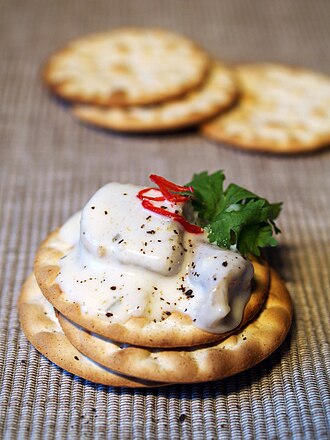
Photo: Wikipedia
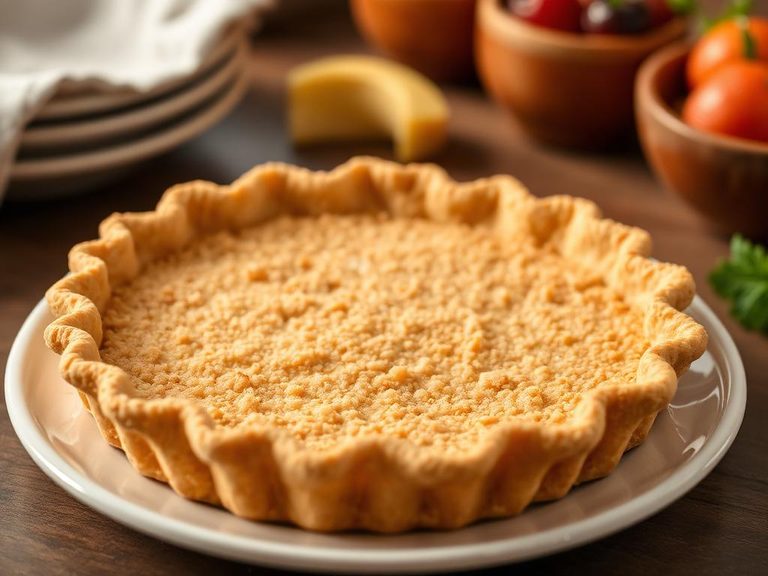
Crackers, NFS (Not Further Specified) are crisp, dry, unleavened biscuits made from flour, water, and fat, offering a satisfying snap and a neutral, savory canvas. Their texture ranges from flaky and buttery to hard and crunchy, depending on the variety. Nutritionally, they are a dense source of energy, providing a quick carbohydrate boost alongside a notable fat content.
Calorie split: 5% protein · 48% carbs · 47% fat
↓ Full nutrition💚 Why it's loved
People love crackers for their perfect, no-mess crunch and incredible versatility—they are the ultimate blank slate for dips, cheeses, and spreads. Their mild, toasty flavor makes them a comforting and familiar staple in lunchboxes and on snack platters worldwide.
⚠️ Watch-outs & how to enjoy it better
Crackers are typically low in fiber and protein, which can lead to rapid blood-sugar spikes and leave you feeling hungry soon after. Many varieties are also high in sodium and may contain common allergens like wheat, soy, or sesame. To counteract this, pair them with a protein or healthy fat (like hummus, cheese, or avocado) to slow digestion and improve satiety, and practice portion control by pre-portioning a serving.
Key benefits
- Provides quick, easily digestible energy from carbohydrates.
- Offers a convenient, shelf-stable, and portable snack option.
- Serves as a neutral base for both sweet and savory toppings.
- Can contribute to daily fat intake, which is essential for nutrient absorption.
- Often fortified with small amounts of iron and B vitamins.
🍽️ Popular dishes

🌍 Where it's eaten
💡 Did you know?
The word 'cracker' may have originated in the 14th century to describe a thin, hard biscuit, but it was also used in the 19th century to describe the 'crackling' sound of the dough as it baked.
Full nutrition (USDA data · scales with serving)
| Water | 3.1 g |
| Energy | 510 kcal |
| Protein | 6.6 g |
| Total lipid (fat) | 26.4 g |
| Carbohydrate, by difference | 61.3 g |
| Fiber, total dietary | 2.3 g |
| Total Sugars | 8.2 g |
| Calcium, Ca | 120 mg |
| Iron, Fe | 4.0 mg |
| Magnesium, Mg | 18.0 mg |
| Phosphorus, P | 248 mg |
| Potassium, K | 118 mg |
| Sodium, Na | 726 mg |
| Zinc, Zn | 0.49 mg |
| Copper, Cu | 0.10 mg |
| Selenium, Se | 6.7 ug |
| Vitamin C, total ascorbic acid | 0.00 mg |
| Thiamin | 0.42 mg |
| Riboflavin | 0.46 mg |
| Niacin | 4.4 mg |
| Vitamin B-6 | 0.06 mg |
| Folate, total | 92.0 ug |
| Folic acid | 84.0 ug |
| Folate, food | 8.0 ug |
| Folate, DFE | 150 ug |
| Choline, total | 9.6 mg |
| Vitamin B-12 | 0.00 ug |
| Vitamin B-12, added | 0.00 ug |
| Vitamin A, RAE | 0.00 ug |
| Retinol | 0.00 ug |
| Carotene, beta | 0.00 ug |
| Carotene, alpha | 0.00 ug |
| Cryptoxanthin, beta | 0.00 ug |
| Lycopene | 0.00 ug |
| Lutein + zeaxanthin | 12.0 ug |
| Vitamin E (alpha-tocopherol) | 3.0 mg |
| Vitamin E, added | 0.00 mg |
| Vitamin D (D2 + D3) | 0.00 ug |
| Vitamin K (phylloquinone) | 69.3 ug |
| Alcohol, ethyl | 0.00 g |
| Caffeine | 0.00 mg |
| Theobromine | 0.00 mg |
Fat & fatty acid profile (per 100g)
| Fatty acids, total saturated | 5.6 g |
| SFA 4:0 | 0.01 g |
| SFA 6:0 | 0.00 g |
| SFA 8:0 | 0.00 g |
| SFA 10:0 | 0.01 g |
| SFA 12:0 | 0.01 g |
| SFA 14:0 | 0.05 g |
| SFA 16:0 | 3.2 g |
| SFA 18:0 | 2.1 g |
| Fatty acids, total monounsaturated | 6.6 g |
| MUFA 16:1 | 0.02 g |
| MUFA 18:1 | 6.4 g |
| MUFA 20:1 | 0.11 g |
| MUFA 22:1 | 0.01 g |
| Fatty acids, total polyunsaturated | 13.1 g |
| PUFA 18:2 | 11.6 g |
| PUFA 18:3 | 1.5 g |
| PUFA 18:4 | 0.00 g |
| PUFA 20:4 | 0.01 g |
| PUFA 20:5 n-3 (EPA) | 0.00 g |
| PUFA 22:5 n-3 (DPA) | 0.00 g |
| PUFA 22:6 n-3 (DHA) | 0.00 g |
| Cholesterol | 0.00 mg |
Amino acid profile (per 100g)
Estimated from Crackers, cheese, sandwich-type with cheese filling — USDA does not publish this profile for Crackers.
| Tryptophan | 0.11 g |
| Threonine | 0.33 g |
| Isoleucine | 0.36 g |
| Leucine | 0.64 g |
| Lysine | 0.39 g |
| Methionine | 0.15 g |
| Cystine | 0.15 g |
| Phenylalanine | 0.35 g |
| Tyrosine | 0.25 g |
| Valine | 0.38 g |
| Arginine | 0.29 g |
| Histidine | 0.17 g |
| Alanine | 0.30 g |
| Aspartic acid | 0.52 g |
| Glutamic acid | 2.2 g |
| Glycine | 0.24 g |
| Proline | 0.77 g |
| Serine | 0.40 g |
FAQ
What does 'NFS' mean on a nutrition label?
NFS stands for 'Not Further Specified.' It indicates the food is a generic or composite item, and the nutritional data represents an average for that category, not a specific brand or recipe.
Are crackers a good source of fiber?
Most standard crackers, NFS, are low in fiber (about 2.3g per 100g). For a higher-fiber option, look for varieties made with whole grains, seeds, or added bran.
How should I store crackers to keep them fresh?
Store crackers in a cool, dry place in an airtight container or resealable bag to prevent them from absorbing moisture and becoming stale or soft.
Nutrient density (calculated · NRF9.3)
Nutrient Rich Foods index: beneficial nutrients (protein, fiber, vitamins, minerals) minus saturated fat, added sugar & sodium, per 100 kcal.
NRF9.3 index — Fulgoni, Keast & Drewnowski, 2009. Computed from USDA nutrients.
Weight-loss friendliness (composite index)
Energy density 5.10 kcal/g · 5% calories from protein · 2.3 g fiber · 8.2 g sugar per 100 g.
Composite of energy density (Rolls et al., 1999), protein & fiber satiety, minus sugar. A calculated heuristic — ranks satiety-per-calorie, not a clinical measure.
Dietary load (calculated from USDA values)
Potential renal acid load. Positive = acid-forming, negative = alkaline-forming.
Sodium-to-potassium ratio: 6.15 (lower is better — aim for ≤ 1)
Sodium:potassium per WHO potassium guidance. Computed from USDA nutrients.