

Corned beef sandwich on wheat, with cheese
Common food

Photo: Wikipedia
A hearty sandwich of salt-cured beef brisket, melted cheese, and tangy mustard on nutty whole wheat bread. The beef is tender and savory, the cheese creamy, and the bread adds a wholesome, slightly chewy texture. It provides a solid 15.55g of protein per 100g, making it a satisfying, energy-dense meal.
Calorie split: 23% protein · 31% carbs · 46% fat
↓ Full nutrition💚 Why it's loved
People love it for its robust, salty-savory flavor profile and the comforting combination of tender meat, melted cheese, and tangy condiments. It's a classic, no-fuss deli staple that's both filling and flavorful.
⚠️ Watch-outs & how to enjoy it better
The primary concern is high sodium from the cured beef, which can be problematic for blood pressure. To counteract, pair with potassium-rich foods like a side salad or fresh fruit, and drink plenty of water. The wheat bread is a common allergen (gluten), and the saturated fat from cheese and beef should be considered in moderation.
Key benefits
- High-quality complete protein source
- Provides iron and B vitamins from beef
- Whole wheat adds dietary fiber
- Convenient, portable meal
- Satiating balance of protein, fat, and carbs
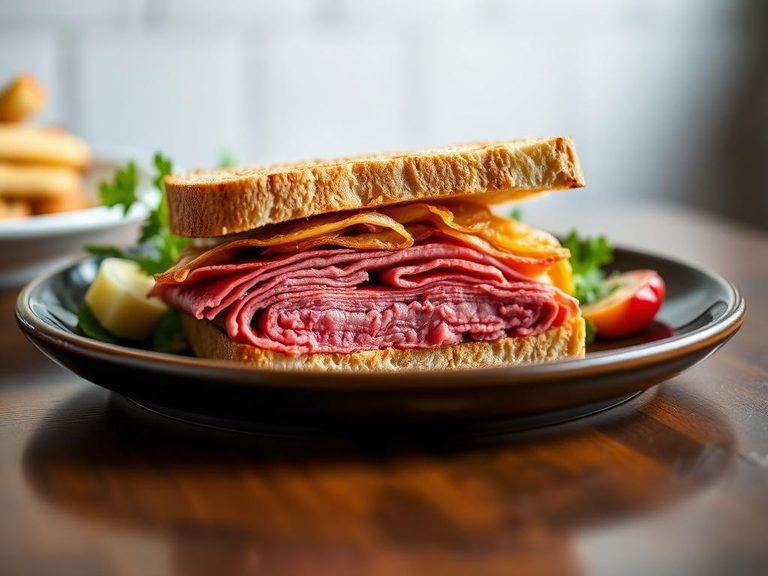
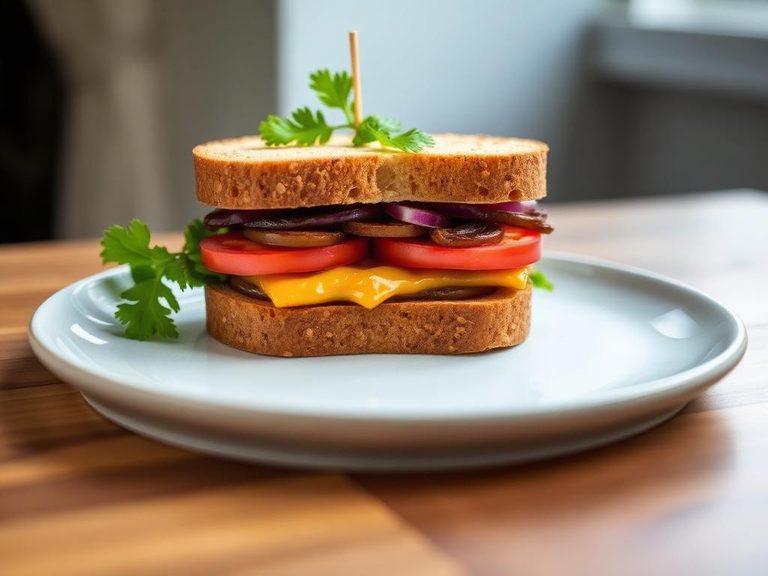
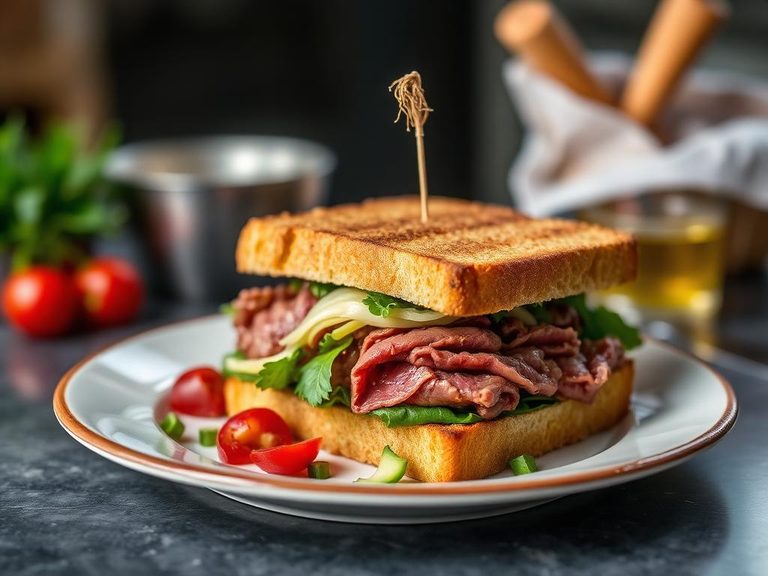
🍽️ Popular dishes


🌍 Where it's eaten
💡 Did you know?
Despite its name, 'corned' beef has nothing to do with corn; the term refers to the large 'corns' of salt historically used to cure the meat.
Full nutrition (USDA data · scales with serving)
| Water | 46.9 g |
| Energy | 273 kcal |
| Protein | 15.6 g |
| Total lipid (fat) | 13.9 g |
| Carbohydrate, by difference | 20.9 g |
| Fiber, total dietary | 2.4 g |
| Total Sugars | 2.7 g |
| Calcium, Ca | 212 mg |
| Iron, Fe | 2.2 mg |
| Magnesium, Mg | 34.0 mg |
| Phosphorus, P | 213 mg |
| Potassium, K | 165 mg |
| Sodium, Na | 745 mg |
| Zinc, Zn | 2.9 mg |
| Copper, Cu | 0.15 mg |
| Selenium, Se | 29.0 ug |
| Vitamin C, total ascorbic acid | 0.10 mg |
| Thiamin | 0.19 mg |
| Riboflavin | 0.22 mg |
| Niacin | 3.4 mg |
| Vitamin B-6 | 0.18 mg |
| Folate, total | 36.0 ug |
| Folic acid | 6.0 ug |
| Folate, food | 30.0 ug |
| Folate, DFE | 41.0 ug |
| Choline, total | 41.0 mg |
| Vitamin B-12 | 0.90 ug |
| Vitamin B-12, added | 0.00 ug |
| Vitamin A, RAE | 41.0 ug |
| Retinol | 40.0 ug |
| Carotene, beta | 13.0 ug |
| Carotene, alpha | 0.00 ug |
| Cryptoxanthin, beta | 1.0 ug |
| Lycopene | 0.00 ug |
| Lutein + zeaxanthin | 31.0 ug |
| Vitamin E (alpha-tocopherol) | 0.33 mg |
| Vitamin E, added | 0.00 mg |
| Vitamin D (D2 + D3) | 0.60 ug |
| Vitamin K (phylloquinone) | 3.4 ug |
| Alcohol, ethyl | 0.00 g |
| Caffeine | 0.00 mg |
| Theobromine | 0.00 mg |
Fat & fatty acid profile (per 100g)
| Fatty acids, total saturated | 5.4 g |
| SFA 4:0 | 0.09 g |
| SFA 6:0 | 0.07 g |
| SFA 8:0 | 0.05 g |
| SFA 10:0 | 0.13 g |
| SFA 12:0 | 0.14 g |
| SFA 14:0 | 0.61 g |
| SFA 16:0 | 2.9 g |
| SFA 18:0 | 1.2 g |
| Fatty acids, total monounsaturated | 5.0 g |
| MUFA 16:1 | 0.67 g |
| MUFA 18:1 | 4.4 g |
| MUFA 20:1 | 0.02 g |
| MUFA 22:1 | 0.00 g |
| Fatty acids, total polyunsaturated | 1.1 g |
| PUFA 18:2 | 0.98 g |
| PUFA 18:3 | 0.14 g |
| PUFA 18:4 | 0.00 g |
| PUFA 20:4 | 0.01 g |
| PUFA 20:5 n-3 (EPA) | 0.00 g |
| PUFA 22:5 n-3 (DPA) | 0.00 g |
| PUFA 22:6 n-3 (DHA) | 0.00 g |
| Cholesterol | 54.0 mg |
Amino acid profile (per 100g)
Estimated from Beef, cured, corned beef, brisket, raw — USDA does not publish this profile for Corned beef sandwich on wheat.
| Tryptophan | 0.13 g |
| Threonine | 0.55 g |
| Isoleucine | 0.63 g |
| Leucine | 1.1 g |
| Lysine | 1.1 g |
| Methionine | 0.34 g |
| Cystine | 0.19 g |
| Phenylalanine | 0.53 g |
| Tyrosine | 0.48 g |
| Valine | 0.65 g |
| Arginine | 0.91 g |
| Histidine | 0.47 g |
| Alanine | 1.1 g |
| Aspartic acid | 1.4 g |
| Glutamic acid | 2.4 g |
| Glycine | 1.2 g |
| Proline | 1.1 g |
| Serine | 0.59 g |
FAQ
Is corned beef the same as pastrami?
No. Corned beef is brined in a salt solution, while pastrami is typically smoked after curing. Corned beef has a milder, saltier flavor; pastrami is smokier and often spicier.
Why is it often served with mustard?
The sharp, acidic tang of mustard cuts through the rich, fatty, and salty flavors of the beef and cheese, providing a bright contrast that balances the palate.
Can I make a healthier version at home?
Yes. Use low-sodium corned beef, choose reduced-fat cheese, load up on fresh veggies like sauerkraut or lettuce, and opt for a whole-grain bread with less added sugar.
Nutrient density (calculated · NRF9.3)
Nutrient Rich Foods index: beneficial nutrients (protein, fiber, vitamins, minerals) minus saturated fat, added sugar & sodium, per 100 kcal.
NRF9.3 index — Fulgoni, Keast & Drewnowski, 2009. Computed from USDA nutrients.
Weight-loss friendliness (composite index)
Energy density 2.73 kcal/g · 23% calories from protein · 2.4 g fiber · 2.7 g sugar per 100 g.
Composite of energy density (Rolls et al., 1999), protein & fiber satiety, minus sugar. A calculated heuristic — ranks satiety-per-calorie, not a clinical measure.
Dietary load (calculated from USDA values)
Potential renal acid load. Positive = acid-forming, negative = alkaline-forming.
Sodium-to-potassium ratio: 4.52 (lower is better — aim for ≤ 1)
Sodium:potassium per WHO potassium guidance. Computed from USDA nutrients.