

Coconut milk, used in cooking
Common food
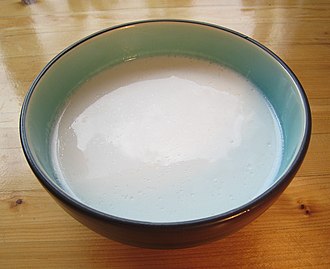
Photo: Wikipedia
Coconut milk, extracted from the grated flesh of mature coconuts, is a rich, creamy liquid with a subtly sweet, nutty flavor. Its velvety texture and high fat content make it a luxurious base for curries, soups, and desserts. Nutritionally, it's a calorie-dense source of energy, primarily from fats, with minimal protein and carbs.
Calorie split: 4% protein · 9% carbs · 87% fat
↓ Full nutrition💚 Why it's loved
People love it for its unparalleled ability to add a rich, creamy depth and a hint of tropical sweetness to both savory and sweet dishes. It's a cornerstone ingredient in many cuisines, offering a versatile and indulgent dairy-free option.
⚠️ Watch-outs & how to enjoy it better
Its high saturated fat and calorie content can be a concern for heart health and weight management if consumed in large amounts. The natural sugars, while low, can still contribute to blood sugar impact in very large servings. To mitigate, use it in moderation, balance it with high-fiber vegetables and lean proteins, and opt for light coconut milk for lower-fat cooking.
Key benefits
- Provides medium-chain triglycerides (MCTs) for quick energy
- Contains lauric acid, a fatty acid with antimicrobial properties
- Rich in manganese, essential for bone health and metabolism
- Lactose-free and dairy-free alternative for creamy dishes
- Adds a rich, satisfying mouthfeel to plant-based meals
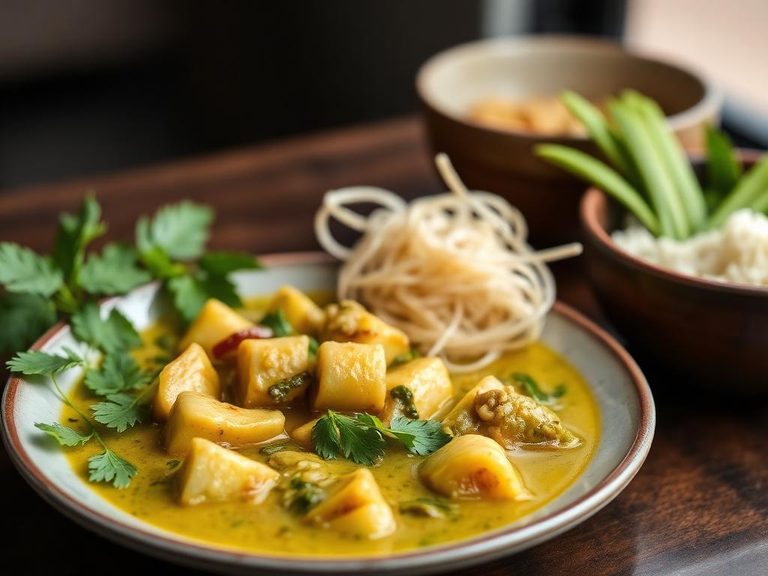
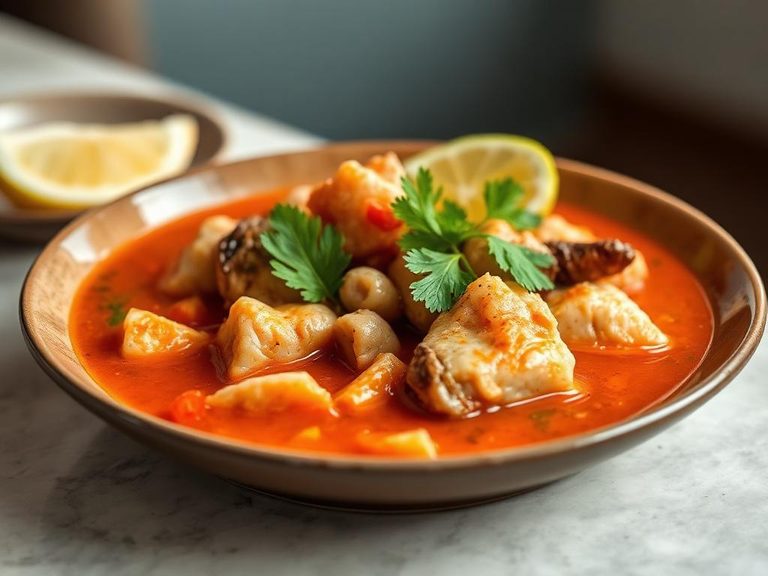
🍽️ Popular dishes




🌍 Where it's eaten
💡 Did you know?
The white 'meat' of the coconut is actually a seed, and the 'milk' is an emulsion of oil and water created when it's grated and pressed, not a natural liquid found inside the fruit.
Full nutrition (USDA data · scales with serving)
| Water | 67.6 g |
| Energy | 230 kcal |
| Protein | 2.3 g |
| Total lipid (fat) | 23.8 g |
| Carbohydrate, by difference | 5.5 g |
| Fiber, total dietary | 2.2 g |
| Total Sugars | 3.3 g |
| Calcium, Ca | 16.0 mg |
| Iron, Fe | 1.6 mg |
| Magnesium, Mg | 37.0 mg |
| Phosphorus, P | 100 mg |
| Potassium, K | 263 mg |
| Sodium, Na | 15.0 mg |
| Zinc, Zn | 0.67 mg |
| Copper, Cu | 0.27 mg |
| Selenium, Se | 6.2 ug |
| Vitamin C, total ascorbic acid | 2.8 mg |
| Thiamin | 0.03 mg |
| Riboflavin | 0.00 mg |
| Niacin | 0.76 mg |
| Vitamin B-6 | 0.03 mg |
| Folate, total | 16.0 ug |
| Folic acid | 0.00 ug |
| Folate, food | 16.0 ug |
| Folate, DFE | 16.0 ug |
| Choline, total | 8.5 mg |
| Vitamin B-12 | 0.00 ug |
| Vitamin B-12, added | 0.00 ug |
| Vitamin A, RAE | 0.00 ug |
| Retinol | 0.00 ug |
| Carotene, beta | 0.00 ug |
| Carotene, alpha | 0.00 ug |
| Cryptoxanthin, beta | 0.00 ug |
| Lycopene | 0.00 ug |
| Lutein + zeaxanthin | 0.00 ug |
| Vitamin E (alpha-tocopherol) | 0.15 mg |
| Vitamin E, added | 0.00 mg |
| Vitamin D (D2 + D3) | 0.00 ug |
| Vitamin K (phylloquinone) | 0.10 ug |
| Alcohol, ethyl | 0.00 g |
| Caffeine | 0.00 mg |
| Theobromine | 0.00 mg |
Fat & fatty acid profile (per 100g)
| Fatty acids, total saturated | 21.1 g |
| SFA 4:0 | 0.00 g |
| SFA 6:0 | 0.14 g |
| SFA 8:0 | 1.7 g |
| SFA 10:0 | 1.3 g |
| SFA 12:0 | 10.6 g |
| SFA 14:0 | 4.2 g |
| SFA 16:0 | 2.0 g |
| SFA 18:0 | 1.2 g |
| Fatty acids, total monounsaturated | 1.0 g |
| MUFA 16:1 | 0.00 g |
| MUFA 18:1 | 1.0 g |
| MUFA 20:1 | 0.00 g |
| MUFA 22:1 | 0.00 g |
| Fatty acids, total polyunsaturated | 0.26 g |
| PUFA 18:2 | 0.26 g |
| PUFA 18:3 | 0.00 g |
| PUFA 18:4 | 0.00 g |
| PUFA 20:4 | 0.00 g |
| PUFA 20:5 n-3 (EPA) | 0.00 g |
| PUFA 22:5 n-3 (DPA) | 0.00 g |
| PUFA 22:6 n-3 (DHA) | 0.00 g |
| Cholesterol | 0.00 mg |
Amino acid profile (per 100g)
Estimated from Puddings, coconut cream, dry mix, instant, prepared with 2% milk — USDA does not publish this profile for Coconut milk.
| Tryptophan | 0.04 g |
| Threonine | 0.12 g |
| Isoleucine | 0.17 g |
| Leucine | 0.27 g |
| Lysine | 0.22 g |
| Methionine | 0.07 g |
| Cystine | 0.03 g |
| Phenylalanine | 0.13 g |
| Tyrosine | 0.13 g |
| Valine | 0.18 g |
| Arginine | 0.12 g |
| Histidine | 0.07 g |
| Alanine | 0.10 g |
| Aspartic acid | 0.21 g |
| Glutamic acid | 0.58 g |
| Glycine | 0.06 g |
| Proline | 0.26 g |
| Serine | 0.15 g |
FAQ
What's the difference between coconut milk, cream, and water?
Coconut milk is the pressed liquid from grated meat (high fat). Coconut cream is the thicker, higher-fat layer that rises to the top of canned milk. Coconut water is the clear, hydrating liquid from inside young green coconuts (low fat, high in electrolytes).
Why does my canned coconut milk sometimes have a solid layer on top?
This is normal separation. The high-fat coconut cream solidifies when chilled. Simply shake the can vigorously before opening to re-emulsify it into a smooth, homogeneous liquid.
Is coconut milk high in cholesterol?
Coconut milk contains no dietary cholesterol, as cholesterol is only found in animal products. However, it is high in saturated fat, which for some individuals can raise blood cholesterol levels. Moderation is key.
Nutrient density (calculated · NRF9.3)
Nutrient Rich Foods index: beneficial nutrients (protein, fiber, vitamins, minerals) minus saturated fat, added sugar & sodium, per 100 kcal.
NRF9.3 index — Fulgoni, Keast & Drewnowski, 2009. Computed from USDA nutrients.
Weight-loss friendliness (composite index)
Energy density 2.30 kcal/g · 4% calories from protein · 2.2 g fiber · 3.3 g sugar per 100 g.
Composite of energy density (Rolls et al., 1999), protein & fiber satiety, minus sugar. A calculated heuristic — ranks satiety-per-calorie, not a clinical measure.
Dietary load (calculated from USDA values)
Potential renal acid load. Positive = acid-forming, negative = alkaline-forming.
Sodium-to-potassium ratio: 0.06 (lower is better — aim for ≤ 1)
Sodium:potassium per WHO potassium guidance. Computed from USDA nutrients.