

Chicken or turkey, potatoes, and vegetables excluding carrots, broccoli, and dark-green leafy; cream sauce, white sauce, or mushroom sauce
Common food

Photo: Wikipedia
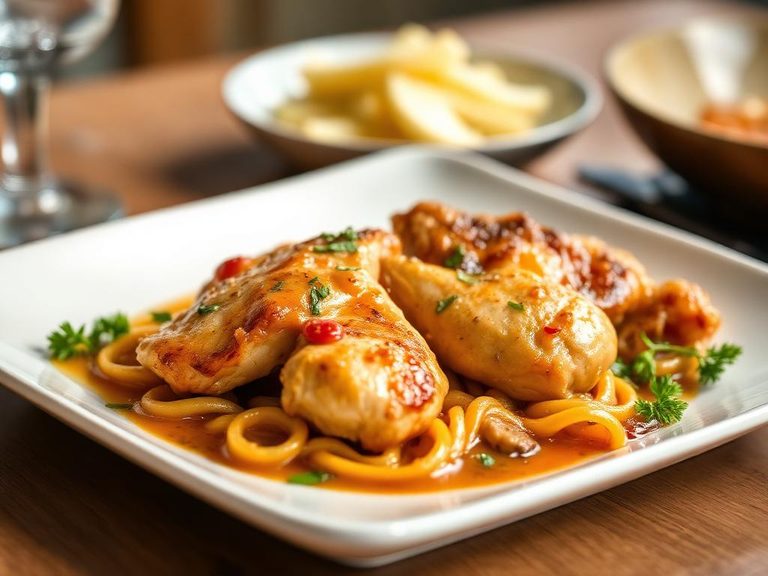
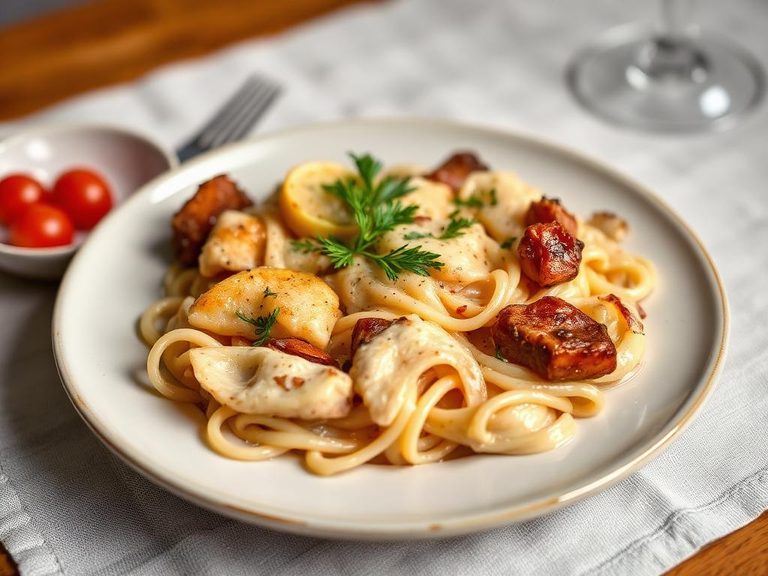
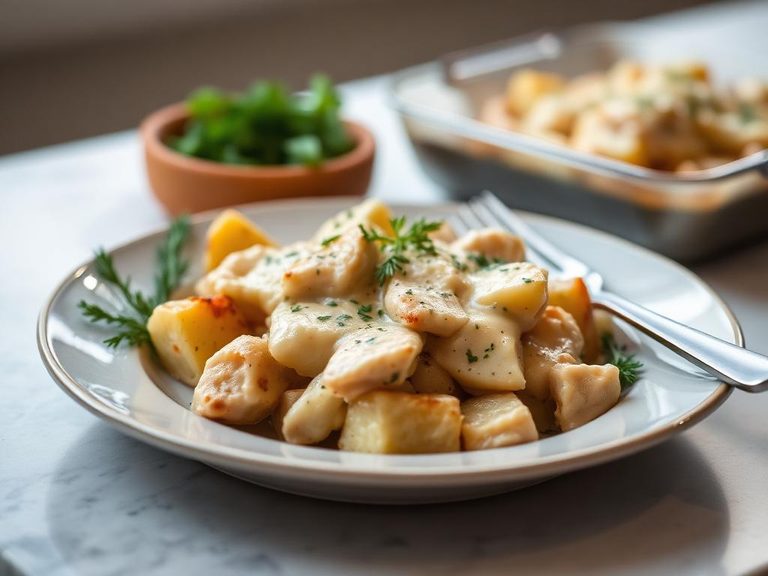
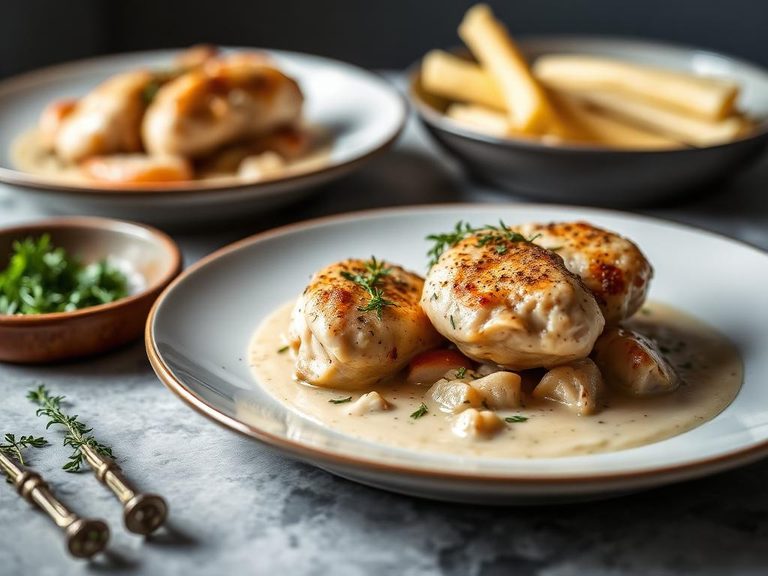
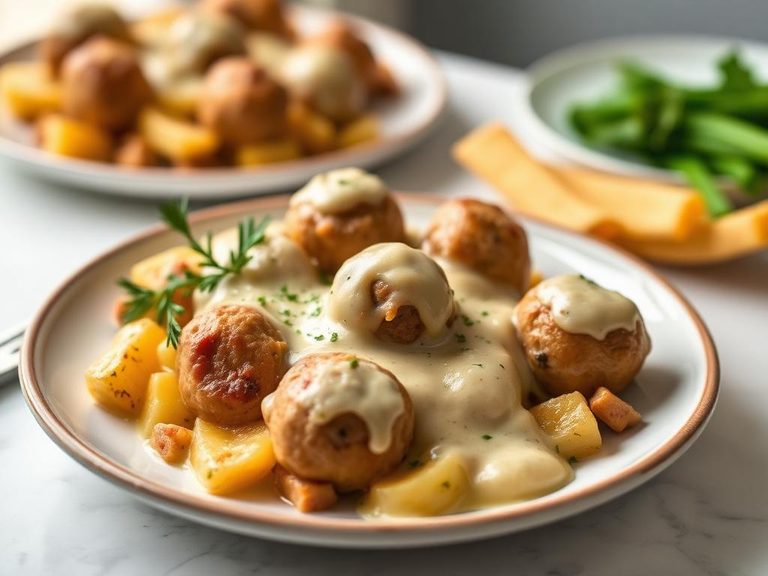
This is a classic, comforting plate of tender chicken or turkey nestled with soft potatoes and a medley of vegetables like peas, corn, and green beans, all enveloped in a rich, savory cream, white, or mushroom sauce. The texture is a delightful contrast between the succulent meat, the starchy potatoes, and the slight pop of the vegetables, all unified by the velvety sauce. For a relatively light calorie count, it offers a balanced mix of protein and carbohydrates, making it a satisfying yet not overly heavy meal.
Calorie split: 15% protein · 38% carbs · 47% fat
↓ Full nutrition💚 Why it's loved
People adore this dish for its deep, homestyle comfort and the way the creamy sauce brings all the simple, wholesome components together into a harmonious, nostalgic bite. It's a versatile canvas that feels like a warm hug, often evoking memories of family dinners and Sunday roasts.
⚠️ Watch-outs & how to enjoy it better
The cream-based sauces can be high in saturated fat and sodium, which may be a concern for heart health. The dish's glycemic load, primarily from potatoes and white sauce, could cause blood-sugar spikes for some individuals. To counteract this, opt for a mushroom sauce for umami depth with less fat, choose a smaller portion of potatoes, and ensure the meal includes a generous serving of the non-starchy vegetables to add fiber and slow digestion.
Key benefits
- Good source of lean protein from poultry for muscle maintenance.
- Provides complex carbohydrates from potatoes for sustained energy.
- Contains a variety of vegetables for essential vitamins and minerals.
- The sauce can be a vehicle for calcium and fat-soluble vitamins.
- A comforting, balanced meal that supports satiety.
🍽️ Popular dishes
🌍 Where it's eaten
💡 Did you know?
The 'white sauce' in this dish is a classic French béchamel, one of the five mother sauces of French cuisine, made from a roux of butter and flour whisked with milk.
Full nutrition (USDA data · scales with serving)
| Water | 75.0 g |
| Energy | 126 kcal |
| Protein | 4.8 g |
| Total lipid (fat) | 6.8 g |
| Carbohydrate, by difference | 12.1 g |
| Fiber, total dietary | 1.3 g |
| Total Sugars | 1.3 g |
| Calcium, Ca | 22.0 mg |
| Iron, Fe | 0.35 mg |
| Magnesium, Mg | 16.0 mg |
| Phosphorus, P | 67.0 mg |
| Potassium, K | 225 mg |
| Sodium, Na | 338 mg |
| Zinc, Zn | 0.43 mg |
| Copper, Cu | 0.09 mg |
| Selenium, Se | 4.0 ug |
| Vitamin C, total ascorbic acid | 3.6 mg |
| Thiamin | 0.06 mg |
| Riboflavin | 0.06 mg |
| Niacin | 1.7 mg |
| Vitamin B-6 | 0.16 mg |
| Folate, total | 10.0 ug |
| Folic acid | 0.00 ug |
| Folate, food | 10.0 ug |
| Folate, DFE | 10.0 ug |
| Choline, total | 20.0 mg |
| Vitamin B-12 | 0.09 ug |
| Vitamin B-12, added | 0.00 ug |
| Vitamin A, RAE | 9.0 ug |
| Retinol | 6.0 ug |
| Carotene, beta | 23.0 ug |
| Carotene, alpha | 6.0 ug |
| Cryptoxanthin, beta | 10.0 ug |
| Lycopene | 0.00 ug |
| Lutein + zeaxanthin | 100 ug |
| Vitamin E (alpha-tocopherol) | 1.0 mg |
| Vitamin E, added | 0.00 mg |
| Vitamin D (D2 + D3) | 0.10 ug |
| Vitamin K (phylloquinone) | 13.2 ug |
| Alcohol, ethyl | 0.00 g |
| Caffeine | 0.00 mg |
| Theobromine | 0.00 mg |
Fat & fatty acid profile (per 100g)
| Fatty acids, total saturated | 1.1 g |
| SFA 4:0 | 0.01 g |
| SFA 6:0 | 0.00 g |
| SFA 8:0 | 0.00 g |
| SFA 10:0 | 0.01 g |
| SFA 12:0 | 0.01 g |
| SFA 14:0 | 0.03 g |
| SFA 16:0 | 0.79 g |
| SFA 18:0 | 0.24 g |
| Fatty acids, total monounsaturated | 2.5 g |
| MUFA 16:1 | 0.08 g |
| MUFA 18:1 | 2.4 g |
| MUFA 20:1 | 0.04 g |
| MUFA 22:1 | 0.00 g |
| Fatty acids, total polyunsaturated | 2.6 g |
| PUFA 18:2 | 2.3 g |
| PUFA 18:3 | 0.29 g |
| PUFA 18:4 | 0.00 g |
| PUFA 20:4 | 0.00 g |
| PUFA 20:5 n-3 (EPA) | 0.00 g |
| PUFA 22:5 n-3 (DPA) | 0.00 g |
| PUFA 22:6 n-3 (DHA) | 0.00 g |
| Cholesterol | 14.0 mg |
Amino acid profile (per 100g)
Estimated from Turnover, chicken- or turkey-, and vegetable-filled, reduced fat, frozen — USDA does not publish this profile for Chicken or turkey.
| Tryptophan | 0.16 g |
| Threonine | 0.41 g |
| Isoleucine | 0.47 g |
| Leucine | 0.80 g |
| Lysine | 0.61 g |
| Methionine | 0.23 g |
| Cystine | 0.13 g |
| Phenylalanine | 0.47 g |
| Tyrosine | 0.37 g |
| Valine | 0.53 g |
| Arginine | 0.51 g |
| Histidine | 0.30 g |
| Alanine | 0.45 g |
| Aspartic acid | 0.80 g |
| Glutamic acid | 2.2 g |
| Glycine | 0.38 g |
| Proline | 0.87 g |
| Serine | 0.42 g |
| Hydroxyproline | 0.00 g |
FAQ
Can I make this dish healthier?
Yes, you can lighten it significantly. Use Greek yogurt or a cornstarch slurry to thicken the sauce instead of heavy cream, choose skinless chicken breast, and load up on extra vegetables like zucchini or bell peppers to increase fiber and nutrient density.
What's the best way to reheat leftovers?
Reheat gently in a saucepan over medium-low heat, adding a splash of milk or broth to loosen the sauce. Stir frequently to prevent the sauce from breaking or the vegetables from becoming mushy. Microwaving works too, but cover and stir halfway through for even heating.
Is this dish gluten-free?
Not in its traditional form, as the white or cream sauce is typically thickened with wheat flour (a roux). To make it gluten-free, use a gluten-free flour blend for the roux or thicken the sauce with a cornstarch or arrowroot slurry.
Nutrient density (calculated · NRF9.3)
Nutrient Rich Foods index: beneficial nutrients (protein, fiber, vitamins, minerals) minus saturated fat, added sugar & sodium, per 100 kcal.
NRF9.3 index — Fulgoni, Keast & Drewnowski, 2009. Computed from USDA nutrients.
Weight-loss friendliness (composite index)
Energy density 1.26 kcal/g · 15% calories from protein · 1.3 g fiber · 1.3 g sugar per 100 g.
Composite of energy density (Rolls et al., 1999), protein & fiber satiety, minus sugar. A calculated heuristic — ranks satiety-per-calorie, not a clinical measure.
Dietary load (calculated from USDA values)
Potential renal acid load. Positive = acid-forming, negative = alkaline-forming.
Sodium-to-potassium ratio: 1.50 (lower is better — aim for ≤ 1)
Sodium:potassium per WHO potassium guidance. Computed from USDA nutrients.