

Chicken leg, drumstick and thigh, rotisserie, skin eaten
Common food
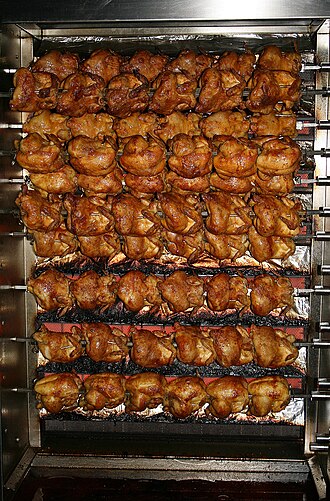
Photo: Wikipedia
Rotisserie chicken leg, drumstick and thigh, skin-on, is a savory, juicy cut of poultry slow-roasted on a spit until the meat is tender and the skin is golden and crisp. The combination of white and dark meat offers a richer, more flavorful experience than breast meat alone, with a satisfyingly succulent texture. Nutritionally, it's a high-protein, low-carb food, providing substantial energy primarily from protein and fats.
Calorie split: 44% protein · 0% carbs · 56% fat
↓ Full nutrition💚 Why it's loved
People adore it for its deep, savory flavor and the perfect contrast between crispy, seasoned skin and tender, juicy meat. It's a versatile comfort food, equally at home as a quick weeknight dinner, a picnic centerpiece, or the star of a hearty soup.
⚠️ Watch-outs & how to enjoy it better
The skin and dark meat are higher in saturated fat and calories than skinless breast, which may concern those monitoring fat intake. It can also be high in sodium if heavily seasoned during rotisserie cooking. To mitigate, enjoy it occasionally, remove some skin before eating, and pair it with fiber-rich vegetables like roasted broccoli or a leafy salad to balance the meal.
Key benefits
- Excellent source of high-quality protein for muscle maintenance and satiety.
- Very low in carbohydrates and sugars, suitable for low-carb and ketogenic diets.
- Rich in B vitamins like niacin and B6, essential for energy metabolism.
- Provides essential minerals such as selenium and phosphorus.
- The skin adds flavor and contains some healthy monounsaturated fats.
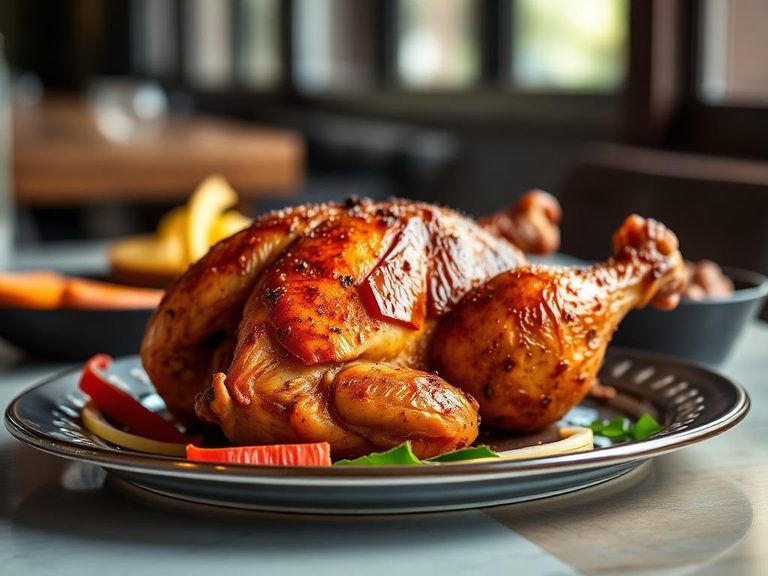
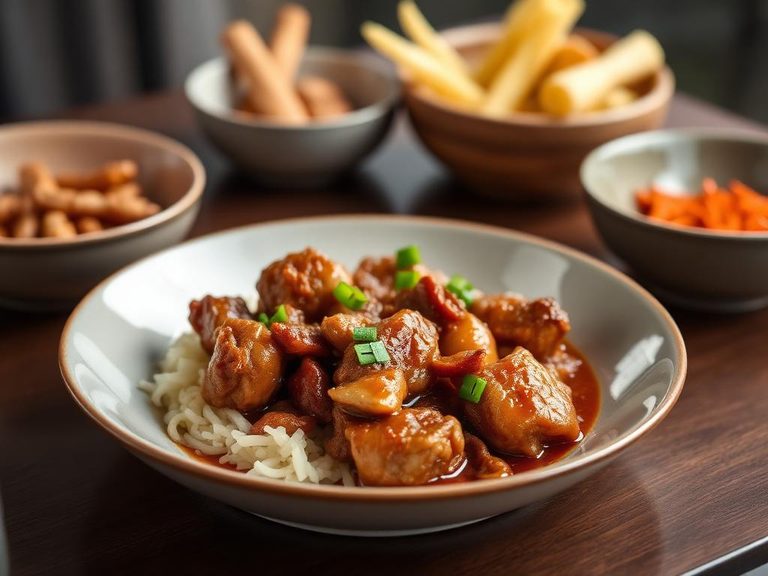
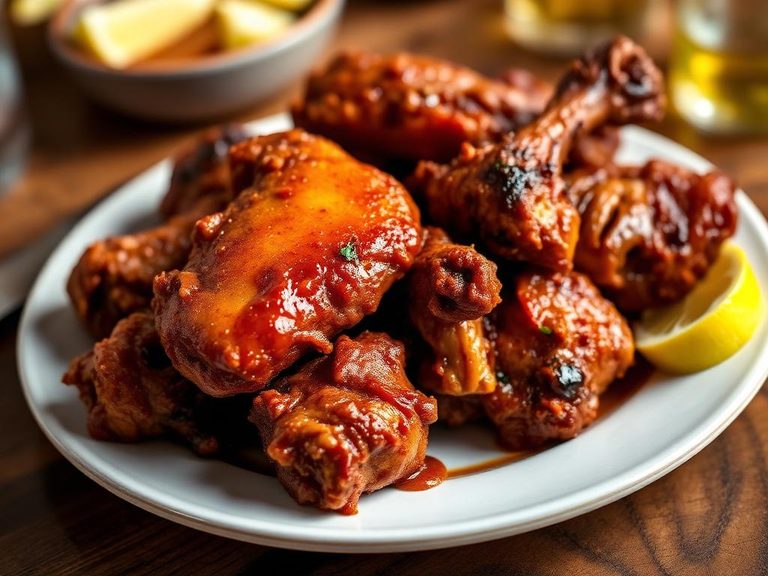
🍽️ Popular dishes


🌍 Where it's eaten
💡 Did you know?
The practice of spit-roasting poultry dates back to at least the 12th century in Europe, but the modern commercial rotisserie chicken boom was largely sparked by Boston Market in the U.S. during the late 1980s.
Full nutrition (USDA data · scales with serving)
| Water | 61.4 g |
| Energy | 218 kcal |
| Protein | 23.8 g |
| Total lipid (fat) | 13.6 g |
| Carbohydrate, by difference | 0.12 g |
| Fiber, total dietary | 0.00 g |
| Total Sugars | 0.12 g |
| Calcium, Ca | 18.0 mg |
| Iron, Fe | 0.98 mg |
| Magnesium, Mg | 22.0 mg |
| Phosphorus, P | 229 mg |
| Potassium, K | 265 mg |
| Sodium, Na | 358 mg |
| Zinc, Zn | 2.1 mg |
| Copper, Cu | 0.08 mg |
| Selenium, Se | 23.5 ug |
| Vitamin C, total ascorbic acid | 0.00 mg |
| Thiamin | 0.06 mg |
| Riboflavin | 0.23 mg |
| Niacin | 5.8 mg |
| Vitamin B-6 | 0.19 mg |
| Folate, total | 8.0 ug |
| Folic acid | 0.00 ug |
| Folate, food | 8.0 ug |
| Folate, DFE | 8.0 ug |
| Choline, total | 67.1 mg |
| Vitamin B-12 | 0.48 ug |
| Vitamin B-12, added | 0.00 ug |
| Vitamin A, RAE | 19.0 ug |
| Retinol | 19.0 ug |
| Carotene, beta | 0.00 ug |
| Carotene, alpha | 0.00 ug |
| Cryptoxanthin, beta | 0.00 ug |
| Lycopene | 0.00 ug |
| Lutein + zeaxanthin | 0.00 ug |
| Vitamin E (alpha-tocopherol) | 0.48 mg |
| Vitamin E, added | 0.00 mg |
| Vitamin D (D2 + D3) | 0.00 ug |
| Vitamin K (phylloquinone) | 0.00 ug |
| Alcohol, ethyl | 0.00 g |
| Caffeine | 0.00 mg |
| Theobromine | 0.00 mg |
Fat & fatty acid profile (per 100g)
| Fatty acids, total saturated | 3.5 g |
| SFA 4:0 | 0.00 g |
| SFA 6:0 | 0.00 g |
| SFA 8:0 | 0.00 g |
| SFA 10:0 | 0.00 g |
| SFA 12:0 | 0.00 g |
| SFA 14:0 | 0.07 g |
| SFA 16:0 | 2.8 g |
| SFA 18:0 | 0.61 g |
| Fatty acids, total monounsaturated | 5.8 g |
| MUFA 16:1 | 0.95 g |
| MUFA 18:1 | 4.8 g |
| MUFA 20:1 | 0.04 g |
| MUFA 22:1 | 0.00 g |
| Fatty acids, total polyunsaturated | 1.8 g |
| PUFA 18:2 | 1.7 g |
| PUFA 18:3 | 0.09 g |
| PUFA 18:4 | 0.00 g |
| PUFA 20:4 | 0.03 g |
| PUFA 20:5 n-3 (EPA) | 0.00 g |
| PUFA 22:5 n-3 (DPA) | 0.00 g |
| PUFA 22:6 n-3 (DHA) | 0.00 g |
| Cholesterol | 136 mg |
Amino acid profile (per 100g)
Estimated from Chicken, broilers or fryers, leg, meat only, cooked, fried — USDA does not publish this profile for Chicken leg.
| Tryptophan | 0.33 g |
| Threonine | 1.2 g |
| Isoleucine | 1.5 g |
| Leucine | 2.1 g |
| Lysine | 2.4 g |
| Methionine | 0.78 g |
| Cystine | 0.36 g |
| Phenylalanine | 1.1 g |
| Tyrosine | 0.96 g |
| Valine | 1.4 g |
| Arginine | 1.7 g |
| Histidine | 0.88 g |
| Alanine | 1.5 g |
| Aspartic acid | 2.5 g |
| Glutamic acid | 4.3 g |
| Glycine | 1.4 g |
| Proline | 1.2 g |
| Serine | 0.98 g |
FAQ
Is rotisserie chicken leg healthy?
It's a nutritious source of protein and minerals, but the skin and dark meat are higher in fat and calories than skinless breast. Enjoying it in moderation as part of a balanced diet is key.
How does the nutrition compare to fried chicken?
Rotisserie chicken is generally lower in calories and unhealthy fats because it's cooked by dry heat without added breading or deep-frying oil, though the skin still adds significant fat.
Can I eat the skin?
Yes, the skin is edible and flavorful, but it contains a large portion of the total fat and calories. You can remove it to reduce fat intake while still enjoying the flavorful dark meat.
Nutrient density (calculated · NRF9.3)
Nutrient Rich Foods index: beneficial nutrients (protein, fiber, vitamins, minerals) minus saturated fat, added sugar & sodium, per 100 kcal.
NRF9.3 index — Fulgoni, Keast & Drewnowski, 2009. Computed from USDA nutrients.
Weight-loss friendliness (composite index)
Energy density 2.18 kcal/g · 44% calories from protein · 0.0 g fiber · 0.1 g sugar per 100 g.
Composite of energy density (Rolls et al., 1999), protein & fiber satiety, minus sugar. A calculated heuristic — ranks satiety-per-calorie, not a clinical measure.
Dietary load (calculated from USDA values)
Potential renal acid load. Positive = acid-forming, negative = alkaline-forming.
Sodium-to-potassium ratio: 1.35 (lower is better — aim for ≤ 1)
Sodium:potassium per WHO potassium guidance. Computed from USDA nutrients.