

Chicken, fried, with potatoes, vegetable, dessert, frozen meal, large meat portion
Common food
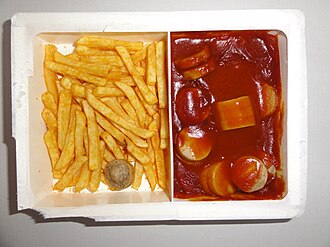
Photo: Wikipedia
This is a classic frozen TV dinner featuring a breaded, fried chicken portion alongside a scoop of mashed potatoes, mixed vegetables, and a small dessert, all in one compartmentalized tray. The chicken offers a crispy, savory coating with a tender interior, while the potatoes are creamy and the vegetables provide a soft, slightly sweet contrast. Nutritionally, it delivers a moderate 201 calories per 100g with a balanced mix of protein (10.88g) and carbs (18.05g), though the fat content (9.93g) is notable for a single meal.
Calorie split: 21% protein · 35% carbs · 44% fat
↓ Full nutrition💚 Why it's loved
People love it for its nostalgic, comforting appeal and the convenience of a complete, hot meal ready in minutes. The familiar combination of crispy chicken, creamy potatoes, and sweet dessert hits a satisfying, predictable flavor note.
⚠️ Watch-outs & how to enjoy it better
The meal can be high in sodium and may contain preservatives common in frozen foods, which is a concern for those monitoring blood pressure. The breading and frying add extra fat and refined carbs, potentially causing blood-sugar spikes. To counteract, pair it with a fresh side salad to add fiber, or choose a smaller portion and supplement with a piece of whole fruit.
Key benefits
- Convenient all-in-one meal with protein, carbs, and vegetables
- Provides a quick source of energy (201 kcal per 100g)
- Contains 10.88g of protein per 100g for muscle maintenance
- Offers a familiar, comforting taste profile
- Requires minimal preparation time
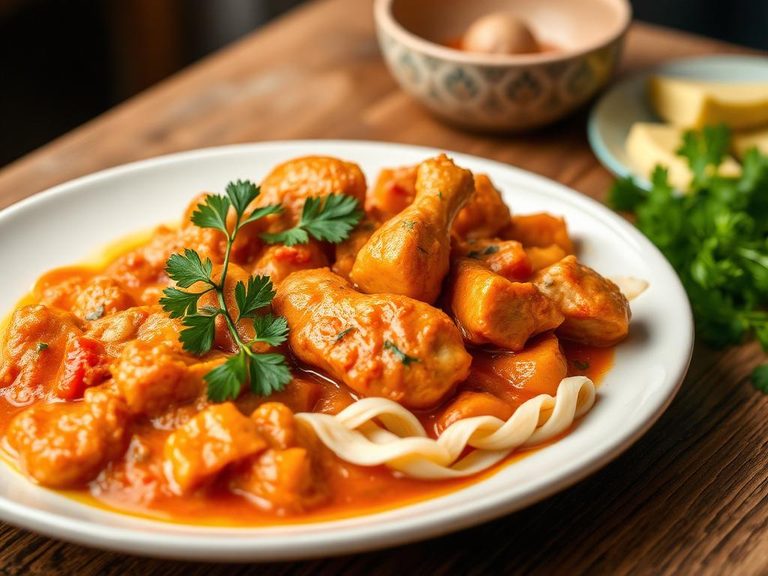
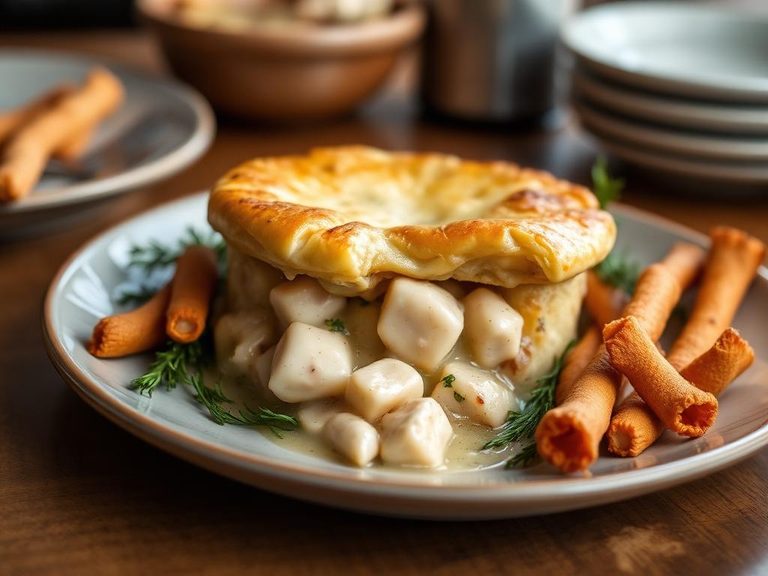
🍽️ Popular dishes
🌍 Where it's eaten
💡 Did you know?
The first commercially successful frozen TV dinner was introduced by Swanson in 1954, inspired by surplus Thanksgiving turkeys, and was packaged in an aluminum tray designed to look like a TV screen.
Full nutrition (USDA data · scales with serving)
| Water | 59.0 g |
| Energy | 201 kcal |
| Protein | 10.9 g |
| Total lipid (fat) | 9.9 g |
| Carbohydrate, by difference | 18.1 g |
| Fiber, total dietary | 1.3 g |
| Total Sugars | 6.0 g |
| Calcium, Ca | 30.0 mg |
| Iron, Fe | 0.70 mg |
| Magnesium, Mg | 22.0 mg |
| Phosphorus, P | 134 mg |
| Potassium, K | 265 mg |
| Sodium, Na | 551 mg |
| Zinc, Zn | 0.78 mg |
| Copper, Cu | 0.07 mg |
| Selenium, Se | 13.1 ug |
| Vitamin C, total ascorbic acid | 2.5 mg |
| Thiamin | 0.08 mg |
| Riboflavin | 0.15 mg |
| Niacin | 3.5 mg |
| Vitamin B-6 | 0.17 mg |
| Folate, total | 21.0 ug |
| Folic acid | 6.0 ug |
| Folate, food | 15.0 ug |
| Folate, DFE | 25.0 ug |
| Choline, total | 46.7 mg |
| Vitamin B-12 | 0.20 ug |
| Vitamin B-12, added | 0.00 ug |
| Vitamin A, RAE | 21.0 ug |
| Retinol | 19.0 ug |
| Carotene, beta | 19.0 ug |
| Carotene, alpha | 3.0 ug |
| Cryptoxanthin, beta | 21.0 ug |
| Lycopene | 0.00 ug |
| Lutein + zeaxanthin | 117 ug |
| Vitamin E (alpha-tocopherol) | 0.59 mg |
| Vitamin E, added | 0.00 mg |
| Vitamin D (D2 + D3) | 0.10 ug |
| Vitamin K (phylloquinone) | 3.4 ug |
| Alcohol, ethyl | 0.00 g |
| Caffeine | 0.00 mg |
| Theobromine | 0.00 mg |
Fat & fatty acid profile (per 100g)
| Fatty acids, total saturated | 2.5 g |
| SFA 4:0 | 0.01 g |
| SFA 6:0 | 0.01 g |
| SFA 8:0 | 0.01 g |
| SFA 10:0 | 0.02 g |
| SFA 12:0 | 0.02 g |
| SFA 14:0 | 0.10 g |
| SFA 16:0 | 1.6 g |
| SFA 18:0 | 0.61 g |
| Fatty acids, total monounsaturated | 4.2 g |
| MUFA 16:1 | 0.30 g |
| MUFA 18:1 | 3.8 g |
| MUFA 20:1 | 0.06 g |
| MUFA 22:1 | 0.00 g |
| Fatty acids, total polyunsaturated | 2.2 g |
| PUFA 18:2 | 1.9 g |
| PUFA 18:3 | 0.22 g |
| PUFA 18:4 | 0.00 g |
| PUFA 20:4 | 0.03 g |
| PUFA 20:5 n-3 (EPA) | 0.00 g |
| PUFA 22:5 n-3 (DPA) | 0.00 g |
| PUFA 22:6 n-3 (DHA) | 0.00 g |
| Cholesterol | 49.0 mg |
Amino acid profile (per 100g)
Estimated from Restaurant, Latino, chicken and rice, entree, prepared — USDA does not publish this profile for Chicken.
| Tryptophan | 0.16 g |
| Threonine | 0.50 g |
| Isoleucine | 0.55 g |
| Leucine | 0.93 g |
| Lysine | 0.93 g |
| Methionine | 0.31 g |
| Cystine | 0.15 g |
| Phenylalanine | 0.51 g |
| Tyrosine | 0.35 g |
| Valine | 0.62 g |
| Arginine | 0.80 g |
| Histidine | 0.40 g |
| Alanine | 0.68 g |
| Aspartic acid | 1.1 g |
| Glutamic acid | 1.9 g |
| Glycine | 0.58 g |
| Proline | 0.51 g |
| Serine | 0.47 g |
FAQ
Is this meal considered healthy?
It's a convenient option but is typically processed and may be high in sodium and saturated fat. It's best enjoyed occasionally rather than as a daily staple.
How does the nutrition compare to a homemade version?
A homemade version would likely have less sodium, no preservatives, and you could control the oil for frying and the seasoning on the potatoes and vegetables, making it nutritionally superior.
Can I improve its nutritional profile?
Yes, you can add a large serving of steamed broccoli or a green salad to increase fiber and micronutrients, and drink water instead of a sugary beverage.
Nutrient density (calculated · NRF9.3)
Nutrient Rich Foods index: beneficial nutrients (protein, fiber, vitamins, minerals) minus saturated fat, added sugar & sodium, per 100 kcal.
NRF9.3 index — Fulgoni, Keast & Drewnowski, 2009. Computed from USDA nutrients.
Weight-loss friendliness (composite index)
Energy density 2.01 kcal/g · 22% calories from protein · 1.3 g fiber · 6.0 g sugar per 100 g.
Composite of energy density (Rolls et al., 1999), protein & fiber satiety, minus sugar. A calculated heuristic — ranks satiety-per-calorie, not a clinical measure.
Dietary load (calculated from USDA values)
Potential renal acid load. Positive = acid-forming, negative = alkaline-forming.
Sodium-to-potassium ratio: 2.08 (lower is better — aim for ≤ 1)
Sodium:potassium per WHO potassium guidance. Computed from USDA nutrients.