

Cheese, paneer
Common food

Photo: Wikipedia
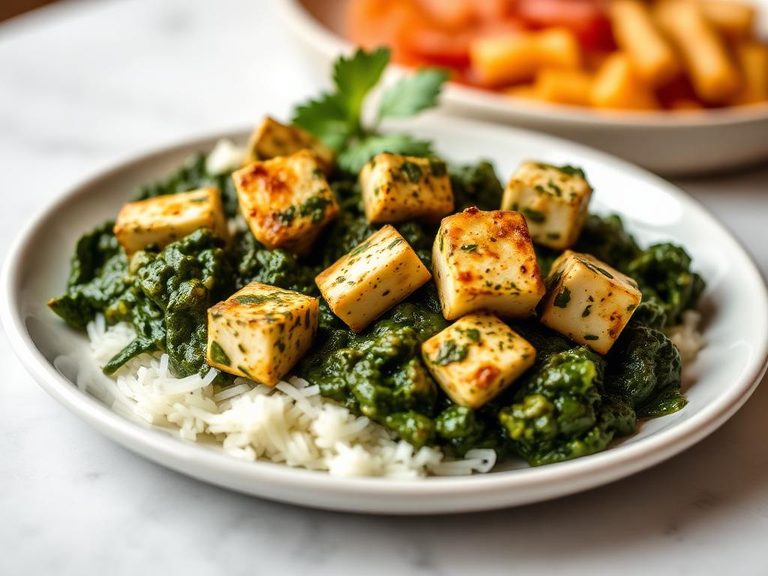
Paneer is a fresh, non-melting Indian cheese with a mild, milky flavor and a firm, crumbly yet chewy texture that absorbs spices beautifully. It's a protein powerhouse, offering nearly 16g per 100g, making it a staple vegetarian protein source. Its unique ability to hold its shape when fried, grilled, or simmered makes it incredibly versatile in both savory and sweet dishes.
Calorie split: 22% protein · 31% carbs · 48% fat
↓ Full nutrition💚 Why it's loved
People love paneer for its mild, creamy taste that acts as a perfect canvas for bold spices and rich gravies. Its satisfying, meaty texture and cultural significance in festive Indian meals make it a beloved comfort food.
⚠️ Watch-outs & how to enjoy it better
Paneer can be high in saturated fat and calories, and its sugar content (though naturally occurring lactose) may concern those monitoring blood sugar. It's also a common dairy allergen. To counteract, pair it with high-fiber vegetables like spinach (Palak Paneer) or use it in moderate portions within a balanced meal. For a lighter option, opt for grilled or baked paneer instead of fried.
Key benefits
- Excellent source of complete protein for muscle repair and satiety.
- Rich in calcium for bone and dental health.
- Naturally lactose-free, as the whey is removed during production.
- High in phosphorus, which works with calcium for bone strength.
- Provides conjugated linoleic acid (CLA), a fatty acid linked to health benefits.
🍽️ Popular dishes


🌍 Where it's eaten
💡 Did you know?
Paneer is one of the few cheeses in the world that does not melt, because it's made by curdling milk with an acid like lemon juice or vinegar, which gives it a unique, non-melting, crumbly structure.
Full nutrition (USDA data · scales with serving)
| Water | 41.5 g |
| Energy | 299 kcal |
| Protein | 15.9 g |
| Total lipid (fat) | 15.5 g |
| Carbohydrate, by difference | 22.5 g |
| Fiber, total dietary | 0.00 g |
| Total Sugars | 23.3 g |
| Calcium, Ca | 597 mg |
| Iron, Fe | 0.00 mg |
| Magnesium, Mg | 58.0 mg |
| Phosphorus, P | 490 mg |
| Potassium, K | 728 mg |
| Sodium, Na | 185 mg |
| Zinc, Zn | 2.0 mg |
| Copper, Cu | 0.01 mg |
| Selenium, Se | 9.3 ug |
| Vitamin C, total ascorbic acid | 0.00 mg |
| Thiamin | 0.27 mg |
| Riboflavin | 0.67 mg |
| Niacin | 0.51 mg |
| Vitamin B-6 | 0.30 mg |
| Folate, total | 0.00 ug |
| Folic acid | 0.00 ug |
| Folate, food | 0.00 ug |
| Folate, DFE | 0.00 ug |
| Choline, total | 86.3 mg |
| Vitamin B-12 | 2.6 ug |
| Vitamin B-12, added | 0.00 ug |
| Vitamin A, RAE | 155 ug |
| Retinol | 150 ug |
| Carotene, beta | 34.0 ug |
| Carotene, alpha | 0.00 ug |
| Cryptoxanthin, beta | 0.00 ug |
| Lycopene | 0.00 ug |
| Lutein + zeaxanthin | 0.00 ug |
| Vitamin E (alpha-tocopherol) | 0.24 mg |
| Vitamin E, added | 0.00 mg |
| Vitamin D (D2 + D3) | 5.3 ug |
| Vitamin K (phylloquinone) | 1.5 ug |
| Alcohol, ethyl | 0.00 g |
| Caffeine | 0.00 mg |
| Theobromine | 0.00 mg |
Fat & fatty acid profile (per 100g)
| Fatty acids, total saturated | 9.0 g |
| SFA 4:0 | 0.33 g |
| SFA 6:0 | 0.26 g |
| SFA 8:0 | 0.17 g |
| SFA 10:0 | 0.41 g |
| SFA 12:0 | 0.47 g |
| SFA 14:0 | 1.5 g |
| SFA 16:0 | 4.2 g |
| SFA 18:0 | 1.5 g |
| Fatty acids, total monounsaturated | 3.3 g |
| MUFA 16:1 | 0.23 g |
| MUFA 18:1 | 3.4 g |
| MUFA 20:1 | 0.02 g |
| MUFA 22:1 | 0.00 g |
| Fatty acids, total polyunsaturated | 0.52 g |
| PUFA 18:2 | 0.56 g |
| PUFA 18:3 | 0.06 g |
| PUFA 18:4 | 0.00 g |
| PUFA 20:4 | 0.02 g |
| PUFA 20:5 n-3 (EPA) | 0.01 g |
| PUFA 22:5 n-3 (DPA) | 0.01 g |
| PUFA 22:6 n-3 (DHA) | 0.00 g |
| Cholesterol | 58.0 mg |
Amino acid profile (per 100g)
Estimated from Crackers, cheese, sandwich-type with cheese filling — USDA does not publish this profile for Cheese.
| Tryptophan | 0.11 g |
| Threonine | 0.33 g |
| Isoleucine | 0.36 g |
| Leucine | 0.64 g |
| Lysine | 0.39 g |
| Methionine | 0.15 g |
| Cystine | 0.15 g |
| Phenylalanine | 0.35 g |
| Tyrosine | 0.25 g |
| Valine | 0.38 g |
| Arginine | 0.29 g |
| Histidine | 0.17 g |
| Alanine | 0.30 g |
| Aspartic acid | 0.52 g |
| Glutamic acid | 2.2 g |
| Glycine | 0.24 g |
| Proline | 0.77 g |
| Serine | 0.40 g |
FAQ
Is paneer the same as cottage cheese?
No. Paneer is pressed and firm, while cottage cheese is soft and curd-like. Paneer is also made by acid curdling and pressing, whereas cottage cheese involves a different curdling and draining process.
Can I make paneer at home?
Yes. You can make it by boiling milk, adding lemon juice or vinegar to curdle it, then straining the curds through a cloth and pressing them into a block.
Is paneer good for weight loss?
It can be, due to its high protein content which promotes satiety. However, it's also calorie-dense, so portion control and choosing lower-fat cooking methods (like grilling) are key.
Nutrient density (calculated · NRF9.3)
Nutrient Rich Foods index: beneficial nutrients (protein, fiber, vitamins, minerals) minus saturated fat, added sugar & sodium, per 100 kcal.
NRF9.3 index — Fulgoni, Keast & Drewnowski, 2009. Computed from USDA nutrients.
Weight-loss friendliness (composite index)
Energy density 2.99 kcal/g · 21% calories from protein · 0.0 g fiber · 23.3 g sugar per 100 g.
Composite of energy density (Rolls et al., 1999), protein & fiber satiety, minus sugar. A calculated heuristic — ranks satiety-per-calorie, not a clinical measure.
Dietary load (calculated from USDA values)
Potential renal acid load. Positive = acid-forming, negative = alkaline-forming.
Sodium-to-potassium ratio: 0.25 (lower is better — aim for ≤ 1)
Sodium:potassium per WHO potassium guidance. Computed from USDA nutrients.