

Palak Paneer
Common food

Photo: Wikipedia
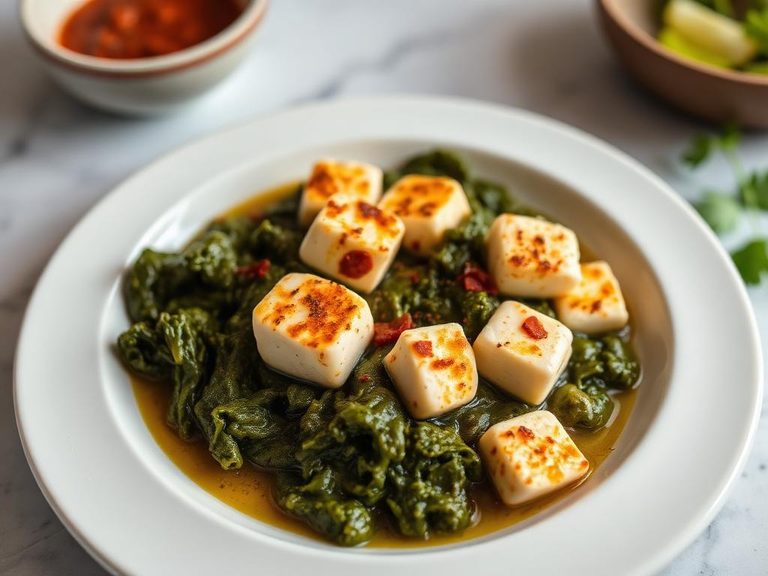
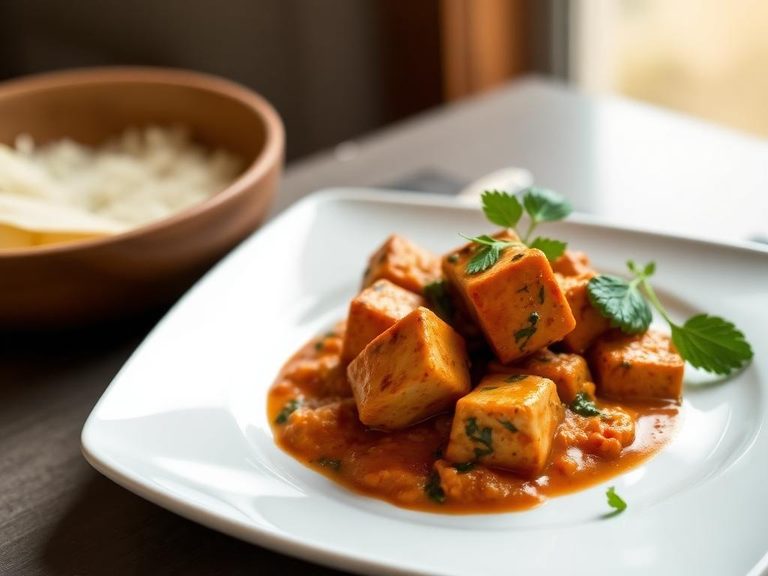
Palak Paneer is a vibrant North Indian curry featuring cubes of fresh, mild cheese (paneer) simmered in a smooth, creamy spinach purée. The dish offers a delightful contrast between the soft, squeaky texture of the paneer and the earthy, slightly tangy spinach sauce, often enriched with cream or yogurt. Nutritionally, it's a protein-rich dish with a good dose of healthy fats from the paneer and cooking oil, making it a satisfying vegetarian main.
Calorie split: 21% protein · 17% carbs · 62% fat
↓ Full nutrition💚 Why it's loved
People adore Palak Paneer for its comforting, creamy texture and the perfect balance of mild, milky cheese against the robust, herby spinach. It's a versatile centerpiece in Indian cuisine, beloved both as a hearty family meal and a festive restaurant dish.
⚠️ Watch-outs & how to enjoy it better
The spinach can be high in oxalates, which may affect mineral absorption and be a concern for those with certain kidney conditions. To mitigate this, blanching the spinach before puréeing can reduce oxalate content. Additionally, the dish can be high in sodium and saturated fat depending on preparation; using low-sodium broth and moderate cream can help.
Key benefits
- Excellent source of complete protein from paneer.
- Rich in iron and antioxidants from spinach.
- Provides calcium for bone health.
- High in healthy fats for satiety.
- Naturally low in carbohydrates.
🍽️ Popular dishes
🌍 Where it's eaten
💡 Did you know?
The term 'Palak' specifically refers to spinach in Hindi, while 'Saag' is a broader term for various leafy greens, making Palak Paneer a distinct, spinach-only version of the more general saag dish.
Full nutrition (USDA data · scales with serving)
| Water | 81.9 g |
| Energy | 101 kcal |
| Protein | 5.4 g |
| Total lipid (fat) | 7.0 g |
| Carbohydrate, by difference | 4.3 g |
| Fiber, total dietary | 0.90 g |
| Total Sugars | 1.9 g |
| Calcium, Ca | 60.0 mg |
| Iron, Fe | 0.55 mg |
| Magnesium, Mg | 38.0 mg |
| Phosphorus, P | 75.0 mg |
| Potassium, K | 244 mg |
| Sodium, Na | 242 mg |
| Zinc, Zn | 0.36 mg |
| Copper, Cu | 0.04 mg |
| Selenium, Se | 3.5 ug |
| Vitamin C, total ascorbic acid | 9.2 mg |
| Thiamin | 0.05 mg |
| Riboflavin | 0.13 mg |
| Niacin | 0.31 mg |
| Vitamin B-6 | 0.11 mg |
| Folate, total | 32.0 ug |
| Folic acid | 0.00 ug |
| Folate, food | 32.0 ug |
| Folate, DFE | 32.0 ug |
| Choline, total | 13.4 mg |
| Vitamin B-12 | 0.13 ug |
| Vitamin B-12, added | 0.00 ug |
| Vitamin A, RAE | 123 ug |
| Retinol | 15.0 ug |
| Carotene, beta | 1286 ug |
| Carotene, alpha | 12.0 ug |
| Cryptoxanthin, beta | 3.0 ug |
| Lycopene | 313 ug |
| Lutein + zeaxanthin | 2666 ug |
| Vitamin E (alpha-tocopherol) | 1.8 mg |
| Vitamin E, added | 0.00 mg |
| Vitamin D (D2 + D3) | 0.00 ug |
| Vitamin K (phylloquinone) | 177 ug |
| Alcohol, ethyl | 0.00 g |
| Caffeine | 0.00 mg |
| Theobromine | 0.00 mg |
Fat & fatty acid profile (per 100g)
| Fatty acids, total saturated | 1.8 g |
| SFA 4:0 | 0.05 g |
| SFA 6:0 | 0.01 g |
| SFA 8:0 | 0.01 g |
| SFA 10:0 | 0.03 g |
| SFA 12:0 | 0.06 g |
| SFA 14:0 | 0.19 g |
| SFA 16:0 | 1.0 g |
| SFA 18:0 | 0.32 g |
| Fatty acids, total monounsaturated | 2.5 g |
| MUFA 16:1 | 0.04 g |
| MUFA 18:1 | 2.4 g |
| MUFA 20:1 | 0.03 g |
| MUFA 22:1 | 0.00 g |
| Fatty acids, total polyunsaturated | 2.0 g |
| PUFA 18:2 | 1.7 g |
| PUFA 18:3 | 0.28 g |
| PUFA 18:4 | 0.00 g |
| PUFA 20:4 | 0.00 g |
| PUFA 20:5 n-3 (EPA) | 0.00 g |
| PUFA 22:5 n-3 (DPA) | 0.00 g |
| PUFA 22:6 n-3 (DHA) | 0.00 g |
| Cholesterol | 7.0 mg |
FAQ
Is Palak Paneer the same as Saag Paneer?
Not exactly. 'Palak' means spinach, so Palak Paneer is made specifically with spinach. 'Saag' refers to a mixture of leafy greens (like mustard greens, kale, or collards), so Saag Paneer is a broader category that may or may not include spinach.
Can I make Palak Paneer vegan?
Yes, by substituting the paneer with a firm tofu or a commercial vegan paneer alternative, and using coconut cream or cashew cream instead of dairy cream.
Why is my Palak Paneer bitter?
Spinach can become bitter if overcooked. To avoid this, blanch the spinach quickly in boiling water, then immediately plunge it into ice water to retain its bright green color and milder flavor before blending.
Nutrient density (calculated · NRF9.3)
Nutrient Rich Foods index: beneficial nutrients (protein, fiber, vitamins, minerals) minus saturated fat, added sugar & sodium, per 100 kcal.
NRF9.3 index — Fulgoni, Keast & Drewnowski, 2009. Computed from USDA nutrients.
Weight-loss friendliness (composite index)
Energy density 1.01 kcal/g · 21% calories from protein · 0.9 g fiber · 1.9 g sugar per 100 g.
Composite of energy density (Rolls et al., 1999), protein & fiber satiety, minus sugar. A calculated heuristic — ranks satiety-per-calorie, not a clinical measure.
Dietary load (calculated from USDA values)
Potential renal acid load. Positive = acid-forming, negative = alkaline-forming.
Sodium-to-potassium ratio: 0.99 (lower is better — aim for ≤ 1)
Sodium:potassium per WHO potassium guidance. Computed from USDA nutrients.