

Cereal or granola bar, with rice cereal
Common food

Photo: Wikipedia
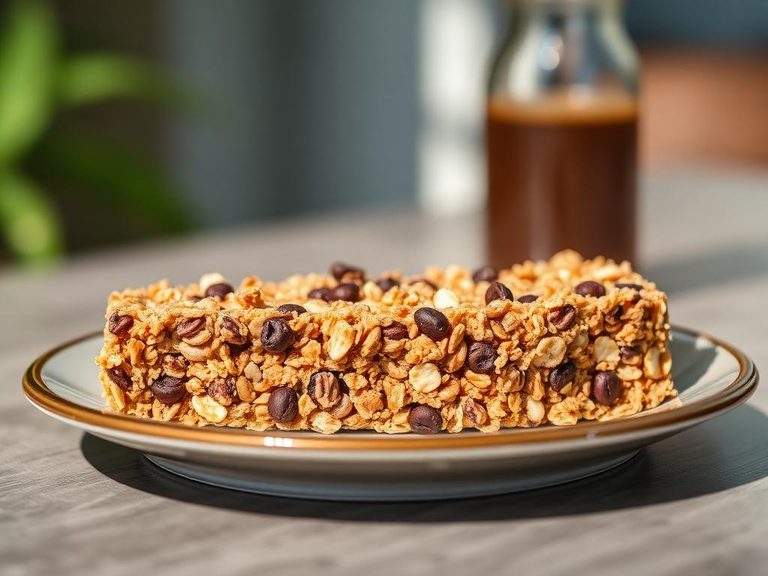
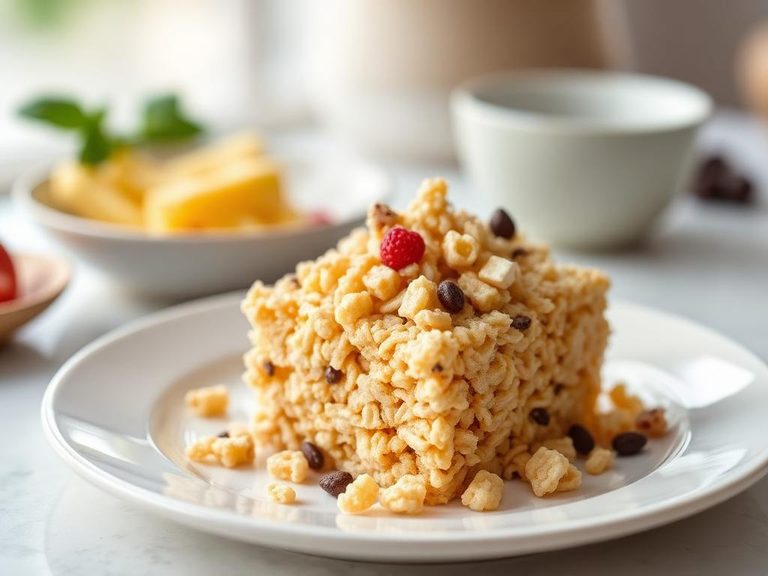
A crispy, sweet, and chewy snack bar primarily made from puffed rice cereal bound together with a sugary syrup. It offers a satisfying crunch with a very high carbohydrate content and minimal protein or fiber. This bar is a quick, energy-dense treat that delivers a significant sugar payload per serving.
Calorie split: 3% protein · 77% carbs · 19% fat
↓ Full nutrition💚 Why it's loved
People love these bars for their satisfying crunch and sweet, nostalgic flavor that evokes childhood breakfasts. Their convenience and portability make them a go-to for a quick energy boost during busy days or outdoor activities.
⚠️ Watch-outs & how to enjoy it better
The extremely high sugar and refined carbohydrate content can cause rapid blood-sugar spikes and subsequent crashes, making it a poor choice for sustained energy or those managing blood sugar. It also lacks fiber and protein, offering little satiety. To counteract this, pair it with a source of protein (like nuts or Greek yogurt) or healthy fat (like peanut butter) to slow digestion and stabilize energy levels, and practice strict portion control.
Key benefits
- Provides rapid, easily digestible energy from simple carbohydrates
- Convenient, portable, and shelf-stable for on-the-go snacking
- Lightweight and easy to pack for hiking, sports, or travel
- Offers a quick source of calories for active individuals
- Familiar, comforting taste and texture for many people
🍽️ Popular dishes
🌍 Where it's eaten
💡 Did you know?
The modern granola bar was invented in 1975 by Stanley Mason, who also created the first commercial granola bar for the Quaker Oats Company.
Full nutrition (USDA data · scales with serving)
| Water | 5.9 g |
| Energy | 417 kcal |
| Protein | 3.4 g |
| Total lipid (fat) | 9.0 g |
| Carbohydrate, by difference | 80.5 g |
| Fiber, total dietary | 0.00 g |
| Total Sugars | 19.4 g |
| Calcium, Ca | 3.0 mg |
| Iron, Fe | 2.2 mg |
| Magnesium, Mg | 13.0 mg |
| Phosphorus, P | 42.0 mg |
| Potassium, K | 39.0 mg |
| Sodium, Na | 351 mg |
| Zinc, Zn | 0.50 mg |
| Copper, Cu | 0.10 mg |
| Selenium, Se | 11.0 ug |
| Vitamin C, total ascorbic acid | 0.00 mg |
| Thiamin | 0.70 mg |
| Riboflavin | 0.80 mg |
| Niacin | 9.1 mg |
| Vitamin B-6 | 0.90 mg |
| Folate, total | 241 ug |
| Folic acid | 199 ug |
| Folate, food | 42.0 ug |
| Folate, DFE | 381 ug |
| Choline, total | 0.00 mg |
| Vitamin B-12 | 0.00 ug |
| Vitamin B-12, added | 0.00 ug |
| Vitamin A, RAE | 270 ug |
| Retinol | 270 ug |
| Carotene, beta | 0.00 ug |
| Carotene, alpha | 0.00 ug |
| Cryptoxanthin, beta | 0.00 ug |
| Lycopene | 0.00 ug |
| Lutein + zeaxanthin | 0.00 ug |
| Vitamin E (alpha-tocopherol) | 0.00 mg |
| Vitamin E, added | 0.00 mg |
| Vitamin D (D2 + D3) | 0.00 ug |
| Vitamin K (phylloquinone) | 0.00 ug |
| Alcohol, ethyl | 0.00 g |
| Caffeine | 0.00 mg |
| Theobromine | 0.00 mg |
Fat & fatty acid profile (per 100g)
| Fatty acids, total saturated | 1.4 g |
| SFA 4:0 | 0.00 g |
| SFA 6:0 | 0.00 g |
| SFA 8:0 | 0.00 g |
| SFA 10:0 | 0.00 g |
| SFA 12:0 | 0.00 g |
| SFA 14:0 | 0.01 g |
| SFA 16:0 | 0.88 g |
| SFA 18:0 | 0.32 g |
| Fatty acids, total monounsaturated | 2.5 g |
| MUFA 16:1 | 0.02 g |
| MUFA 18:1 | 1.9 g |
| MUFA 20:1 | 0.02 g |
| MUFA 22:1 | 0.00 g |
| Fatty acids, total polyunsaturated | 5.1 g |
| PUFA 18:2 | 4.3 g |
| PUFA 18:3 | 0.58 g |
| PUFA 18:4 | 0.00 g |
| PUFA 20:4 | 0.00 g |
| PUFA 20:5 n-3 (EPA) | 0.00 g |
| PUFA 22:5 n-3 (DPA) | 0.00 g |
| PUFA 22:6 n-3 (DHA) | 0.00 g |
| Cholesterol | 0.00 mg |
Amino acid profile (per 100g)
Estimated from Cereals ready-to-eat, granola, homemade — USDA does not publish this profile for Cereal or granola bar.
| Tryptophan | 0.19 g |
| Threonine | 0.48 g |
| Isoleucine | 0.55 g |
| Leucine | 0.98 g |
| Lysine | 0.63 g |
| Methionine | 0.23 g |
| Cystine | 0.30 g |
| Phenylalanine | 0.67 g |
| Tyrosine | 0.38 g |
| Valine | 0.70 g |
| Arginine | 1.3 g |
| Histidine | 0.35 g |
| Alanine | 0.69 g |
| Aspartic acid | 1.4 g |
| Glutamic acid | 3.1 g |
| Glycine | 0.81 g |
| Proline | 0.66 g |
| Serine | 0.67 g |
| Hydroxyproline | 0.00 g |
FAQ
Is a rice cereal bar a healthy snack?
While it provides quick energy, it is generally not considered a healthy snack due to its very high sugar content (over 19g per 100g), lack of fiber and protein, and reliance on refined carbohydrates. It is best enjoyed occasionally and in small portions.
How does it differ from a granola bar?
A rice cereal bar is primarily made from puffed rice cereal and a sugary binder, while a traditional granola bar is made from oats, nuts, seeds, and dried fruit, often with a more complex texture and potentially more fiber and protein.
Can it be part of a balanced diet?
Yes, but only in moderation. It should be considered an occasional treat rather than a staple. To make it more balanced, consume it alongside a protein source or a piece of fruit to add nutrients and fiber.
Nutrient density (calculated · NRF9.3)
Nutrient Rich Foods index: beneficial nutrients (protein, fiber, vitamins, minerals) minus saturated fat, added sugar & sodium, per 100 kcal.
NRF9.3 index — Fulgoni, Keast & Drewnowski, 2009. Computed from USDA nutrients.
Weight-loss friendliness (composite index)
Energy density 4.17 kcal/g · 3% calories from protein · 0.0 g fiber · 19.4 g sugar per 100 g.
Composite of energy density (Rolls et al., 1999), protein & fiber satiety, minus sugar. A calculated heuristic — ranks satiety-per-calorie, not a clinical measure.
Dietary load (calculated from USDA values)
Potential renal acid load. Positive = acid-forming, negative = alkaline-forming.
Sodium-to-potassium ratio: 9.00 (lower is better — aim for ≤ 1)
Sodium:potassium per WHO potassium guidance. Computed from USDA nutrients.